
HRID 270639As reactant
Completing data — refresh the page later to see the latest
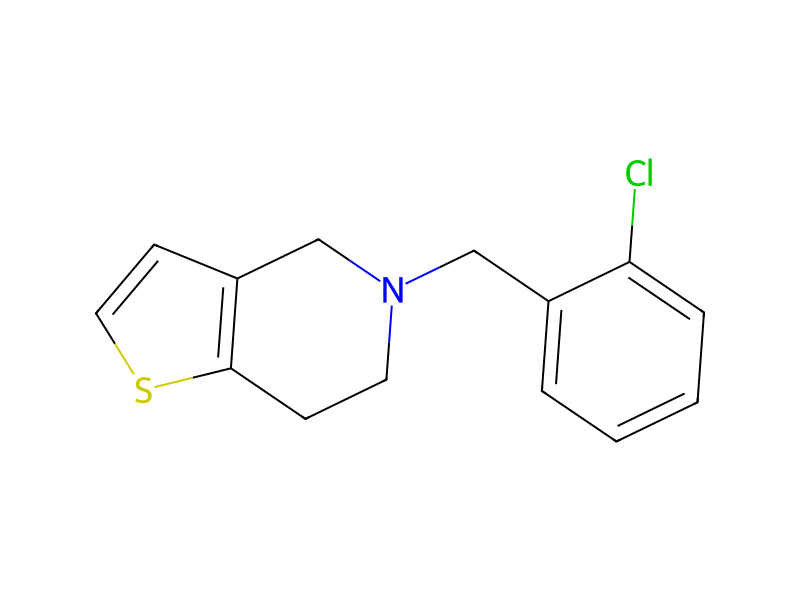
55142-85-3Clc1ccccc1CN1CCc2sccc2C1PHWBOXQYWZNQIN-UHFFFAOYSA-NTiclopidine is a thienopyridine that is 4,5,6,7-tetrahydrothieno[3,2-c]pyridine in which the hydrogen attached to the nitrogen is replaced by an o-chlorobenzyl group. It has a role as a fibrin modulating drug, a hematologic agent, an anticoagulant, a platelet aggregation inhibitor and a P2Y12 receptor antagonist. It is a thienopyridine and a member of monochlorobenzenes.
55142-85-3Pharmaceuticals
Pharmaceuticals -> Listed in ZINC15
2.9
3.46
Freely soluble
2.19e-02 g/L
1 [ug/mL] (The mean of the results at pH 7.4)
156.8 Ų [M+H]+ [CCS Type: DT; Buffer gas: N2; Ionization: ESI+; Dataset: TOXCAST; Source Identifier: DTXSID80202141]
153.84 Ų [M+H]+ [CCS Type: TW; Method: calibrated with polyalanine and drug standards]
Safety information is for reference only and does not replace the supplier’s Safety Data Sheet (SDS), applicable regulations, or professional assessment.
Ticlopidine has been associated with serum enzyme elevations in approximately 4% of patients during therapy. These elevations are usually mild, asymptomatic and rarely require dose modification or stopping. Ticlopidine has also been associated with clinically apparent, acute liver injury. While these reactions are rare, more than 50 instances have been reported in the literature and some have been severe. The onset of symptoms is typically within 6 weeks (range 1 to 24 weeks) and marked by onset with fatigue, jaundice and itching. The usual pattern of liver enzyme elevations is cholestatic (~75%), but cases with mixed or hepatocellular enzyme elevations have also been described. Immunoallergic features such as fever, rash and eosinophilia can occur but are not common and, if present, are usually mild. Autoantibody formation is rare. Liver biopsy usually shows cholestatic hepatitis with mixed cellular infiltrates. Most cases are self-limited with recovery within 1 to 3 months, but isolated cases of prolonged jaundice or liver test abnormalities have been described, including at least one case of probable vanishing bile duct syndrome that eventually required liver transplantation. Ticlopidine therapy has also been associated with aplastic anemia and thrombotic thrombocytopenic purpura (TTP) that can be severe and lead to death; these patients may also have accompanying cholestatic liver injury.
Benchmark Dataset for the Liver Toxicity Knowledge Base (LTKB)
ticlopidine
Ticlid
Antithrombotics
4
most-DILI-concern
B01AC05
B - Blood and blood forming organs
QB - Blood and blood forming organs
Binds reversibly (98%) to plasma proteins, mainly to serum albumin and lipoproteins. The binding to albumin and lipoproteins is nonsaturable over a wide concentration range. Ticlopidine also binds to alpha-1 acid glycoprotein (about 15% or less).
Ticlopidine is a prodrug that is metabolised to an as yet undetermined metabolite that acts as a platelet aggregation inhibitor. Inhibition of platelet aggregation causes a prolongation of bleeding time. In its prodrug form, ticlopidine has no significant in vitro activity at the concentrations attained in vivo.
The active metabolite of ticlopidine prevents binding of adenosine diphosphate (ADP) to its platelet receptor, impairing the ADP-mediated activation of the glycoprotein GPIIb/IIIa complex. It is proposed that the inhibition involves a defect in the mobilization from the storage sites of the platelet granules to the outer membrane. No direct interference occurs with the GPIIb/IIIa receptor. As the glycoprotein GPIIb/IIIa complex is the major receptor for fibrinogen, its impaired activation prevents fibrinogen binding to platelets and inhibits platelet aggregation. By blocking the amplification of platelet activation by released ADP, platelet aggregation induced by agonists other than ADP is also inhibited by the active metabolite of ticlopidine.
Half-life following a single 250-mg dose is approximately 7.9 hours in subjects 20 to 43 years of age and 12.6 hours in subjects 65 to 76 years of age. With repeated dosing (250 mg twice a day), half-life is about 4 days in subjects 20 to 43 years of age and about 5 days in subjects 65 to 76 years of age.
Ticlopidine is metabolized extensively by the liver with only trace amounts of intact drug detected. At least 20 metabolites have been identified.


DTXSID5023669CHEMBL833CHEBI:9588Ticlopidine
11.7
49.3
The recommended dose of ticlopidine hydrochloride is 250 mg b.i.d. taken with food.
Data used to generate the benchmarks include the following: Lowest Daily Dose (LDD): 500 mg/day, Lowest Therapeutic Dose (LTD): 6.3 mg/kg-day, and Screening Dose: 0.002 mg/kg-day.
6-Aug-16
Ticlopidine has known human metabolites that include Thienodihydropyridinium and Ticlopidine S-oxide.
OM90ZUW7M1
TICLOPIDINE
Physiologic Effects [PE] - Decreased Platelet Aggregation
Established Pharmacologic Class [EPC] - Platelet Aggregation Inhibitor
Ticlopidine is a Platelet Aggregation Inhibitor. The physiologic effect of ticlopidine is by means of Decreased Platelet Aggregation.
Fibrinolysin or agents that convert plasminogen to FIBRINOLYSIN.
Drugs or agents which antagonize or impair any mechanism leading to blood platelet aggregation, whether during the phases of activation and shape change or following the dense-granule release reaction and stimulation of the prostaglandin-thromboxane system.
Compounds that bind to and block the stimulation of PURINERGIC P2Y RECEPTORS. Included under this heading are antagonists for specific P2Y receptor subtypes.
Drugs and compounds which inhibit or antagonize the biosynthesis or actions of CYTOCHROME P-450 CYP2C19.
Absorption is greater than 80%. Food increases absorption by approximately 20%.
Ticlopidine is eliminated mostly in the urine (60%) and somewhat in the feces (23%).
The volume of distribution was not quantified.
Ticlopidine clearance was not quantified, but clearance decreases with age.
UsesTiclopidine is an antiplatelet drug for the treatment of ischemic heart diseases.
UsesTiclopidine suppresses aggregation of thrombocytes and possesses antiaggregant activity. It is believed that its action is connected to its effect on thrombocyte membranes and the reduction in quantity of released adenosine diphosphate and serotonin, which facilitate aggregation of thrombocytes. In wide-ranging clinical trials, ticlopidine presented a number of advantages compared to aspirin.
General DescriptionTiclopidine, 5-[(2-chlorophenyl)methyl]-4,5,6,7-tetrahydrothieno [3,2-c]pyridine hydrochloride(Ticlid), is useful in reducing cardiac events in patients withunstable angina and cerebrovascular events in secondaryprevention of stroke. It belongs to the thienopyridine classand facilitated the development of clopidogrel. One of thedrawbacks to this agent is its side effect profile, whichincludes neutropenia, and patients receiving this antithromboticshould have their blood levels monitored. Its mechanismof action is similar to that of clopidogrel, in that itinhibits the purinergic receptors on platelets.
DefinitionChEBI: A thienopyridine that is 4,5,6,7-tetrahydrothieno[3,2-c]pyridine in which the hydrogen attached to the nitrogen is replaced by an o-chlorobenzyl group.