Reaction equation

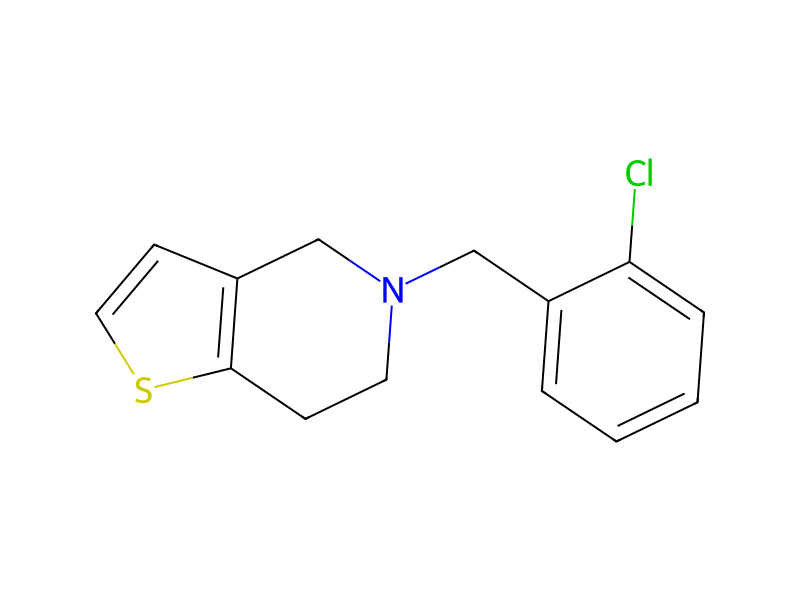
Cl.[S:2]1[C:10]2[CH2:9][CH2:8][NH:7][CH2:6][C:5]=2[CH:4]=[CH:3]1.[Cl:11][C:12]1[CH:19]=[CH:18][CH:17]=[CH:16][C:13]=1[CH2:14]Cl.[OH-].[Na+]>C1C=CC=CC=1.S([O-])(O)(=O)=O.C([N+](CCCC)(CCCC)CCCC)CCC>[Cl:11][C:12]1[CH:19]=[CH:18][CH:17]=[CH:16][C:13]=1[CH2:14][N:7]1[CH2:8][CH2:9][C:10]2[S:2][CH:3]=[CH:4][C:5]=2[CH2:6]1Participants





Procedure
To a solution of 4,5,6,7-tetrahydrothieno-[3,2-c]pyridine hydrochloride (24.0 g, 0.137 mol) and 2-chlorobenzyl chloride (26.4 g, 0.164 mol) in benzene (100 ml) were added an aqueous 2.5N NaOH solution (150 ml, 0.375 mol) and tetra-n-butyl ammonium hydrogen sulfate (1.0 g, 0.003 mol). The mixture was stirred for 40 hours at toom temperature. The reaction mixture was allowed to stand, thereby separating an organic layer from an aqueous layer. The aqueous layer was extracted with benzene (100 ml×2 times). The originally separated organic layer was combined with the extracted benzene layer, and the combined organic layer was washed with water and then with saturated NaCl solution, dried (over K2CO3), and concentrated. The residue was distilled under reduced pressure to prepare 28,8 g (yield 80.0%) of 5-(2-chlorobenzyl)-4,5,6,7tetrahydrothieno[3,2-c]pyridine as an oily product, b.p. 155.0°-158.0° C. (1.5 mmHg).
Workup
- customseparating an organic layer from an aqueous layer
- extractionThe aqueous layer was extracted with benzene (100 ml×2 times)
- washthe combined organic layer was washed with water
- dry with materialwith saturated NaCl solution, dried (over K2CO3)
- concentrationconcentrated
- distillationThe residue was distilled under reduced pressure
Sources & evidence
- ORD record
- ord-417d9b86c0504b38b5aa0471d1926f9d
- Source dataset
- uspto-grants-1988_03
- Patent number
- US04730049
Linked notes
Loading…