
Tetraethylammonium Chloride
Completing data — refresh the page later to see the latest
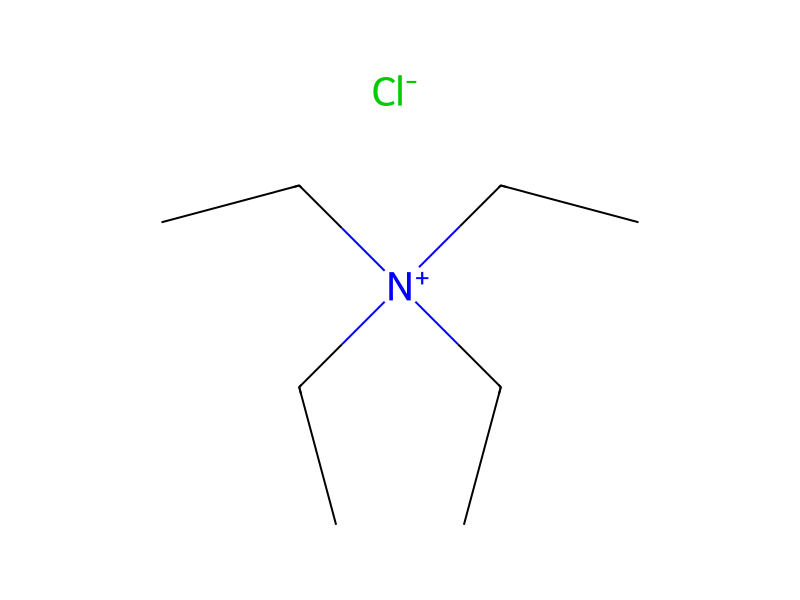
Basic information
- CAS
56-34-8- Standard SMILES
CC[N+](CC)(CC)CC.[Cl-]- InChIKey
YMBCJWGVCUEGHA-UHFFFAOYSA-M- Molecular formula
- C8H20N.Cl
- Average molar mass
- 165.7 g/mol
- Monoisotopic mass
- 165.12842732
Overview
Tetraethylammonium chloride is a quarternary ammonium chloride salt in which the cation has four ethyl substituents around the central nitrogen. It has a role as a potassium channel blocker. It is a quaternary ammonium salt and an organic chloride salt. It contains a tetraethylammonium.
Names & identifiers
- Preferred name
- Tetraethylammonium Chloride
- IUPAC
- tetraethylazanium chloride
- English name
- Tetraethylammonium Chloride
- Molecular formula
- C8H20ClN
- Molecular weight
- 165.7
Names & synonyms
TETRAETHYLAMMONIUM CHLORIDE56-34-8Etamon chlorideTea chlorideTEACN,N,N-Triethylethanaminium chlorideEthanaminium, N,N,N-triethyl-, chloridetetraethylazanium;chlorideDTXSID6041137CHEBI:781618B82Z83XNNDTXCID4021137
Show more names
TetraethylammoniumtetraethylazaniuM chlorideSKL1479N2,2,2,2Clammonium chLEthamon chlorideTetraethylammonium choride
RefChem:188563Chloride, Tetraethylammonium200-267-5Tetraethyl ammonium chloridetetraethylammoniumchlorideEt4NClTetraethylammonium (chloride)EINECS 200-267-5
Database identifiers
- CAS
56-34-8- PubChem CID
- 5946
- DTXSID
DTXSID6041137- ChEMBL
CHEMBL434435- ChEBI
CHEBI:78161- UNII
- 8B82Z83XNN
Properties
Computed structural propertiesFilling in
- Topological polar surface area
- 0 Ų
- Hydrogen bond donors
- 0
- Hydrogen bond acceptors
- 1
- Rotatable bonds
- 4
- Heavy atoms
- 10
- Formal charge
- 0
- Complexity
- 47.5
Experimental & physicochemical properties
Chemical ClassesNitrogen Compounds -> Quaternary Amines
Density1.08 @25 °C
Solubility20.3 [ug/mL] (The mean of the results at pH 7.4)
Vapor Pressure0.00000308 [mmHg]
Physical Description
Liquid
Deliquescent solid; [Merck Index] Colorless or light yellow hygroscopic crystals; [Sigma-Aldrich MSDS]
Physicochemical properties
- Melting point
- 39 °C · 39°C
- Boiling point
- 273.32 °C · 273.32°C (rough estimate)
- Density
- 1.08 · 1.08
- refractive index
- 1.548 · 1.5480 (estimate)
- storage temp.
- Inert atmosphere,Room Temperature
- solubility
- 0.1 g/mL, · methanol: 0.1 g/mL, clear, colorless
- form
Safety & regulation
Safety information is for reference only and does not replace the supplier’s Safety Data Sheet (SDS), applicable regulations, or professional assessment.
GHS classification
GHS Classification
Warning
H302 (25.2%): Harmful if swallowed [Warning Acute toxicity, oral]
P261, P264, P264+P265, P270, P271, P280, P301+P317, P302+P352, P304+P340, P305+P351+P338, P319, P321, P330, P332+P317, P337+P317, P362+P364, P403+P233, P405, and P501 (click each P-code to see the statement)
Aggregated GHS information provided per 103 reports by companies from 6 notifications to the ECHA C&L Inventory. Each notification may be associated with multiple companies.
Warning
H320: Causes eye irritation [Warning Serious eye damage/eye irritation]
Hazard information
Regulatory Information
Chemical: Ethanaminium, N,N,N-triethyl-, chloride (1:1)
Ethanaminium, N,N,N-triethyl-, chloride (1:1) is listed on the EPA's Chemical Data Reporting (CDR) system. Manufacturers and importers of Ethanaminium, N,N,N-triethyl-, chloride (1:1) are required to report information about their production and use of this chemical to the EPA under the Toxic Substances Control Act (TSCA). (40 eCFR Part 711)
Status: Active Update: 06-07-2022 https://echa.europa.eu/registration-dossier/-/registered-dossier/20036
Ethanaminium, N,N,N-triethyl-, chloride: Does not have an individual approval but may be used under an appropriate group standard
Other Safety InformationIMAP assessments - Tetraethylammonium salts: Human health tier II assessment
Hazards Summary
Causes somnolence, tremor, and muscle weakness in oral, intraperitoneal, and intramuscular lethal-dose studies of mice and rats; Human intravenous injection of 5 mg/kg causes paresthesias, mydriasis, and ptosis; [RTECS] A skin and strong eye irritant; Targets the heart and CNS; [Sigma-Aldrich MSDS] See Tetraethylammonium bromide.
Hazard Classes and Categories
Chemistry & industry
Pharmacology
MeSH Pharmacological ClassificationA class of drugs that act by inhibition of potassium efflux through cell membranes. Blockade of potassium channels prolongs the duration of ACTION POTENTIALS. They are used as ANTI-ARRHYTHMIA AGENTS and VASODILATOR AGENTS.
Uses & manufacturing
UsesUsed as a catalyst (dehydrogenation and polymerization) and electrolyte (membrane transport studies); [Merck Index]
U.S. Production2023: 1,000,000 - <5,000,000 lb
Industry UsesIntermediate
General Manufacturing Information
All Other Basic Organic Chemical Manufacturing
Ethanaminium, N,N,N-triethyl-, chloride (1:1): ACTIVE
Applications
UsesMedicine (nerve-blocking agent).
UsesTetraethylammonium Chloride can be used as a source of tetraethylammonium ions for various pharmaceutical studies and has the ability to block K+ channels in various tissues. Tetraethylammonium Chloride can also block the transmission of nervous impulses across autonomic ganglions.
UsesTetraethylammonium chloride (TEAC) has been used:used for inhibition of peroxynitrite induced relaxation in rat aorta ringsas a pharmacological blocker of K+ current and Ca2+ induced K+ current in antennal lobe neuronsfor the induction of TEAC sensitive currents in cochlear inner hair cells digested with proteolytic enzymes and analyze its properties
General DescriptionVisit our Sensor Applications portal to learn more.
Preparation methods
Related reactions
185 records


Compound notes
Loading…