
Cyanide
Basic information
- CAS
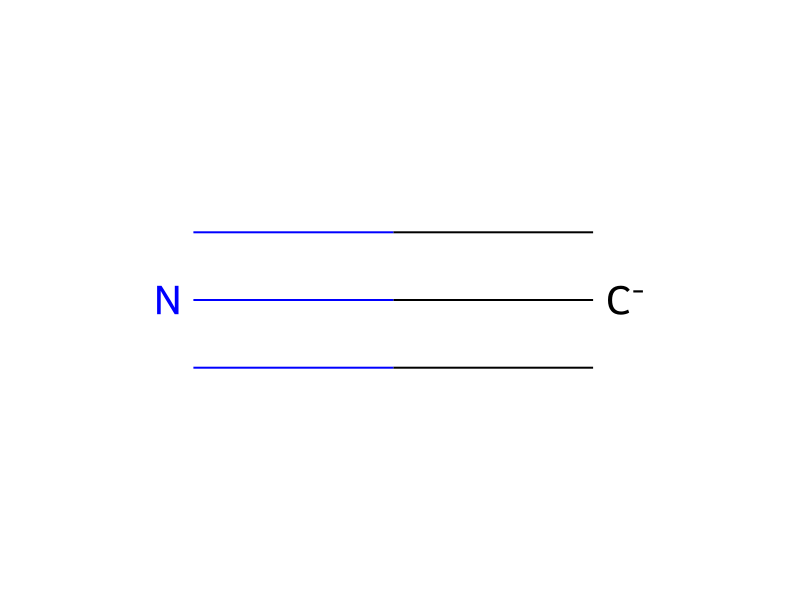
57-12-5- Standard SMILES
[C-]#N- InChIKey
XFXPMWWXUTWYJX-UHFFFAOYSA-N- Molecular formula
- CN-
- Average molar mass
- 26.017 g/mol
- Monoisotopic mass
- 26.003074
Overview
Aqueous solutions with a faint odor of bitter almonds. Toxic by skin absorption, by ingestion, and inhalation of the hydrogen cyanide from the decomposition of the material. Toxic oxides of nitrogen are produced in fires involving this material. Obtain the technical name of the material from the shipping papers and contact CHEMTREC, 800-424-9300 for specific response information.
Names & identifiers
- Preferred name
- Cyanide
- IUPAC
- cyanide
- English name
- Cyanide
- Molecular formula
- CHN
- Molecular weight
- 26.02
Names & synonyms
cyanideCYANIDE IONIsocyanide57-12-5Cyanide anionNitrile anionCyanide ionsCyanide(1-) ioniminomethanideCyanide(1-)CyanureCarbon nitride ion (CN1-)
Show more names
Cyanogen ionCyanides (as CN)TIANFU-CHEM Methyl4-(cyanomethyl)benzoate57-12-5Cyanides, except hydrogen cyanide, cyanogen & cyanogen chloride, (as CN)
PrussiateOXN4E7L11KDTXSID6023991CHEBI:17514HYDROCYANIC ACID, ION(1-)methylidyneazanidylRefChem:1082356DTXCID203991
Database identifiers
- CAS
57-12-5- PubChem CID
- 5975
- DTXSID
DTXSID6023991- ChEMBL
CHEMBL183419- ChEBI
CHEBI:17514- UNII
- OXN4E7L11K
- Nikkaji
- J55.295J
Properties
Computed structural properties
- XLogP
- 0.1
- Topological polar surface area
- 23.8 Ų
- Hydrogen bond donors
- 0
- Hydrogen bond acceptors
- 2
- Rotatable bonds
- 0
- Heavy atoms
- 2
- Formal charge
- -1
- Complexity
- 10
Experimental & physicochemical properties
Chemical Classes
Hazardous Air Pollutants (HAPs)
Toxic Gases & Vapors -> Cyanides
Toxic Gases & Vapors -> Chemical Asphyxiants
Major ion
PesticidesPesticide -> EPA IRIS
Physical Description
Aqueous solutions with a faint odor of bitter almonds. Toxic by skin absorption, by ingestion, and inhalation of the hydrogen cyanide from the decomposition of the material. Toxic oxides of nitrogen are produced in fires involving this material. Obtain the technical name of the material from the shipping papers and contact CHEMTREC, 800-424-9300 for specific response information.
Generally white crystals or powders but possibly colored Toxic by skin absorption through open wounds, by ingestion, and inhalation of the hydrogen cyanide from the decomposition of the material. Toxic oxides of nitrogen are produced in fires. Obtain the technical name of the material form the shipping papers and contact CHEMTREC, 800-424-9300 for specific response information.
Varies; See specific cyanide salt;
Physicochemical properties
- Melting point
- 148 °C · 148 °C (decomp)
Safety & regulation
Safety information is for reference only and does not replace the supplier’s Safety Data Sheet (SDS), applicable regulations, or professional assessment.
Hazard information
Regulatory Information
Regulation (EC) No 178/2002 (amended)
Cyanide: Does not have an individual approval but may be used as a component in a product covered by a group standard. It is not approved for use as a chemical in its own right.
The New Jersey Worker and Community Right to Know Act requires public and private employers to provide information about hazardous substances at their workplaces. (N.J.S.A. 34:5A-1 et. seq.)
DOT Label
Poison
Poison
Fire Hazards
Excerpt from ERG Guide 157 [Substances - Toxic and/or Corrosive (Non-Combustible / Water-Sensitive)]:
Excerpt from ERG Guide 157 [Substances - Toxic and/or Corrosive (Non-Combustible / Water-Sensitive)]:
Health Hazards
Excerpt from ERG Guide 157 [Substances - Toxic and/or Corrosive (Non-Combustible / Water-Sensitive)]:
Excerpt from ERG Guide 157 [Substances - Toxic and/or Corrosive (Non-Combustible / Water-Sensitive)]:
Hazards Summary
Cyanide is used in a number of industries and is found at low levels in air from car exhaust. Cyanide is extremely toxic to humans. Chronic (long-term) inhalation exposure of humans to cyanide results primarily in effects on the central nervous system (CNS). Other effects in humans include cardiovascular and respiratory effects, an enlarged thyroid gland, and irritation to the eyes and skin. No data are available on the carcinogenic effects of cyanide in humans via inhalation. Animal studies have suggested that oral exposure to cassava (a cyanide-containing vegetable) may be associated with malformations in the fetus and low fetal body weights. EPA has classified cyanide as a Group D, not classifiable as to human carcinogenicity.
A fatal inhalation dose of hydrogen cyanide is 600 to 700 ppm for 5 minutes or 200 ppm for 30 minutes. In victims overcome by smoke inhalation, hypoxia from carbon monoxide is initially indistinguishable from that caused by cyanide. Smokers have elevated whole blood cyanide levels up to 0.4 ug/ml. In poisoning cases, victims are agitated at levels above 1.0 ug/ml and comatose at levels above 2.5 ug/ml. Acrylonitrile, acetonitrile, and other aliphatic nitriles can cause cyanide poisoning after absorption and hepatic transformation. [ATSDR Case Studies # 15] Symptoms of cyanide toxicity can occur within seconds of inhalation of hydrogen cyanide or within minutes of ingestion of cyanide salts. Onset may be delayed up to 12 h after ingestion of cyanogenic glycosides, nitriles, or thiocyanates. [INCHEM: CICAD 61] Cyanide is detoxified in the body when it is combined with sulfur to form thiocyanate. [Ford, p. 705] Urine thiocyanate levels are <0.11 mg/24h without occupational exposure. The no-adverse-effect-level is 6.5 mg/24h. Smokers have higher levels. [LaDou, 4th edition, p. 633] In nitroprusside poisoning cases, the half-life of thiocyanate is 2.7 days (normal renal function). [Ford, p. 410] Thiocyanate levels correlate with thiocyanate toxicity, not with degree of cyanide poisoning. Thiocyanate toxicity occurs when thiocyanate levels exceed 100 mg/L. [Haddad, p. 985] Chronic exposure to cyanide causes tobacco amblyopia (from cigarette smoking) and tropical ataxic neuropathy (from eating improperly processed cassava). Both conditions are associated with low B12 levels. Thiocyanate can competitively inhibit the entry of iodide into the thyroid gland and cause hypothyroidism and goiters. [Goldfrank, p. 1680] Handle all cyanide compounds with care. HCN may be released from relatively stable compounds like ferro- and ferricyanides in the presence of strong acids. Even weak acids can cause a slow release of cyanide. [Ullmann] Workers exposed to HCN for seven years at 4.2 to 12.4 ppm in breathing zone air had increased headache, weakness, and thyroid gland enlargement. [ACGIH: HCN] See Hydrogen cyanide. See NITRILES.
Chemistry & industry
Pharmacology
Biological Half-LifeWhole body: 19 hours; [TDR, p. 422]
Metabolism/Metabolites
Organic nitriles are converted into cyanide ions through the action of cytochrome P450 enzymes in the liver. Cyanide is rapidly absorbed and distributed throughout the body. Cyanide is mainly metabolized into thiocyanate by either rhodanese or 3-mercaptopyruvate sulfur transferase. Cyanide metabolites are excreted in the urine. (L96)
Organic nitriles are converted into cyanide ions through the action of cytochrome P450 enzymes in the liver. Cyanide is rapidly absorbed and distributed throughout the body. Cyanide is mainly metabolized into thiocyanate by either rhodanese or 3-mercaptopyruvate sulfur transferase. Cyanide metabolites are excreted in the urine. (L96)
Uses & manufacturing
Uses
The major uses of hydrogen cyanide are as an intermediate in the production of a number of chemicals and as an insecticide for fumigating enclosed spaces. Hydrogen cyanide has also been used in gas chamber executions.
Used in electroplating, silver and gold extraction, metal cleaning, metal nitriding, ship fumigating, mining processes, cement stabilizing, photo developing, and organic synthesis; Used in the past to fumigate fruit trees, railroad cars, ships, warehouses, rabbit and rat burrows, and termite nests; In tropical countries where the potato-like tubers of the cassava plant are grown, cyanide poisonings due to ingestion of the cassava root have been reported. [ATSDR ToxProfiles] In the past, occupational cyanide poisoning was most common in metal extraction, electroplating, metal hardening, and fumigation; [Sullivan, p. 706] The cyanides of mercury, lead, cobalt, and nickel do not have any major industrial importance. [Ullmann]
Steel Producing [Category: Industry]
Sculpturing plastics [Category: Hobbies]
Cyanide compounds are used in electroplating, metallurgy, organic chemicals production, photographic developing, manufacture of plastics, fumigation of ships, and some mining processes. (L96)
Hydrogen cyanide is a precursor to many chemical compounds, ranging from polymers to pharmaceuticals. (L101)
Related reactions
1,031 records






Compound notes
Loading…