
HRID 215663As product
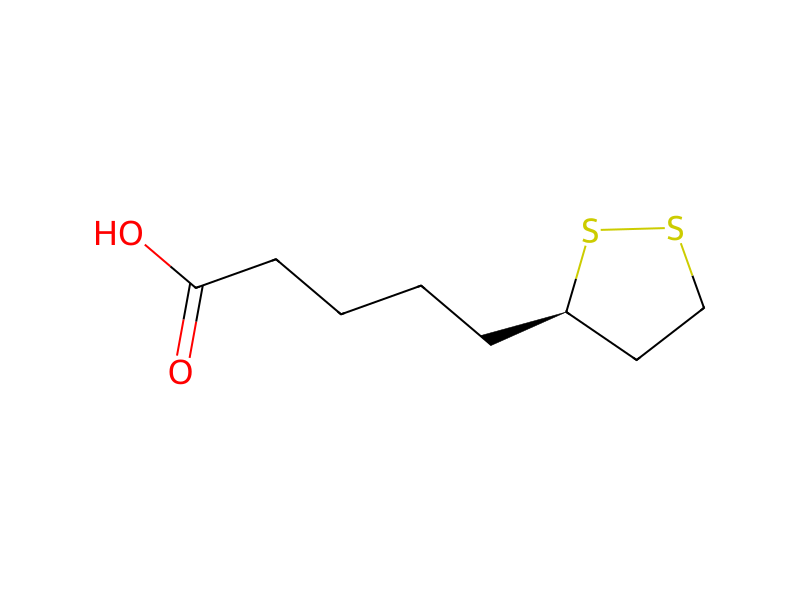
1200-22-2O=C(O)CCCC[C@@H]1CCSS1AGBQKNBQESQNJD-SSDOTTSWSA-N(R)-lipoic acid is the (R)-enantiomer of lipoic acid. A vitamin-like, C8 thia fatty acid with anti-oxidant properties. It has a role as a cofactor, a prosthetic group and a nutraceutical. It is a lipoic acid, a member of dithiolanes, a heterocyclic fatty acid and a thia fatty acid. It is functionally related to an octanoic acid. It is a conjugate acid of a (R)-lipoate. It is an enantiomer of a (S)-lipoic acid.
1200-22-2、62-46-4DTXSID20152651CHEMBL134342CHEBI:30314Safety information is for reference only and does not replace the supplier’s Safety Data Sheet (SDS), applicable regulations, or professional assessment.
If the compound has been ingested, rapid gastric lavage should be performed using 5% sodium bicarbonate. For skin contact, the skin should be washed with soap and water. If the compound has entered the eyes, they should be washed with large quantities of isotonic saline or water. In serious cases, atropine and/or pralidoxime should be administered. Anti-cholinergic drugs work to counteract the effects of excess acetylcholine and reactivate AChE. Atropine can be used as an antidote in conjunction with pralidoxime or other pyridinium oximes (such as trimedoxime or obidoxime), though the use of '-oximes' has been found to be of no benefit, or possibly harmful, in at least two meta-analyses. Atropine is a muscarinic antagonist, and thus blocks the action of acetylcholine peripherally.
Acute exposure to cholinesterase inhibitors can cause a cholinergic crisis characterized by severe nausea/vomiting, salivation, sweating, bradycardia, hypotension, collapse, and convulsions. Increasing muscle weakness is a possibility and may result in death if respiratory muscles are involved. Accumulation of ACh at motor nerves causes overstimulation of nicotinic expression at the neuromuscular junction. When this occurs symptoms such as muscle weakness, fatigue, muscle cramps, fasciculation, and paralysis can be seen. When there is an accumulation of ACh at autonomic ganglia this causes overstimulation of nicotinic expression in the sympathetic system. Symptoms associated with this are hypertension, and hypoglycemia. Overstimulation of nicotinic acetylcholine receptors in the central nervous system, due to accumulation of ACh, results in anxiety, headache, convulsions, ataxia, depression of respiration and circulation, tremor, general weakness, and potentially coma. When there is expression of muscarinic overstimulation due to excess acetylcholine at muscarinic acetylcholine receptors symptoms of visual disturbances, tightness in chest, wheezing due to bronchoconstriction, increased bronchial secretions, increased salivation, lacrimation, sweating, peristalsis, and urination can occur. Certain reproductive effects in fertility, growth, and development for males and females have been linked specifically to organophosphate pesticide exposure. Most of the research on reproductive effects has been conducted on farmers working with pesticides and insecticdes in rural areas. In females menstrual cycle disturbances, longer pregnancies, spontaneous abortions, stillbirths, and some developmental effects in offspring have been linked to organophosphate pesticide exposure. Prenatal exposure has been linked to impaired fetal growth and development. Neurotoxic effects have also been linked to poisoning with OP pesticides causing four neurotoxic effects in humans: cholinergic syndrome, intermediate syndrome, organophosphate-induced delayed polyneuropathy (OPIDP), and chronic organophosphate-induced neuropsychiatric disorder (COPIND). These syndromes result after acute and chronic exposure to OP pesticides.
(R)-lipoic acid is a cholinesterase or acetylcholinesterase (AChE) inhibitor. A cholinesterase inhibitor (or 'anticholinesterase') suppresses the action of acetylcholinesterase. Because of its essential function, chemicals that interfere with the action of acetylcholinesterase are potent neurotoxins, causing excessive salivation and eye-watering in low doses, followed by muscle spasms and ultimately death. Nerve gases and many substances used in insecticides have been shown to act by binding a serine in the active site of acetylcholine esterase, inhibiting the enzyme completely. Acetylcholine esterase breaks down the neurotransmitter acetylcholine, which is released at nerve and muscle junctions, in order to allow the muscle or organ to relax. The result of acetylcholine esterase inhibition is that acetylcholine builds up and continues to act so that any nerve impulses are continually transmitted and muscle contractions do not stop. Among the most common acetylcholinesterase inhibitors are phosphorus-based compounds, which are designed to bind to the active site of the enzyme. The structural requirements are a phosphorus atom bearing two lipophilic groups, a leaving group (such as a halide or thiocyanate), and a terminal oxygen.
Symptoms of low dose exposure include excessive salivation and eye-watering. Acute dose symptoms include severe nausea/vomiting, salivation, sweating, bradycardia, hypotension, collapse, and convulsions. Increasing muscle weakness is a possibility and may result in death if respiratory muscles are involved. Hypertension, hypoglycemia, anxiety, headache, tremor and ataxia may also result.
Lipoic acid (or α-lipoic acid) is able to pass the blood-brain barrier and is putatively used for detoxification of mercury attached to the brain cells. It can mobilise bound mercury into the blood stream as it is a mercaptan (sulfur compound which readily binds to the mercury). In the blood stream, another chelator such as dimercaptosuccinic acid (DMSA) or methylsulfonylmethane (MSM) is used to transfer mercury safely into the urine for excretion. Since DMSA cannot cross the blood-brain barrier, both lipoic acid and DMSA tend to be used together. It is hypothesized that this treatment-along with carnitine, dimethylglycine (DMG), Vitamin B6, folic acid, and magnesium—could be used to treat autism and amalgam poisoning. In this hypothesis, the reason why autism is difficult to treat is that mercury is attached to the brain cells and most medicines and vitamin supplements do not penetrate the blood-brain barrier. However, α-lipoic acid and perhaps vitamin B12 could making it possible for other chelators to remove mercury safely out of the body and could perhaps one day be used as a treatment for autism. Because lipoic acid is related to cellular uptake of glucose and it is both soluble in water and fat, it is being used for treatment in diabetes. It may be helpful for people with Alzheimer's disease or Parkinson's disease.
Lipoic Acid is generally involved in oxidative decarboxylations of keto acids and is presented as a growth factor for some organisms. Lipoic acid exists as two enantiomers, the R-enantiomer and the S-enantiomer. Normally only the R-enantiomer of an amino acid is biologically active, but for lipoic acid the S-enantiomer assists in the reduction of the R-enantiomer when a racemic mixture is given. Some recent studies have suggested that the S-enantiomer in fact has an inhibiting effect on the R-enantiomer, reducing its biological activity substantially and actually adding to oxidative stress rather than reducing it. Furthermore, the S-enantiomer has been found to reduce the expression of GLUT-4s in cells, responsible for glucose uptake, and hence reduce insulin sensitivity.
Paraoxonase (PON1) is a key enzyme in the metabolism of organophosphates. PON1 can inactivate some organophosphates through hydrolysis. PON1 hydrolyzes the active metabolites in several organophosphates insecticides as well as, nerve agents such as soman, sarin, and VX. The presence of PON1 polymorphisms causes there to be different enzyme levels and catalytic efficiency of this esterase, which in turn suggests that different individuals may be more susceptible to the toxic effect of OP exposure.
UsesA fat-metabolism stimulator
Usesα-Lipoic acid has been used as a reference standard for the analysis of α-lipoic acid in human plasma by high performance liquid chromatography coupled to electron capture detector (HPLC-ECD), in various food matrices and dietary supplements by HPLC combined with coulometric electrode array detector (CEAD) as well as electrospray ionization mass spectrometer (ESI-MS). It may be used as a reference standard for the determination of α-lipoic acid in human urine by isocratic reversed-phase HPLC and in α-lipoic acid capsules by HPLC with chemiluminescence detection.
General Descriptionα-Lipoic acid is an antioxidant which is generally present in plants, animals and many other microorganisms.
DefinitionChEBI: (R)-lipoic acid is the (R)-enantiomer of lipoic acid. A vitamin-like, C8 thia fatty acid with anti-oxidant properties. It has a role as a prosthetic group, a nutraceutical and a cofactor. It is a lipoic acid, a member of dithiolanes, a heterocyclic fatty acid and a thia fatty acid. It is functionally related to an octanoic acid. It is a conjugate acid of a (R)-lipoate. It is an enantiomer of a (S)-lipoic acid.


