Reaction equation

S1C=CCS1.[CH2:6]1[C@@H:10]([CH2:11][CH2:12][CH2:13][CH2:14][C:15]([OH:17])=[O:16])[S:9][S:8][CH2:7]1.[BH4-].[Na+].Cl>C(=O)(O)[O-].[Na+].C1(C)C=CC=CC=1.O>[CH2:12]([CH2:11][C@@H:10]([SH:9])[CH2:6][CH2:7][SH:8])[CH2:13][CH2:14][C:15]([OH:17])=[O:16]Participants

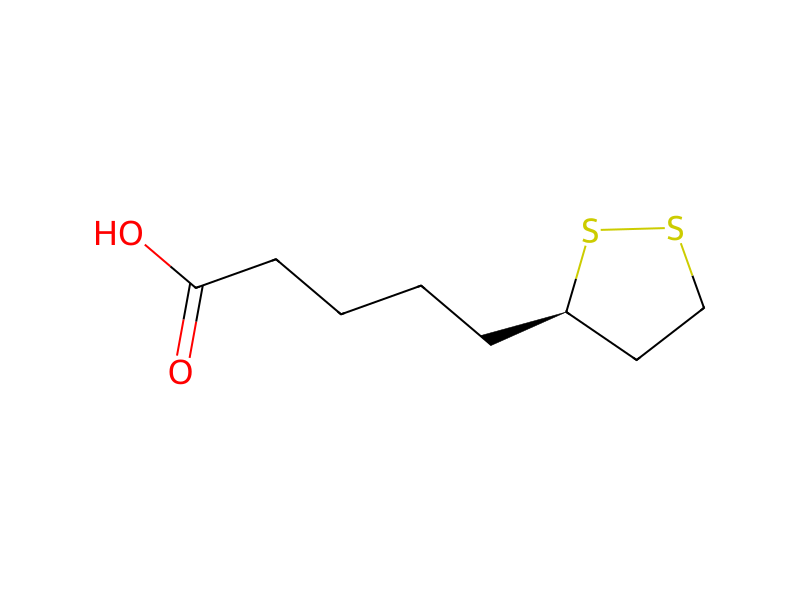


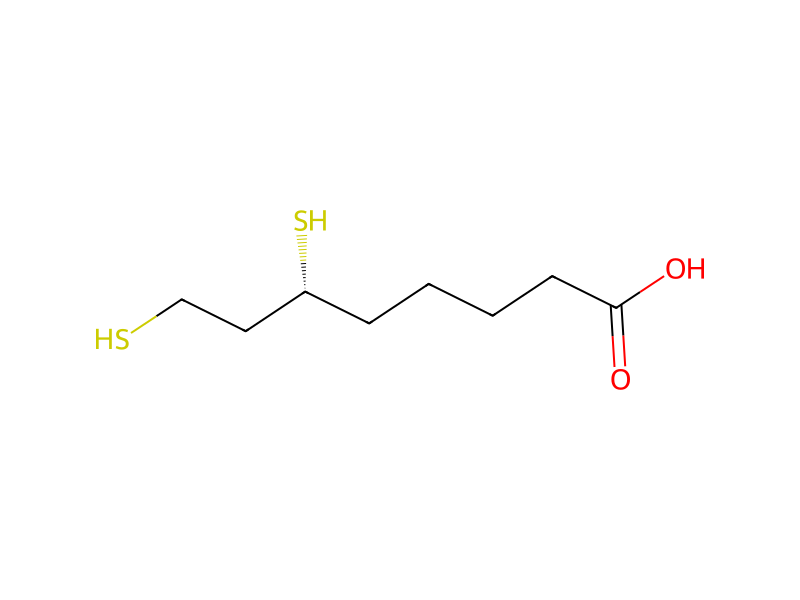



Conditions
- Temperature
- 0 °C
Procedure
The synthesis of a bidentate dithiol ligand was accomplished via the reduction of the coenzyme lipoic acid. The general procedure was described in Gunsalus et al. (1956) J. Am. Chem. Soc. 78:1763-1766. Sodium borohydride (1.2 g) was added in 30-50 mg portions to a stirring suspension of lipoic acid (6.0 g) in 117 mL of 0.25 M sodium bicarbonate in 0° C. water. The reaction was stirred for 45 minutes at 0° C., after which 100 mL toluene was added and the mixture was acidified to pH ˜2 with hydrochloric acid. The toluene layer was collected and saved. The aqueous layer was washed three times with 15 mL toluene. The organic layers were combined, dried with anhydrous magnesium sulfate, filtered, and the solvent removed under vacuum, leaving behind the product dihydrolipoic acid as a yellow oil (yield 80%).
Workup
- customThe toluene layer was collected
- washThe aqueous layer was washed three times with 15 mL toluene
- dry with materialdried with anhydrous magnesium sulfate
- filtrationfiltered
- customthe solvent removed under vacuum
Sources & evidence
- ORD record
- ord-3f1c440367504db186634cd4b584e736
- Source dataset
- uspto-grants-2001_11
- Patent number
- US06319426B1
Linked notes
Loading…