

Basic information
- Standard SMILES
CCCCn1ccnc1- InChIKey
MCMFEZDRQOJKMN-UHFFFAOYSA-N- Molecular formula
- C7H12N2
- Average molar mass
- 124.18 g/mol
- Monoisotopic mass
- 124.10004838
Overview
N,n-butyl imidazole appears as a colorless to light yellow colored liquid. Insoluble in water and more dense than water. Hence sinks in water. Contact may irritate skin, eyes or mucous membranes. Toxic by ingestion, inhalation or skin absorption.
Names & identifiers
- Preferred name
- Butylimidazole
- IUPAC
- 1-butylimidazole
- English name
- 1-Butylimidazole
- Molecular formula
- C7H12N2
- Molecular weight
- 124.18
Names & synonyms
1-BUTYLIMIDAZOLE4316-42-11-butyl-1H-imidazole1H-Imidazole, 1-butyl-1-N-ButylimidazoleButylimidazoleC7JXC99E8FNSC-158165DTXSID8073976butyl imidazoleRefChem:571854DTXCID7040239
Show more names
SKL15591-Butyl-1-N-ButyLN-BUTYL IMIDAZOLEButyl-N-imidazole1-buthylimidazoleN-Butyl-1H-imidazole
224-335-9N-ButylimidazoleN-(n-Butyl)imidazoleMFCD00042753N-n-butylimidazoleEINECS 224-335-9n-n-butyl imidazoleNSC158165
Database identifiers
- CAS
4316-42-1- PubChem CID
- 61347
- DTXSID
DTXSID8073976- ChEMBL
CHEMBL97667- UNII
- C7JXC99E8F
- EC Number
- 224-335-9
- Nikkaji
- J61.488B
Properties
Computed structural properties
- XLogP
- 1.2
- Topological polar surface area
- 17.8 Ų
- Hydrogen bond donors
- 0
- Hydrogen bond acceptors
- 1
- Rotatable bonds
- 3
- Heavy atoms
- 9
- Formal charge
- 0
- Complexity
- 73.3
Experimental & physicochemical properties
Chemical ClassesNitrogen Compounds -> Imidazoles
Physical Description
N,n-butyl imidazole appears as a colorless to light yellow colored liquid. Insoluble in water and more dense than water. Hence sinks in water. Contact may irritate skin, eyes or mucous membranes. Toxic by ingestion, inhalation or skin absorption.
Colorless to light yellow liquid; [CAMEO] Colorless liquid with an amine-like odor; [Alfa Aesar MSDS]
Physicochemical properties
- Boiling point
- 114 · 114-116 °C12 mm Hg(lit.)
- Density
- 0.945 g/mL · 0.945 g/mL at 25 °C(lit.)
- refractive index
- 20 · n20/D 1.480(lit.)
- Flash point
- 230 °F · >230 °F
- storage temp.
- Refrigerator
- solubility
- Soluble in Chloroform, Methanol.
- pka
- 7.09 · 7.09±0.10(Predicted)
- form
- clear liquid
- color
- Colorless to Light yellow to Light orange
- Specific Gravity
- 0.948 · 0.948
- explosive limit
- 2.7 · 2.7-15.7%(V)
- BRN
- 109499 · 109499
- InChI
- 1S/C7H12N2/c1-2-3-5-9-6-4-8-7-9/h4,6-7H,2-3,5H2,1H3
- InChIKey
- MCMFEZDRQOJKMN-UHFFFAOYSA-N
- SMILES
- CCCCn1ccnc1
- CAS DataBase Reference
- 4316 · 4316-42-1(CAS DataBase Reference)
- FDA UNII
- 7 JXC99E8F · C7JXC99E8F
- NIST Chemistry Reference
- 1 · 1-Butylimidazole(4316-42-1)
- EPA Substance Registry System
- 1 · 1-Butylimidazole (4316-42-1)
- UNSPSC Code
- 12352005 · 12352005
- NACRES
- 22 · NA.22
- Symbol(GHS)
- 5 · GHS05,GHS06
- Signal word
- Danger
- Hazard statements
- 330 · H330-H301+H311-H315-H318-H335
- Precautionary statements
- 501 · P501-P270-P260-P271-P264-P280-P284-P361+P364-P332+P313-P301+P310+P330-P302+P352+P312-P304+P340+P310-P305+P351+P338+P310-P403+P233-P405
- PPE
- Eyeshields, Gloves, type ABEK (EN14387) respirator filter
- Hazard Codes
- Xi
- Risk Statements
- 37 · 37/38-41
- Safety Statements
- 26 · 26-39
- RIDADR
- 2690 · UN 2690
- WGK Germany
- 3 · 3
- HazardClass
- 6.1 · 6.1
- PackingGroup
- II
- HS Code
- 29332990 · 29332990
- Storage Class
- 6.1 A · 6.1A - Combustible acute toxic Cat. 1 and 2very toxic hazardous materials
- Hazard Classifications
- 2 InhalationEye · Acute Tox. 2 InhalationEye Dam. 1Skin Corr. 1B
Safety & regulation
GHS classification
GHS Classification
Danger
H315 (96.2%): Causes skin irritation [Warning Skin corrosion/irritation]
P260, P261, P264, P264+P265, P271, P280, P284, P302+P352, P304+P340, P305+P354+P338, P316, P317, P319, P320, P321, P332+P317, P362+P364, P403+P233, P405, and P501 (click each P-code to see the statement)
Aggregated GHS information provided per 52 reports by companies from 11 notifications to the ECHA C&L Inventory. Each notification may be associated with multiple companies.
Hazard information
DOT LabelPoison
Fire HazardsExcerpt from ERG Guide 152 [Substances - Toxic (Combustible)]:
Health HazardsExcerpt from ERG Guide 152 [Substances - Toxic (Combustible)]:
Hazards SummaryMay cause irritation; Toxic by ingestion, inhalation, and skin absorption; [CAMEO] An irritant that may cause serious eye injury; Highly toxic by inhalation; [Alfa Aesar MSDS]
Reactive GroupAmines, Phosphines, and Pyridines
Reactivity Profile
N,N-BUTYL IMIDAZOLE neutralizes acids in exothermic reactions to form salts plus water. May be incompatible with isocyanates, halogenated organics, peroxides, phenols (acidic), epoxides, anhydrides, and acid halides. Flammable gaseous hydrogen may be generated in combination with strong reducing agents, such as hydrides.
DOT Hazard Classification
N-n-Butyl imidazole
UN2690
Div 6.1 Poisonous materials (49 eCFR § 173.132)
PG II: the degree of danger presented by the material is medium
Air and Water ReactionsInsoluble in water.
Hazard Classes and CategoriesSkin Irrit. 2 (96.2%)
Safety & protection
Fire FightingExcerpt from ERG Guide 152 [Substances - Toxic (Combustible)]:
First AidExcerpt from ERG Guide 152 [Substances - Toxic (Combustible)]:
Nonfire Spill ResponseExcerpt from ERG Guide 152 [Substances - Toxic (Combustible)]:
Isolation and EvacuationExcerpt from ERG Guide 152 [Substances - Toxic (Combustible)]:
Personal Protective Equipment (PPE)Excerpt from ERG Guide 152 [Substances - Toxic (Combustible)]:
Toxicology
Toxicity DataLC50 (rat) = 110 mg/m3/4hr
Safety data
- PPE
- Eyeshields, Gloves, type ABEK (EN14387) respirator filter
- wgk
- 3
- ridadr
- UN 2690
- hs_code
- 29332990
- risk_code
- 37/38-41
- Signal word
- Danger
- Symbol(GHS)
- GHS05,GHS06
- hazard_code
- Xi
- safety_code
- 26-39
- hazard_class
- 6.1
- Storage Class
- 6.1A - Combustible acute toxic Cat. 1 and 2very toxic hazardous materials
- packing_group
- II
- Hazard statements
- H330-H301+H311-H315-H318-H335
- Hazard Classifications
- Acute Tox. 2 InhalationEye Dam. 1Skin Corr. 1B
- Precautionary statements
- P501-P270-P260-P271-P264-P280-P284-P361+P364-P332+P313-P301+P310+P330-P302+P352+P312-P304+P340+P310-P305+P351+P338+P310-P403+P233-P405
Chemistry & industry
Applications
Uses1-(n-Butyl)imidazole is used in the synthesis of a heterocyclic mesomeric betaine and 1-(1-butyl-3-imidazolio)propane-3-sulfonate (BIm3S). It acts as an N-coordinated ligand. It is used in the chiral separation of amino acids and anionic pharmaceuticals by capillary electrophoresis. It is used for preparation of substituted phenyl-containing imidazolium ionic liquid.
Uses1-Butylimidazole may be used in the synthesis of a heterocyclic mesomeric betaine. It was used in the synthesis of 1-(1-butyl-3-imidazolio)propane-3-sulfonate (BIm3S).
General DescriptionA colorless to light yellow colored liquid. Insoluble in water and more dense than water. Hence sinks in water. Contact may irritate skin, eyes or mucous membranes. Toxic by ingestion, inhalation or skin absorption.
Upstream & downstream products
Upstream raw materials
Downstream products
Suppliers50 total
国药集团化学试剂有限公司86-21-63210123 · [email protected]
梯希爱(上海)化成工业发展有限公司021-67121386 · [email protected]
Shandong chuangyingchemical Co., Ltd.18853181302 · [email protected]
温州共赢化学有限公司+86-0086-577-64498589 +86-15355981851 · [email protected]
河北创海生物科技有限公司+86-86-13131129325 · [email protected]
Dayang Chem (Hangzhou) Co.,Ltd.+86-0571-88938639 17705817739 · [email protected]
Hebei Yanxi Chemical Co., Ltd.+86-17531190177 · [email protected]
科瑞迪化学400-821-5857 021-64326257 · [email protected]
济南新时代化工有限公司0531-84319199 18660131512
Syntechem Co.,Ltd[email protected]
上海迈瑞尔生化科技有限公司4006356688 18621169109 · [email protected]
阿法埃莎(中国)化学有限公司400-6106006 · [email protected]
太原市瑞和丰科贸有限公司+86 351 7031519 · [email protected]
安耐吉化学&3A(安徽泽升科技股份有限公司)400-0056266 · [email protected]
上海瀚鸿科技股份有限公司021-54306202 13764082696 · [email protected]
嘉兴市艾森化工有限公司0573-85285100 18627885956 · [email protected]
Pure Chemistry Scientific Inc.001-857-928-2050 or 1-888-588-9418 · [email protected]
上海隆盛化工有限公司58099637 13585536065 · [email protected]
蒲城祥火环保新能源有限公司029-84111412 15829468087 · [email protected]
山东西亚化学有限公司13355009207 13355009207 · [email protected]
成都川科化工有限公司+86 (28) 68626087 · [email protected]
玛雅试剂+86 (573) 82222445 (0)18006601000 452520369 · [email protected]
四川库利南科技有限公司400-1166-196 18981987031 · [email protected]
天津希恩思生化科技有限公司400 638 7771 · [email protected]
Xiamen AmoyChem Co., Ltd+86-86-5926051114 · [email protected]
上海思域化工科技有限公司86-21-34053660 · [email protected]
南京诺利斯医药科技有限公司13901585132 · [email protected]
TCI AMERICA800-4238616 · [email protected]
TOKYO CHEMICAL INDUSTRY CO., LTD.03-36680489 · [email protected]
TCI Europe320-37350700 · [email protected]
上海贤鼎生物科技有限公司4009209199 · [email protected]
深圳康特腾科技有限公司86-0755-86635001 · [email protected]
越林试剂021-62960152 · [email protected]
Xunteng International Trading Co.,Limited—
北京环宇世纪化学科技有限公司hysj_bj.com
上海湄水化工科技有限公司021-60549325 18616193163
美岚实业(上海)有限公司021-58958189 · [email protected]
上海爱蝶实业有限公司021-58957966 18930537195 · [email protected]
成都零六生物科技有限公司400-1166-196 13458535857 · [email protected]
广拓化学(上海)有限公司021-60899189-8001 18918189673 · [email protected]
雷丁试剂0510-85629785 18013409632 · [email protected]
上海麦克林生化科技股份有限公司15221275939 15221275939 · [email protected]
上海孚一生物科技有限公司+86 (21) 61124340
凯试(上海)科技有限公司021-50135380 · [email protected]
Sigma-Aldrich西格玛奥德里奇(上海)贸易有限公司021-61415566 800-8193336 · [email protected]
AN PharmaTech Co Ltd86(21)68097365 · [email protected]
成都瑞欧克科技有限公司028-64353063 · [email protected]
厦门志信化学有限公司+86-5922680277 +86-13806087780 · [email protected]
成都润泽本土化工有限公司028-88469284 18000562381 · [email protected]
上海岚克医药科技发展有限公司0086-21-58956006
Related reactions
45 records

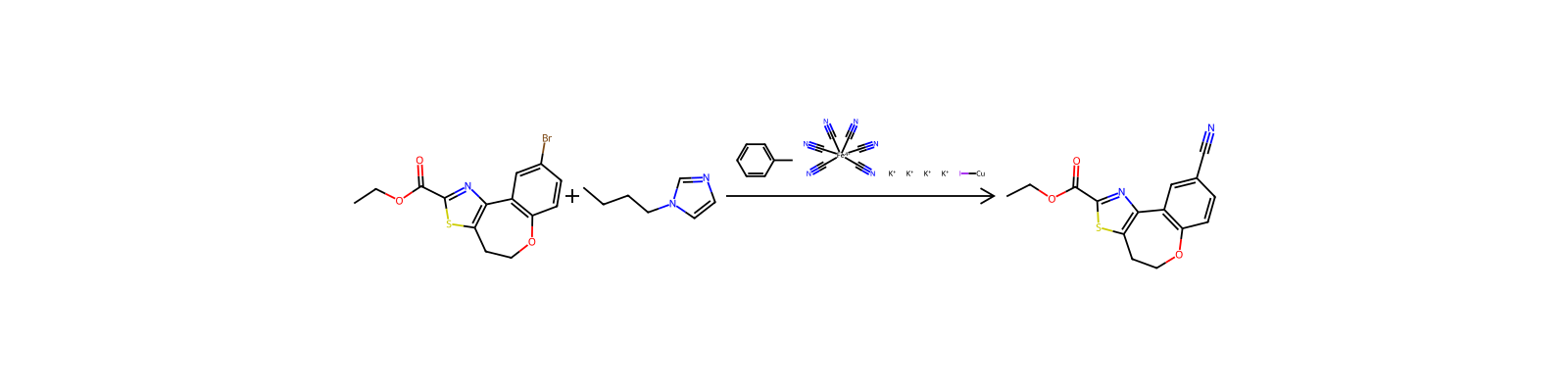





Linked notes
Loading…