

Basic information
- Standard SMILES
CC[N+](CC)(CC)CC.[Br-]- InChIKey
HWCKGOZZJDHMNC-UHFFFAOYSA-M- Molecular formula
- C8H20N.Br
- Average molar mass
- 210.16 g/mol
- Monoisotopic mass
- 209.07791174
Overview
See also: Tetraethylammonium (has active moiety).
Names & identifiers
- Preferred name
- Tetraethylammonium Bromide
- IUPAC
- tetraethylazanium bromide
- English name
- Tetraethylammonium bromide
- Molecular formula
- C8H20BrN
- Molecular weight
- 210.16
Names & synonyms
TETRAETHYLAMMONIUM BROMIDE71-91-0TEABSympatektomanEtambroEthylonBromethylTetraniumBeparonEtamonEtylonTeamon
Show more names
tetraethylazanium bromideTetra ethyl ammonium bromide SolidEthanaminium, N,N,N-triethyl-, bromide (1:1)tmd10
Tetrylammonium bromideTEA bromideTetraethyl ammonium bromideEthanaminium, N,N,N-triethyl-, bromideBromuro de tetrilamonioBromure de tetrylammoniumTMD 10Bromure de tetraethylammonium
Database identifiers
- CAS
71-91-0- PubChem CID
- 6285
- DTXSID
DTXSID9044457- ChEMBL
CHEMBL324254- UNII
- 0435621Z3N
- EC Number
- 200-769-4
Properties
Computed structural properties
- Topological polar surface area
- 0 Ų
- Hydrogen bond donors
- 0
- Hydrogen bond acceptors
- 1
- Rotatable bonds
- 4
- Heavy atoms
- 10
- Formal charge
- 0
- Complexity
- 47.5
Experimental & physicochemical properties
Chemical ClassesNitrogen Compounds -> Quaternary Amines
Density1.39 @ 20°C
Vapor Pressure0.00000079 [mmHg]
Physical Description
Liquid
Deliquescent solid; [Merck Index] Colorless crystalline solid; Highly hygroscopic; [Sigma-Aldrich MSDS]
Physicochemical properties
- Melting point
- 285 °C · 285 °C (dec.)(lit.)
- Boiling point
- 310 °C/979.1 · >310 °C/979.1 hPa
- Density
- 1 · 1,397 g/cm3
- vapor density
- 5.3 · 5.3 (vs air)
- vapor pressure
- 1 hPa · <1 hPa
- refractive index
- 1 · 1,442-1,444
- storage temp.
- 30 °C · Store below +30°C.
- solubility
- 0.1 g/mL · acetonitrile: 0.1 g/mL warm, clear, colorless
- form
- Liquid
- color
- White to cream
- Odor
- Odorless
- PH Range
- 6.5 at · 6.5 at 100 g/l
- PH
- 6.5 · 6.5 (100g/l, H2O, 20℃)
- Water Solubility
- 2795 g/L · 2795 g/L (25 º C)
- Sensitive
- Hygroscopic
- Merck
- 14 · 14,9199
- BRN
- 3563430 · 3563430
- Stability
- Stable. Incompatible with strong oxidizing agents.
- InChI
- 1S/C8H20N.BrH/c1-5-9(6-2,7-3)8-4;/h5-8H2,1-4H3;1H/q+1;/p-1
- InChIKey
- HWCKGOZZJDHMNC-UHFFFAOYSA-M
- SMILES
- [Br-].CC[N+](CC)(CC)CC
- CAS DataBase Reference
- 71 · 71-91-0(CAS DataBase Reference)
- EWG's Food Scores
- 1 · 1
- FDA UNII
- 435621 Z3N · 0435621Z3N
- NIST Chemistry Reference
- Tetraethylammonium bromide(71-91-0)
- EPA Substance Registry System
- Ethanaminium, N,N,N-triethyl-, bromide (71-91-0)
- UNSPSC Code
- 12352107 · 12352107
- NACRES
- 22 · NA.22
- Symbol(GHS)
- 7 · GHS07
- Signal word
- Warning
- Hazard statements
- 412 · H412
- Precautionary statements
- 273 · P273-P501
- PPE
- 95 · dust mask type N95 (US), Eyeshields, Gloves
- Hazard Codes
- Xi
- Risk Statements
- 36 · 36/37/38
- Safety Statements
- 26 · 26-36-37/39
- WGK Germany
- 3 · 3
- RTECS
- 5950000 · BS5950000
- F
- 3 · 3
- TSCA
- TSCA listed
- HS Code
- 29239000 · 29239000
- Storage Class
- 11 · 11 - Combustible Solids
- Hazard Classifications
- 3 · Aquatic Chronic 3
- REACH Registrations
- Active
Safety & regulation
GHS classification
GHS Classification
This chemical does not meet GHS hazard criteria for 1.6% (5 of 317) of reports.
Warning
H302 (18.3%): Harmful if swallowed [Warning Acute toxicity, oral]
P261, P264, P264+P265, P270, P271, P273, P280, P301+P317, P302+P352, P304+P340, P305+P351+P338, P319, P321, P330, P332+P317, P337+P317, P362+P364, P403+P233, P405, and P501 (click each P-code to see the statement)
Aggregated GHS information provided per 317 reports by companies from 15 notifications to the ECHA C&L Inventory. Each notification may be associated with multiple companies.
Warning
Hazard information
Regulatory Information
Chemical: Ethanaminium, N,N,N-triethyl-, bromide
Ethanaminium, N,N,N-triethyl-, bromide (1:1) is listed on the EPA's Chemical Data Reporting (CDR) system. Manufacturers and importers of Ethanaminium, N,N,N-triethyl-, bromide (1:1) are required to report information about their production and use of this chemical to the EPA under the Toxic Substances Control Act (TSCA). (40 eCFR Part 711)
Status: Active Update: 23-04-2022 https://echa.europa.eu/registration-dossier/-/registered-dossier/19226
Tetraethylammonium bromide: HSNO Approval: HSR006306 Approved with controls
Other Safety InformationIMAP assessments - Tetraethylammonium salts: Human health tier II assessment
Hazards Summary
Causes mydriasis, tremor, and changes in motor activity in acute intraperitoneal studies of mice; Causes ganglion blockage and lowered blood pressure in acute intravenous studies of cats; [RTECS] A skin and strong eye irritant; Targets the heart and CNS; [Sigma-Aldrich MSDS]
Hazard Classes and Categories
Acute Tox. 4 (18.3%)
Eye irritation - category 2B
Safety & protection
Protective Action Criteria (PAC)
8.4 [mg/m3]
92 [mg/m3]
550 [mg/m3]
Safety data
- F
- 3
- PPE
- dust mask type N95 (US), Eyeshields, Gloves
- wgk
- 3
- tsca
- TSCA listed
- rtecs
- BS5950000
- hs_code
- 29239000
- risk_code
- 36/37/38
- Signal word
- Warning
- Symbol(GHS)
- GHS07
- hazard_code
- Xi
- safety_code
- 26-36-37/39
- Storage Class
- 11 - Combustible Solids
- Hazard statements
- H412
- REACH Registrations
- Active
- Hazard Classifications
- Aquatic Chronic 3
- Precautionary statements
- P273-P501
Chemistry & industry
Pharmacology
MeSH Pharmacological ClassificationA class of drugs that act by inhibition of potassium efflux through cell membranes. Blockade of potassium channels prolongs the duration of ACTION POTENTIALS. They are used as ANTI-ARRHYTHMIA AGENTS and VASODILATOR AGENTS.
Uses & manufacturing
UsesA ganglion blocking agent; [Merck Index]
U.S. Production2023: 1,000,000 - <5,000,000 lb
Industry UsesIntermediate
General Manufacturing Information
All Other Basic Organic Chemical Manufacturing
Ethanaminium, N,N,N-triethyl-, bromide (1:1): ACTIVE
Applications
UsesTetraethylammonium Bromide, can be used as a source of tetraethylammonium ions for various pharmaceutical studies. It has also the ability to block K+ channels in various tissues.
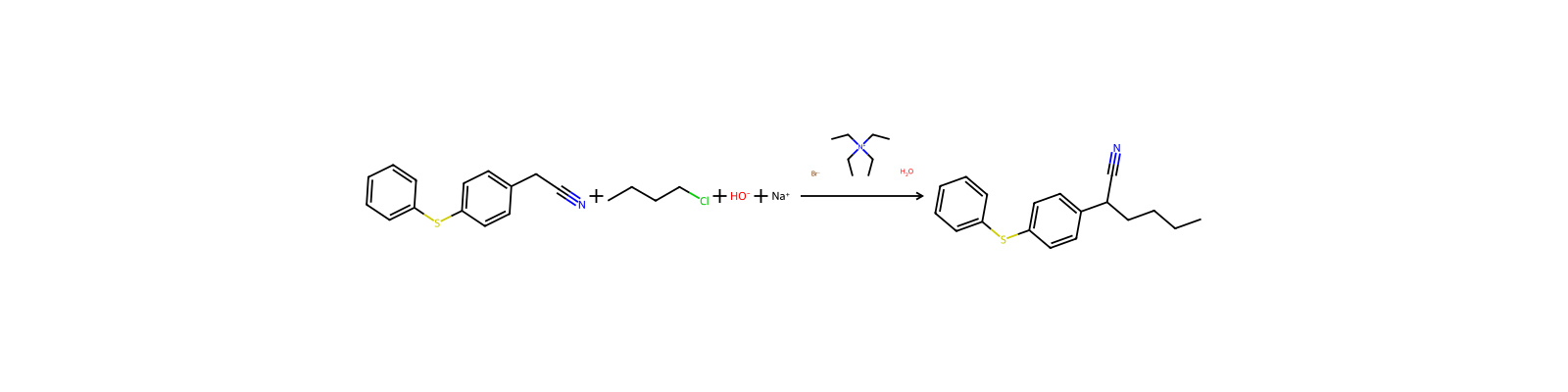
UsesTetraethylammonium bromide (TEAB) catalyzes the synthesis of thioesters by the oxidative coupling of aldehydes or alcohols with thiols or disulfides.It is used as a catalyst, along with o-iodoxybenzoic acid (IBX), in the oxidation of sulfides to sulfoxides and primary carboxamides to one-carbon dehomologated nitriles.TEAB can also be used as an organic template to synthesize zeolite beta.
General DescriptionThe use of ion-pairing reagents as mobile phase additives allows the separation of ionic and highly polar substances on reversed phase HPLC columns. The purity of mobile phase additives is of utmost importance to their successful application. Sigma-Aldrich offers an outstanding range of tailor-made reagents for anionic (quaternary ammonium and phosphonium salts) and cationic (alkanesulfonates) determination. All mobile phase additives are subject to rigorous testing with special emphasis on the requirements of modern reversed phase HPLC:
Upstream & downstream products
Upstream raw materials
Downstream products
Suppliers50 total
国药集团化学试剂有限公司86-21-63210123 · [email protected]
北京华美互利生物化工010-56205725 · [email protected]
梯希爱(上海)化成工业发展有限公司021-67121386 · [email protected]
上海阿拉丁生化科技股份有限公司400-6206333 13167063860 · [email protected]
上海如吉生物科技发展有限公司+86-21-65211385-8001 36031160 · [email protected]
南京兰亚化工贸易有限公司+86-25-8331-5620 · [email protected]
韶远科技(上海)有限公司021-50795510 4000665055 · [email protected]
科瑞迪化学400-821-5857 021-64326257 · [email protected]
上海将来实业股份有限公司400-0066400 13621662912 · [email protected]
Syntechem Co.,Ltd[email protected]
上海迈瑞尔生化科技有限公司4006356688 18621169109 · [email protected]
武汉易泰科技有限公司上海分公司18930552037 · [email protected]
阿法埃莎(中国)化学有限公司400-6106006 · [email protected]
安耐吉化学&3A(安徽泽升科技股份有限公司)400-0056266 · [email protected]
上海柏卡化学技术有限公司400-026-1533/(021) 6478-0600 · [email protected]
上海瀚鸿科技股份有限公司021-54306202 13764082696 · [email protected]
山东昱轩化工产品有限公司15315790065 15315790065 · [email protected]
嘉兴市艾森化工有限公司0573-85285100 18627885956 · [email protected]
合肥天健化工有限公司551-65418679 15856988503;15837135945 · [email protected]
南京美博生物科技有限公司025-58619198 · [email protected]
孝感深远化工有限公司15527621225; 15527621225 · [email protected]
山东西亚化学有限公司13355009207 13355009207 · [email protected]
唐山默内德贸易有限公司0315-8309571 15633399667 · [email protected]
玛雅试剂+86 (573) 82222445 (0)18006601000 452520369 · [email protected]
四川库利南科技有限公司400-1166-196 18981987031 · [email protected]
上海耐士化工科技有限公司400-188-0725 +86 21 34310725 13611771617
天津希恩思生化科技有限公司400 638 7771 · [email protected]
湖南汇百侍生物科技有限公司0731-85526065 13308475853 · [email protected]
河南多贝化工有限公司0370-2785118 17550508557 · [email protected]
斯百全化学(上海)有限公司021-021-021-67601398-809-809-809 15221380277 · [email protected]
北京泰亚杰科技有限公司021-33690831-8001 13552411790;18616022633 · [email protected]
上海源叶生物科技有限公司13636370518 · [email protected]
艾科试剂4008-755-333 18080918076 · [email protected]
上海思域化工科技有限公司86-21-34053660 · [email protected]
赛默飞世尔科技(中国)有限公司800-810-5118 · [email protected]
Wuhan NCE Biomedical Co.,Ltd.4000-027-021 |24 +86-13986109188 | +86-15623472865 | +81-08033611988
江苏艾康生物医药研发有限公司025-66113011 13913916777 · [email protected]
TOKYO CHEMICAL INDUSTRY CO., LTD.03-36680489 · [email protected]
上海贤鼎生物科技有限公司4009209199 · [email protected]
深圳康特腾科技有限公司86-0755-86635001 · [email protected]
无锡市乾丰化工科技有限公司0510-82860650 · [email protected]
无锡中坤生化科技有限公司+86 0510-85629785
上海皋翔化工有限公司021-57816257 18930243658 · [email protected]
上海倍卓生物科技有限公司021-61119791,13386096464 · [email protected]
北京环宇世纪化学科技有限公司hysj_bj.com
上海湄水化工科技有限公司021-60549325 18616193163
上海将来实业股份有限公司400-0066400 13621662912 · [email protected]
上海将来实业股份有限公司021-61552785 · [email protected]
HBCChem, Inc.+1-510-219-6317 · [email protected]
日照力德士化工有限公司010-51268198 · [email protected]
Related reactions
72 records






Linked notes
Loading…