1-hydroxypyridine-2-thione;1-hydroxy-3H-pyridin-1-ium-2-thione;zinc
HCID 6327770
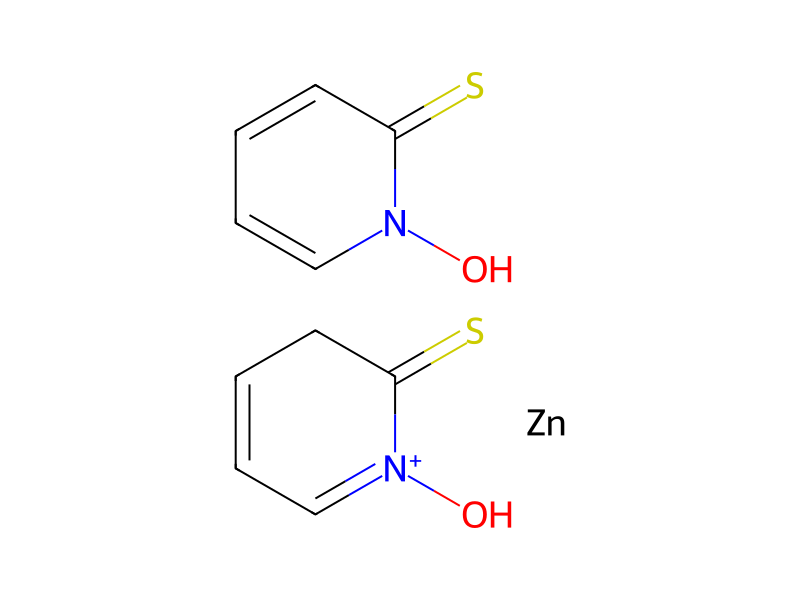
Basic information
- CAS
13463-41-7- Standard SMILES
O[N+]1=CC=CCC1=S.On1ccccc1=S.[Zn]- InChIKey
BSRFMRZGMWYJEK-UHFFFAOYSA-N- Molecular formula
- C10H11N2O2S2Zn+
- Average molar mass
- 320.7 g/mol
- Monoisotopic mass
- 318.955337
Names & identifiers
- Preferred name
- 1-hydroxypyridine-2-thione;1-hydroxy-3H-pyridin-1-ium-2-thione;zinc
- IUPAC
- 1-hydroxypyridine-2-thione;1-hydroxy-3H-pyridin-1-ium-2-thione;zinc
- English name
- Zinc pyrithione
- Molecular formula
- C10H8N2O2S2Zn
- Molecular weight
- 317.71
Names & synonyms
SPBio_000963Spectrum_001006Spectrum2_000962Spectrum3_000403Spectrum4_000523Spectrum5_000941BSPBio_001926KBioGR_001125KBioSS_001486DivK1c_000344SPECTRUM1500260HMS501B06
Show more names
ZPTPyrithione zincZNPT1-HYDROXYPYRIDINE-2-THIONE ZINCBis[[(pyridine 1-oxide)-2-yl]thio] zinc saltzincomadine2-MERCAPTOPYRIDINE N-OXIDE ZINC SALT1-HYDROXYPYRIDINE-2-THIONE ZINC SALTzincptvancid
KBio1_000344KBio2_001486KBio2_004054KBio2_006622KBio3_001146NINDS_000344HMS1920I12HMS2091O20
Database identifiers
- CAS
13463-41-7- PubChem CID
- 6327770
Properties
Computed structural properties
- Topological polar surface area
- 111 Ų
- Hydrogen bond donors
- 2
- Hydrogen bond acceptors
- 4
- Rotatable bonds
- 0
- Heavy atoms
- 17
- Formal charge
- 1
- Complexity
- 417
Physicochemical properties
- Melting point
- 240 ℃ · approximate 240℃
- Density
- 1.782 g/cm3 · 1.782 g/cm3(Temp: 25 °C)
- vapor pressure
- 0 Pa · 0Pa at 25℃
- storage temp.
- Sealed in dry,Room Temperature
- solubility
- almost transparency in Pyridine
- form
- Powder
- color
- White to Orange to Green
- Odor
- Mild Characteristic
- Water Solubility
- Insoluble (<0.1 g/100 mL at 21 ºC)
- Merck
- 14 · 14,7994
- Cosmetics Ingredients Functions
- PRESERVATIVEHAIR CONDITIONINGANTI-SEBORRHEICANTI-SEBUM
- InChI
- InChI=1S/2C5H5NOS.Zn/c2*7-6-4-2-1-3-5(6)8;/h2*1-4,8H;/q;;+2/p-2
- InChIKey
- OTPSWLRZXRHDNX-UHFFFAOYSA-L
- SMILES
- C1(C=CC=C[N+]=1[O-])S[Zn]SC1C=CC=C[N+]=1[O-]
- LogP
- 0.9 at · 0.9 at 25℃ and pH7.5-7.7
- Surface tension
- 73 mN/m · 73mN/m at 7.22mg/L and 20℃
- CAS DataBase Reference
- 13463 · 13463-41-7(CAS DataBase Reference)
- EWG's Food Scores
- 2 · 2-3
- FDA UNII
- 953 O2RHZ5 · R953O2RHZ5
- ATC code
- 11 AX12 · D11AX12
- EPA Substance Registry System
- Zinc pyrithione (13463-41-7)
- UNSPSC Code
- 41116107 · 41116107
- NACRES
- 24 · NA.24
- Symbol(GHS)
- 5 · GHS05,GHS06,GHS08,GHS09
- Signal word
- Danger
- Hazard statements
- 301 · H301-H318-H330-H360D-H372-H410
- Precautionary statements
- 202 · P202-P260-P273-P280-P304+P340+P310-P305+P351+P338
- PPE
- 3 · Eyeshields, Faceshields, Gloves, type P3 (EN 143) respirator cartridges
- Hazard Codes
- T+,N,T
- Risk Statements
- 24 · 24/25-26-37/38-41-50/53-23-22
- Safety Statements
- 26 · 26-28-36/37/39-45-61-60-39
- RIDADR
- 2811 · UN 2811 6.1/PG 2
- WGK Germany
- 3 · 3
- RTECS
- 950000 · ZH0950000
- TSCA
- TSCA listed
- HazardClass
- 6.1 · 6.1(b)
- PackingGroup
- III
- HS Code
- 29333990 · 29333990
- Storage Class
- 6.1 A · 6.1A - Combustible acute toxic Cat. 1 and 2very toxic hazardous materials
- Hazard Classifications
- 2 InhalationAcute · Acute Tox. 2 InhalationAcute Tox. 3 OralAquatic Acute 1Aquatic Chronic 1Eye Dam. 1Repr. 1BSTOT RE 1
- Hazardous Substances Data
- 13463 · 13463-41-7(Hazardous Substances Data)
- Toxicity
- 50 oral · LD50 oral in rat: 177mg/kg
- REACH Registrations
- Active
Safety & regulation
Safety information is for reference only and does not replace the supplier’s Safety Data Sheet (SDS), applicable regulations, or professional assessment.
Safety data
- PPE
- Eyeshields, Faceshields, Gloves, type P3 (EN 143) respirator cartridges
- wgk
- 3
- tsca
- TSCA listed
- rtecs
- ZH0950000
- ridadr
- UN 2811 6.1/PG 2
- hs_code
- 29333990
- Toxicity
- LD50 oral in rat: 177mg/kg
- risk_code
- 24/25-26-37/38-41-50/53-23-22
- Signal word
- Danger
- Symbol(GHS)
- GHS05,GHS06,GHS08,GHS09
- hazard_code
- T+,N,T
- safety_code
- 26-28-36/37/39-45-61-60-39
- hazard_class
- 6.1(b)
- Storage Class
- 6.1A - Combustible acute toxic Cat. 1 and 2very toxic hazardous materials
- packing_group
- III
- Hazard statements
- H301-H318-H330-H360D-H372-H410
- REACH Registrations
- Active
- Hazard Classifications
- Acute Tox. 2 InhalationAcute Tox. 3 OralAquatic Acute 1Aquatic Chronic 1Eye Dam. 1Repr. 1BSTOT RE 1
- Precautionary statements
- P202-P260-P273-P280-P304+P340+P310-P305+P351+P338
- Hazardous Substances Data
- 13463-41-7(Hazardous Substances Data)
Chemistry & industry
Applications
UsesShampoo for dandruff,zinc pyrithione can inhibit Gram positive and negative bacteria and mold growth,Care hair Effectively , delay hair aging ,control white hair and hair loss generation. zinc pyrithion is also used as a cosmetic preservative, oil, paint biocide. Zinc pyrithione has a strong killing power on fungi and bacteria so that it can effectively kill dandruff fungus,playing a role in dandruff .
DescriptionZinc pyrithione is a coordination complex of zinc and pyrithione that has antimicrobial and anticancer activities. It is active against the bacteria E. coli, S. aureus, K. pneumoniae, A. baumannii, P. aeruginosa, E. faecium, E. faecalis, and E. cloacae (MICs = 1-4 μg/ml) and the fungus P. ovale when used at concentrations ranging from 0.01 to 10 μg/ml. Zinc pyrithione reduces tumor growth in an SCC-4 mouse xenograft model when administered at a dose of 1 mg/kg per week for six weeks. Formulations containing zinc pyrithione have been used in the treatment of dandruff.
Useszinc pyrithione is a preservative against bacteria, fungi, and yeast. It is unstable in light and in the presence of oxidizing agents. Zinc pyrithione is useful in gels, creams, heavy lotions, and talcum powder.
UsesReactions may lead to photosensitive eczema and actinic reticuloid syndrome. Zinc pyrithione is used as antifungal, antibacterial and antiseborrheic agent used in many shampoos and hair creams.
UsesZinc pyrithione is directly cytotoxic and has antimicrobial effects. Zinc pyrithione is found in many shampoos (DHS-Zinc, Head and Shoulders) and should be applied for 5 minutes daily for 2 weeks. Zinc pyrithione is the active ingredient in several shampoos used to control dandruff and seborrheic dermatitis and is also effective in the therapy of tinea versicolor. It remains unclear whether the beneficial effects are caused by an antiproliferative or antimicrobial effect or both. It is substantive to the hair, allowing continued therapeutic effect after washing.
General DescriptionFine beige granules.
Upstream & downstream products
Upstream raw materials
Downstream products
Related reactions
0 records
No related reactions yet