HomeMCPWorkbenchSkills
HomeWorkbenchNotificationsMe
llms.txt · MCP GuidePrivacy Policy · Terms of Service · Supportv1.8.3
  1. Home
  2. /Compound

Antioxidant 1010

HCID 64819
New reaction
Print
Basic informationOverviewNames & identifiersPropertiesSafety & regulationChemistry & industryRelated reactionsCompound notes
Substructure searchFind similar structures

Basic information

CAS
6683-19-8
Standard SMILES
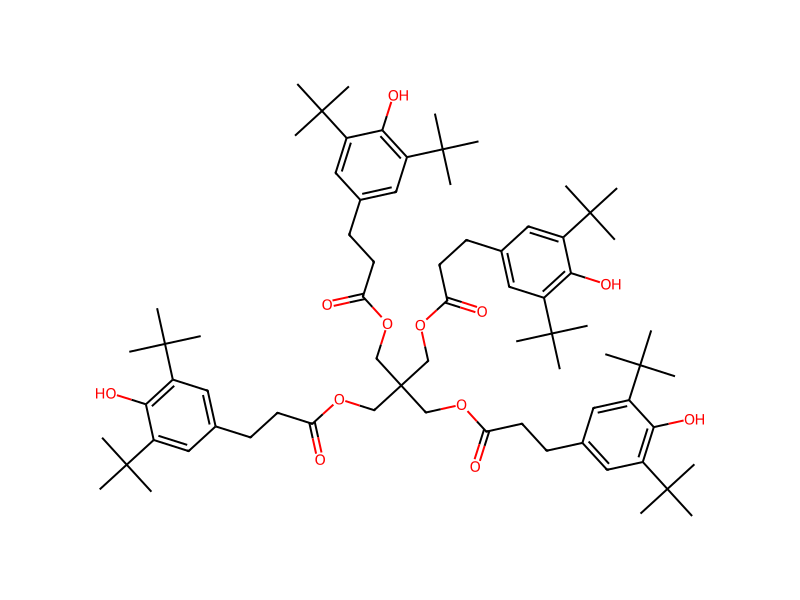
CC(C)(C)c1cc(CCC(=O)OCC(COC(=O)CCc2cc(C(C)(C)C)c(O)c(C(C)(C)C)c2)(COC(=O)CCc2cc(C(C)(C)C)c(O)c(C(C)(C)C)c2)COC(=O)CCc2cc(C(C)(C)C)c(O)c(C(C)(C)C)c2)cc(C(C)(C)C)c1O
InChIKey
BGYHLZZASRKEJE-UHFFFAOYSA-N
Molecular formula
C73H108O12
Average molar mass
1,177.6 g/mol
Monoisotopic mass
1,176.78407888

Overview

has antioxidant activity

Names & identifiers

Preferred name
Antioxidant 1010
IUPAC
[3-[3-(3,5-ditert-butyl-4-hydroxyphenyl)propanoyloxy]-2,2-bis[3-(3,5-ditert-butyl-4-hydroxyphenyl)propanoyloxymethyl]propyl] 3-(3,5-ditert-butyl-4-hydroxyphenyl)propanoate
English name
Antioxidant 1010
Molecular formula
C73H108O12
Molecular weight
1177.66

Names & synonyms

6683-19-8Irganox 1010Antioxidant 1010Pentaerythritol tetrakis(3-(3,5-di-tert-butyl-4-hydroxyphenyl)propionate)Tetraalkofen BPEPhenosane 23Dovernox 10Fenozan 22Fenozan 23Naugard 10Sumilizer BP 101Irganox 1010FF
Show more names
PENTAERYTHRITYL TETRA-DI-t-BUTYL HYDROXYHYDROCINNAMATEPentaerythritol TetrakisBHPMao60Antioxidant1010PENTAERYTHRITOL TETRAKIS(3,5-DI-TERT-BUTYL-4-HYDROXYHYDROCINNAMATE)Carbyltetramethylene tetrakis(3,5-di-tert-butyl-4-hydroxyhydrocinnamate)TTHP
Irganox 1040Anox 20AMRalox 630ANOX 20ADK Stab AO 60Irganox 1010FPMARK AO 60DTXSID1027633

Database identifiers

CAS
6683-19-8
PubChem CID
64819
DTXSID
DTXSID1027633
ChEMBL
CHEMBL3187856
UNII
255PIF62MS
EC Number
229-722-6、687-966-2
Nikkaji
J46.615H

Properties

Computed structural properties

XLogP
19.4
Topological polar surface area
186 Ų
Hydrogen bond donors
4
Hydrogen bond acceptors
12
Rotatable bonds
32
Heavy atoms
85
Formal charge
0
Complexity
1,730

Experimental & physicochemical properties

Chemical ClassesOther Classes -> Other Organic Compounds
Polymers · 2 items

Plastics -> Polyolefin-I; PUR; Polyolefin-II; PVC (soft); PVC (rigid); PET; PA; PC; (E)PS

Plastics -> Antioxidants

CosmeticsCosmetic ingredients (Pentaerythrityl Tetra-di-t-butyl Hydroxyhydrocinnamate) -> CIR (Cosmetic Ingredient Review)
FragrancesFragrance Ingredient (Benzenepropanoic acid, 3,5-bis(1,1-dimethylethyl)-4-hydroxy-, 2,2-bis[[3-[3,5-bis(1,1-dimethylethyl)-4-hydroxyphenyl]-1-oxopropoxy]methyl]- -1,3-propanediyl ester) -> IFRA transparency List
LogP23
Density1.15 g/cm³
SolubilitySolubility in water: none
Flash Point · 2 items

297 °C o.c.

566.6 °F (open cup)

Animal DrugsPharmaceuticals -> UK Veterinary Medicines Directorate List
Endocrine DisruptorsPotential endocrine disrupting compound
Melting Point · 2 items

110-125 °C

230-257 °F

Vapor Density1.15

Physicochemical properties

Melting point
115 · 115-118 °C (dec.)(lit.)
Boiling point
779.1 °C · 779.1°C (rough estimate)
Density
0.9594 · 0.9594 (rough estimate)
refractive index
1.639 · 1.6390 (estimate)
storage temp.
2 · 2-8°C
solubility
Chloroform (Slightly), Ethyl Acetate (Slightly)
pka
11.71 · 11.71±0.40(Predicted)
form
Solid
color
White to Off-White
Cosmetics Ingredients Functions
ANTIOXIDANT
InChIKey
BGYHLZZASRKEJE-UHFFFAOYSA-N
LogP
18.832 · 18.832 (est)
Indirect Additives used in Food Contact Substances
PENTAERYTHRITYL TETRAKIS(3,5-DI-TERT-BUTYL-4-HYDROXYHYDROCINNAMATE)
CAS DataBase Reference
6683 · 6683-19-8(CAS DataBase Reference)
FDA 21 CFR
175.105 · 175.105; 175.300; 177.1680;177.2470; 177.2480; 178.2010;178.3570; 178.3910
EWG's Food Scores
1 · 1
FDA UNII
255 PIF62MS · 255PIF62MS
EPA Substance Registry System
3 · Pentaerithritol tetrakis[3,5-di-tert-butyl-4-hydroxyhydrocinnamate] (6683-19-8)
UNSPSC Code
41116107 · 41116107
NACRES
24 · NA.24
Symbol(GHS)
7 · GHS07
Signal word
Warning
Hazard statements
315 · H315-H319-H335
Precautionary statements
280 · P280-P302+P352-P362+P364
Safety Statements
22 · 22-24/25
WGK Germany
-
RTECS
8340900 · DA8340900
TSCA
TSCA listed
HS Code
2918290000 · 2918290000
Storage Class
11 · 11 - Combustible Solids
Toxicity
50 unreported · LD50 unreported in mammal (species unspecified): 10gm/kg
REACH Registrations
Active

Safety & regulation

Safety information is for reference only and does not replace the supplier’s Safety Data Sheet (SDS), applicable regulations, or professional assessment.

GHS classification

GHS Classification · 6 items

This chemical does not meet GHS hazard criteria for 91.6% (2698 of 2945) of all reports.

Not Classified

Aggregated GHS information provided per 2945 reports by companies from 12 notifications to the ECHA C&L Inventory.

Warning

H302 (100%): Harmful if swallowed [Warning Acute toxicity, oral]

P264, P270, P273, P280, P301+P317, P302+P352, P321, P330, P332+P317, P362+P364, and P501 (click each P-code to see the statement)

Hazard information

Regulatory Information · 4 items

Chemical: Benzenepropanoic acid, 3,5-bis(1,1-dimethylethyl)-4-hydroxy-, 2,2-bis[[3-[3,5-bis(1,1-dimethylethyl)-4-hydroxyphenyl]-1-oxopropoxy]methyl]-1,3-propanediyl ester

Benzenepropanoic acid, 3,5-bis(1,1-dimethylethyl)-4-hydroxy-, 1,1'-[2,2-bis[[3-[3,5-bis(1,1-dimethylethyl)-4-hydroxyphenyl]-1-oxopropoxy]methyl]-1,3-propanediyl] ester is listed on the EPA's Chemical Data Reporting (CDR) system. Manufacturers and importers of Benzenepropanoic acid, 3,5-bis(1,1-dimethylethyl)-4-hydroxy-, 1,1'-[2,2-bis[[3-[3,5-bis(1,1-dimethylethyl)-4-hydroxyphenyl]-1-oxopropoxy]methyl]-1,3-propanediyl] ester are required to report information about their production and use of this chemical to the EPA under the Toxic Substances Control Act (TSCA). (40 eCFR Part 711)

REACH registered substance: Pentaerythritol tetrakis(3-(3,5-di-tert-butyl-4-hydroxyphenyl)propionate) (EC: 229-722-6)

Benzenepropanoic acid, 3,5-bis(1,1-dimethylethyl)-4-hydroxy-, 2,2-bis[[3-[3,5-bis(1,1-dimethylethyl)-4-hydroxyphenyl]-1-oxopropoxy]methyl]-1,3-propanediyl ester: Does not have an individual approval but may be used under an appropriate group standard

Other Safety InformationIMAP assessments - Benzenepropanoic acid, 3,5-bis(1,1-dimethylethyl)-4-hydroxy-, 2,2-bis[[3-[3,5-bis(1,1-dimethylethyl)-4-hydroxyphenyl]-1-oxopropoxy]methyl]-1,3-propanediyl ester: Human health tier I assessment
Fire HazardsCombustible. Finely dispersed particles form explosive mixtures in air.
Hazards Summary · 1 item

May cause mechanical eye and respiratory tract irritation; [ICSC] Not a skin or eye irritant in rabbits; Not a skin sensitizer in guinea pigs; No adverse effects to fertility, reproduction, or development observed in 2-generation oral study of rats (doses up to 10,000ppm in feed); No teratogenic effects observed in mice (doses up to 1,000 mg/kg/day); [IUCLID] May cause mechanical irritation; [Addivant MSDS]

EPA Safer ChemicalChemical: Pentaerythritol, tetrakis(3,5-di-tert-butyl-4-hydroxyhydrocinnamate)
Chemical DangersReacts with strong oxidants, strong acids and strong bases.
Physical DangersDust explosion possible if in powder or granular form, mixed with air.
Hazard Classes and Categories · 2 items

Not Classified

Acute Tox. 4 (100%)

Safety & protection

Fire FightingUse water spray, foam, powder, carbon dioxide.
First Aid Measures · 4 items

Fresh air, rest.

Rinse and then wash skin with water and soap.

Rinse with plenty of water (remove contact lenses if easily possible).

Rinse mouth.

Safe StorageSeparated from strong oxidants, strong bases and strong acids.
Spillage DisposalRemove all ignition sources. Personal protection: particulate filter respirator adapted to the airborne concentration of the substance. Sweep spilled substance into covered containers. If appropriate, moisten first to prevent dusting.
Eye PreventionWear safety spectacles.
Fire PreventionNO open flames. Prevent deposition of dust. Closed system, dust explosion-proof electrical equipment and lighting.
Inhalation RiskA nuisance-causing concentration of airborne particles can be reached quickly when dispersed.
Ingestion PreventionDo not eat, drink, or smoke during work.
Inhalation PreventionAvoid inhalation of dust.
Threshold Limit Values (TLV)2 mg/m³ [2002]
Effects of Short Term ExposureMay cause mechanical irritation to the eyes and respiratory tract.

Toxicology

Toxicity SummarySafe in the present practices of use and concentration. Ingredient, concentration, and use information are available in documents discoverable at https://cir-reports.cir-safety.org
Signs and Symptoms · 2 items

Cough.

Redness.

Toxicity DataLC50 (rat) > 1,950 mg/m3/4hr

Safety data

wgk
-
tsca
TSCA listed
rtecs
DA8340900
hs_code
2918290000
Toxicity
LD50 unreported in mammal (species unspecified): 10gm/kg
Signal word
Warning
Symbol(GHS)
GHS07
safety_code
22-24/25
Storage Class
11 - Combustible Solids
Hazard statements
H315-H319-H335
REACH Registrations
Active
Precautionary statements
P280-P302+P352-P362+P364

Chemistry & industry

Uses & manufacturing

Uses · 4 items

CIR ingredient: Pentaerythrityl Tetra-di-t-butyl Hydroxyhydrocinnamate

Used in the polymers industry as a stabilizer and antioxidant; [IUCLID] Used as a stabilizer for various polymers, as a radical scavenger in polyolefins, to make construction foam, Raffia film (PP film) and fibers, adhesives and sealants, thermoplastics, plastic and rubber products, wire and cable, wood plastic composites, and textiles-leather-fur; [ExPub: ECHA REACH Registrations] Permitted for use as an inert ingredient in non-food pesticide products; [EPA] Used as an antioxidant; [Addivant MSDS]

Textiles (Fiber & Fabric Manufacturing) [Category: Industry]

Plastics -> Typical concentration range in plastic materials -> 0.002 - 0.5%

U.S. Production2023: 40,000,000 - <55,000,000 lb
Consumer UsesAnti-static agent
Industry UsesOxidizing agent
Household ProductsInformation on 33 consumer products that contain Pentaerythrityl Tetra-Di-T-Butyl Hydroxyhydrocinnamate in the following categories is provided:
Use Classification · 5 items

EPA Safer Chemical Functional Use Classes -> Preservatives and Antioxidants

Safer Chemical Classes -> Green circle - The chemical has been verified to be of low concern

Fragrance Ingredients

Plastics -> Antioxidants

Plastics -> Polymer Type -> Polyolefin-I; PUR; Polyolefin-II; PVC (soft); PVC (rigid); PET; PA; PC; (E)PS

General Manufacturing Information · 2 items

Transportation Equipment Manufacturing

Benzenepropanoic acid, 3,5-bis(1,1-dimethylethyl)-4-hydroxy-, 1,1'-[2,2-bis[[3-[3,5-bis(1,1-dimethylethyl)-4-hydroxyphenyl]-1-oxopropoxy]methyl]-1,3-propanediyl] ester: ACTIVE

Applications · 2 items

UsesPentaerythritol Tetrakis(3-(3,5-di-tert-butyl-4-hydroxyphenyl)propionate) is an antioxidant used in food packaging to prevent the spoilage and increase the shelf life of food products. It can be found mainly in food packages made of LDPE, HDPE, PP, PVC and PET.

General DescriptionPentaerythritol tetrakis(3,5-di-tert-butyl-4-hydroxyhydrocinnamate) (PT) is a sterically hindered phenolic antioxidant and a heat stabilizer mainly used to enhance the oxidative resistance and protection against the toxicity of solvents. It has a glass transition temperature of 50℃ and can be annealed at room temperature.PT can be used as an additive to protect biaxially-oriented propylene (BOPP) capacitor film from thermal oxidation on UV exposure. It can also be used as a standard material to study the gas-cluster ion sputtering (GCIS) using X-ray photoelectron microscopy (XPS) and Atomic force microscopy (AFM).

Upstream & downstream products

Upstream raw materials

Potassium tert-butoxideEthanolPhenolSodium MethoxideDOYLE DIRHODIUM CATALYST-RH2(4S-MEOX)4PentaerythritolMethanolMethyl propionate2,6-Di-tert-butylphenolMethyl acrylate3-(3,5-Di-tert-butyl-4-hydroxyphenyl)propionic acid

Downstream products

Complex antioxidant

Related reactions

8 records
New reaction record
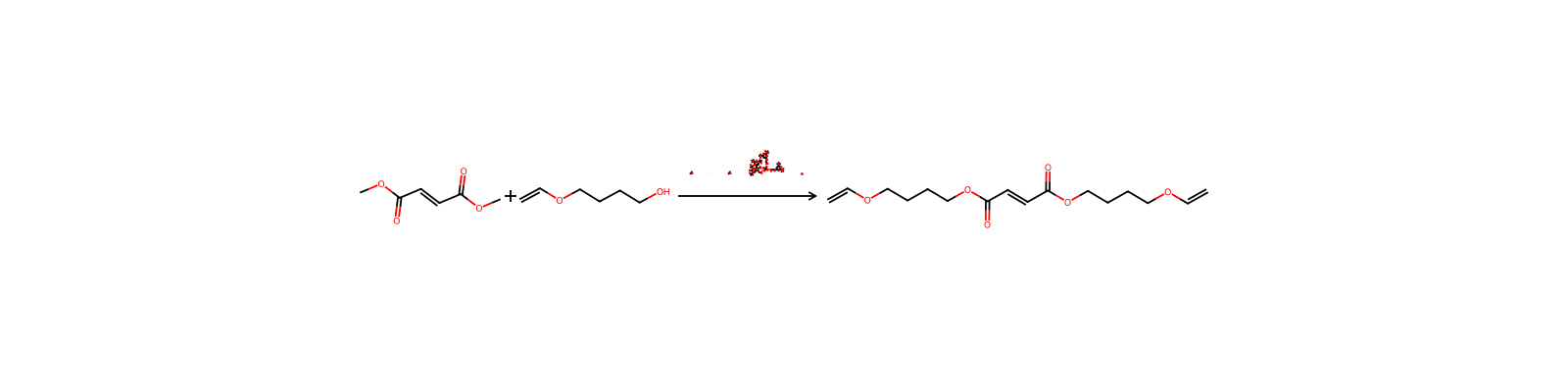
HRID 359339 reaction equation
HRID 359339As reactant
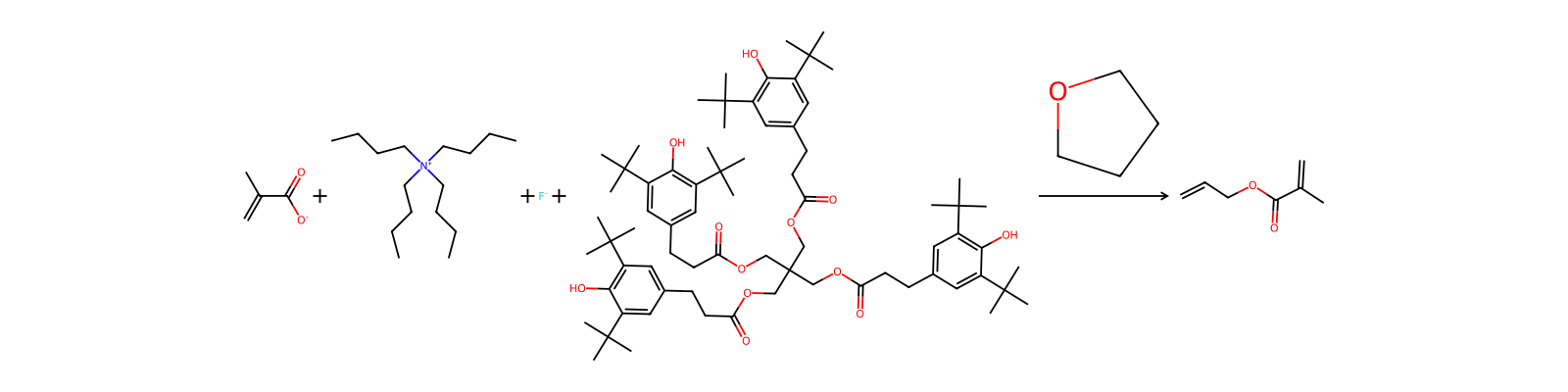
HRID 364914 reaction equation
HRID 364914As reactant
HRID 620691 reaction equation
HRID 620691As reactant
HRID 1087284 reaction equation
HRID 1087284As reactant
HRID 1759500 reaction equation
HRID 1759500As solvent
HRID 1823641 reaction equation
HRID 1823641As catalyst
HRID 2403076 reaction equation
HRID 2403076As reactant
HRID 2413671 reaction equation
HRID 2413671As reactant

Compound notes

On this pageBasic informationOverviewNames & identifiersPropertiesSafety & regulationChemistry & industryRelated reactionsCompound notes