
Basic information
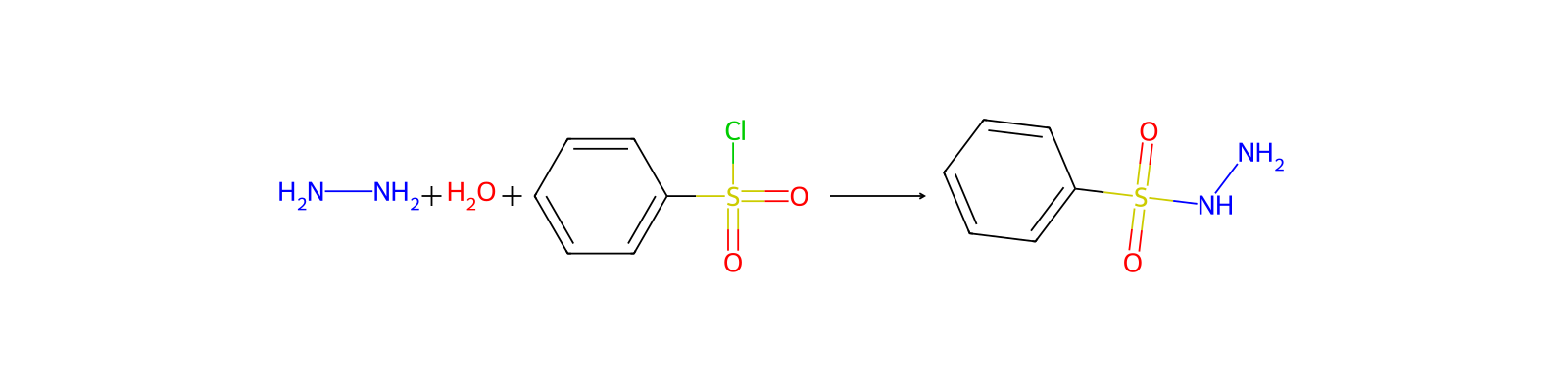
- Standard SMILES
NNS(=O)(=O)c1ccccc1- InChIKey
VJRITMATACIYAF-UHFFFAOYSA-N- Molecular formula
- C6H8N2O2S
- Average molar mass
- 172.21 g/mol
- Monoisotopic mass
- 172.03064868
Names & identifiers
- Preferred name
- Benzenesulfonyl hydrazide
- IUPAC
- benzenesulfonohydrazide
- English name
- Benzenesulfonyl hydrazide
- Molecular formula
- C6H8N2O2S
- Molecular weight
- 172.2
Names & synonyms
Benzenesulfonyl hydrazide80-17-1Benzenesulfonic acid, hydrazidePorofor BSHPhenylsulfonylhydrazineBenzenesulfohydrazidePhenylsulfohydrazideGenitron BSHCelogen BSHBenzenesulfonylhydrazinePhenylsulfonyl hydrazidePorofor ChKhZ 9
Show more names
BSHBENZENESULFONOHYDRAZIDEPoroforBENZENESULPHONYL HYDRAZIDEchkhz9celogenbsh
Porofor-BSH-PulverBenzenesulfonic acid hydrazideHydrazide BSGNitropore OBSHChKhZ 9Benzenesulfonic hydrazideAC8C87U2TAUNICELL BSHTM
Database identifiers
- CAS
80-17-1- PubChem CID
- 65723
- DTXSID
DTXSID0052548- UNII
- AC8C87U2TA
- EC Number
- 201-255-2
- Nikkaji
- J145.957K
Properties
Computed structural properties
- XLogP
- -0.1
- Topological polar surface area
- 80.6 Ų
- Hydrogen bond donors
- 2
- Hydrogen bond acceptors
- 4
- Rotatable bonds
- 2
- Heavy atoms
- 11
- Formal charge
- 0
- Complexity
- 201
Experimental & physicochemical properties
Physical Description
Benzenesulfonyl hydrazide appears as a white to light-colored crystalline solid. Insoluble in water and denser than water. Contact may irritate skin, eyes and mucous membranes. May be toxic by ingestion. Readily ignited by sparks or flames and burns vigorously. Used to make other chemicals.
Physicochemical properties
- Melting point
- 101 · 101-103 °C(lit.)
- Boiling point
- 333.5 · 333.5±25.0 °C(Predicted)
- Density
- 1.303 · 1.303 (estimate)
- refractive index
- 1.649 · 1.6490 (estimate)
- Flash point
- 110 °C · 110 °C
- storage temp.
- Flammables area
- solubility
- soluble in Methanol
- pka
- 9.3 · 9.30±0.50(Predicted)
- form
- solid
- color
- White to Almost white
- Merck
- 14 · 14,7598
- BRN
- 640079 · 640079
- InChIKey
- VJRITMATACIYAF-UHFFFAOYSA-N
- CAS DataBase Reference
- 80 · 80-17-1(CAS DataBase Reference)
- NCI Dictionary of Cancer Terms
- BSH
- FDA UNII
- 8 C87U2TA · AC8C87U2TA
- NIST Chemistry Reference
- Benzenesulfonic acid, hydrazide(80-17-1)
- EPA Substance Registry System
- Benzenesulfonic acid, hydrazide (80-17-1)
- Symbol(GHS)
- 2 · GHS02,GHS07
- Signal word
- Danger
- Hazard statements
- 302 · H302-H242
- Precautionary statements
- 501 · P501-P270-P220-P210-P234-P264-P280-P370+P378-P301+P312+P330-P411-P420-P403+P235
- Hazard Codes
- F
- Risk Statements
- 11 · 11
- Safety Statements
- 15 · 15-16-22-24/25
- RIDADR
- 3226 · UN 3226 4.1
- WGK Germany
- 3 · 3
- RTECS
- 6888000 · DB6888000
- F
- 4.9 · 4.9-16
- TSCA
- TSCA listed
- HazardClass
- 4.1 · 4.1
- PackingGroup
- II
- HS Code
- 29350090 · 29350090
- Toxicity
- 50 mg/kg · LDLo orl-rat: 50 mg/kg IPSTB3 3,93,76
- REACH Registrations
- Active
- Limited Quantities
- 1 Kg · 1.0 Kg (2.2 lbs)
- Excepted Quantities
- Not Permitted as Excepted Quantity
Safety & regulation
GHS classification
GHS Classification
This chemical does not meet GHS hazard criteria for 4.1% (2 of 49) of reports.
Danger
H228 (10.2%): Flammable solid [Danger Flammable solids];H242 (85.7%): Heating may cause a fire [Danger Self-reactive substances and mixtures; Organic peroxides];H302 (10.2%): Harmful if swallowed [Warning Acute toxicity, oral]
P210, P234, P235, P240, P241, P264, P270, P280, P301+P317, P330, P370+P378, P403, P410, P411, P420, and P501 (click each P-code to see the statement)
Aggregated GHS information provided per 49 reports by companies from 7 notifications to the ECHA C&L Inventory. Each notification may be associated with multiple companies.;Reported as not meeting GHS hazard criteria per 2 of 49 reports by companies.;There are 6 notifications provided by 47 of 49 reports by companies with hazard statement code(s).;Information may vary between notifications depending on impurities, additives, and other factors. The percentage value in parenthesis indicates the notified classification ratio from companies that provide hazard codes. Only hazard codes with percentage values above 10% are shown. For more detailed information, please visit ECHA C&L website.
Hazard information
Regulatory Information
Chemical: Benzenesulfonic acid, hydrazide
Status: Active Update: 28-05-2019 https://echa.europa.eu/registration-dossier/-/registered-dossier/28399
Benzenesulfonic acid, hydrazide: Does not have an individual approval but may be used as a component in a product covered by a group standard. It is not approved for use as a chemical in its own right.
DOT LabelFlammable Solid
Fire Hazards
Excerpt from ERG Guide 149 [Substances (Self-Reactive)]:;Self-decomposition, self-polymerization, or self-ignition may be triggered by heat, chemical reaction, friction or impact. May be ignited by heat, sparks or flames. Some may decompose explosively when heated or involved in a fire. Those substances designated with a (P) may polymerize explosively when heated or involved in a fire. May burn violently. Decomposition or polymerization may be self-accelerating and produce large amounts of gases. Vapors or dust may form explosive mixtures with air. (ERG, 2024)
Health Hazards
Excerpt from ERG Guide 149 [Substances (Self-Reactive)]:;Inhalation or contact with vapors, substance or decomposition products may cause severe injury or death. May produce irritating, toxic and/or corrosive gases. Runoff from fire control or dilution water may cause environmental contamination. (ERG, 2024)
Reactive GroupAzo, Diazo, Azido, Hydrazine, and Azide Compounds;Sulfonates, Phosphonates, and Thiophosphonates, Organic
Reactivity ProfileSelf-decomposition or self-ignition may be triggered by heat, chemical reaction, friction or impact. May be ignited by heat, sparks or flames.
Air and Water ReactionsInsoluble in water.
Hazard Classes and CategoriesFlam. Sol. 1 (10.2%);Org. Perox. C (85.7%);Acute Tox. 4 (10.2%)
Safety & protection
Fire Fighting
Excerpt from ERG Guide 149 [Substances (Self-Reactive)]:;SMALL FIRE: Dry chemical, CO2, water spray or regular foam.;LARGE FIRE: Flood fire area with water from a distance. If it can be done safely, move undamaged containers away from the area around the fire.;FIRE INVOLVING TANKS, RAIL TANK CARS OR HIGHWAY TANKS: BEWARE OF POSSIBLE CONTAINER EXPLOSION. Fight fire from maximum distance or use unmanned master stream devices or monitor nozzles. Cool containers with flooding quantities of water until well after fire is out. Withdraw immediately in case of rising sound from venting safety devices or discoloration of tank. ALWAYS stay away from tanks in direct contact with flames. (ERG, 2024)
First AidExcerpt from ERG Guide 149 [Substances (Self-Reactive)]:;Refer to the "General First Aid" section. (ERG, 2024)
Nonfire Spill Response
Excerpt from ERG Guide 149 [Substances (Self-Reactive)]:;ELIMINATE all ignition sources (no smoking, flares, sparks or flames) from immediate area. Do not touch or walk through spilled material. Stop leak if you can do it without risk.;SMALL SPILL: Pick up with inert, damp, non-combustible material using clean, non-sparking tools and place into loosely covered plastic containers for later disposal. Prevent entry into waterways, sewers, basements or confined areas. (ERG, 2024)
Isolation and Evacuation
Excerpt from ERG Guide 149 [Substances (Self-Reactive)]:;IMMEDIATE PRECAUTIONARY MEASURE: Isolate spill or leak area in all directions for at least 50 meters (150 feet) for liquids and at least 25 meters (75 feet) for solids.;LARGE SPILL: Consider initial evacuation for at least 250 meters (800 feet) in all directions.;FIRE: If tank, rail tank car or highway tank is involved in a fire, ISOLATE for 800 meters (1/2 mile) in all directions; also, consider initial evacuation for 800 meters (1/2 mile) in all directions. (ERG, 2024)
Personal Protective Equipment (PPE)
Excerpt from ERG Guide 149 [Substances (Self-Reactive)]:;Wear positive pressure self-contained breathing apparatus (SCBA). Wear chemical protective clothing that is specifically recommended by the manufacturer when there is NO RISK OF FIRE. Structural firefighters' protective clothing provides thermal protection but only limited chemical protection. (ERG, 2024)
Regulatory information
Regulatory Information
Chemical: Benzenesulfonic acid, hydrazide
Status: Active Update: 28-05-2019 https://echa.europa.eu/registration-dossier/-/registered-dossier/28399
Benzenesulfonic acid, hydrazide: Does not have an individual approval but may be used as a component in a product covered by a group standard. It is not approved for use as a chemical in its own right.
Safety data
- F
- 4.9-16
- wgk
- 3
- tsca
- TSCA listed
- rtecs
- DB6888000
- ridadr
- UN 3226 4.1
- hs_code
- 29350090
- Toxicity
- LDLo orl-rat: 50 mg/kg IPSTB3 3,93,76
- risk_code
- 11
- Signal word
- Danger
- Symbol(GHS)
- GHS02,GHS07
- hazard_code
- F
- safety_code
- 15-16-22-24/25
- hazard_class
- 4.1
- packing_group
- II
- Hazard statements
- H302-H242
- Limited Quantities
- 1.0 Kg (2.2 lbs)
- Excepted Quantities
- Not Permitted as Excepted Quantity
- REACH Registrations
- Active
- Precautionary statements
- P501-P270-P220-P210-P234-P264-P280-P370+P378-P301+P312+P330-P411-P420-P403+P235
Chemistry & industry
Uses & manufacturing
General Manufacturing InformationBenzenesulfonic acid, hydrazide: ACTIVE
Applications
DescriptionBenzenesulphonyl hydrazide (BSH) is a chemical blowing agent used to modify the cell structure of natural rubber. The decomposition temperature of BSH blowing agent is 105 °C, and its gas release rate is 120 cm3/g. In the preparation of natural rubber thermal insulation materials, the BSH blowing agent decomposes upon heating to produce nitrogen gas, thereby forming a foam structure within the rubber. When the BSH content is 6 phr, the maximum swelling ratio reaches 324% and the thermal conductivity reaches a minimum of 0.040 W/m/K, making the material an excellent thermal insulation material [1]. Furthermore, BSH is also used as the core material in evaporable core-shell nanocapsules to enable thermally triggered separation of thin films [2].
UsesBenzenesulfonyl hydrazide is used in making foam rubber and foam plastics.
General DescriptionBenzenesulfonyl hydrazide is a white to light-colored crystalline solid. Insoluble in water and denser than water. Contact may irritate skin, eyes and mucous membranes. May be toxic by ingestion. Readily ignited by sparks or flames and burns vigorously. Used to make other chemicals.
Upstream & downstream products
Upstream raw materials
Downstream products
Suppliers50 total
国药集团化学试剂有限公司86-21-63210123 · [email protected]
梯希爱(上海)化成工业发展有限公司021-67121386 · [email protected]
阿诺西(上海)生物技术有限公司400-1107768 15058188853 · [email protected]
上海阿拉丁生化科技股份有限公司400-6206333 13167063860 · [email protected]
Shandong chuangyingchemical Co., Ltd.18853181302 · [email protected]
上海麦克林生化科技股份有限公司021-50706066 15221275939 · [email protected]
武汉欣扬瑞和化学科技有限公司153-07155313 15307155313 · [email protected]
杭州品高化工有限公司0571-87658025 · [email protected]
爱斯特(成都)生物制药股份有限公司+86-28-85122536 85324413 · [email protected]
山东前元高分子材料有限公司18678041314 18765609661 · [email protected]
Dayang Chem (Hangzhou) Co.,Ltd.+86-0571-88938639 17705817739 · [email protected]
南京兰亚化工贸易有限公司+86-25-8331-5620 · [email protected]
科瑞迪化学400-821-5857 021-64326257 · [email protected]
Syntechem Co.,Ltd[email protected]
上海迈瑞尔生化科技有限公司4006356688 18621169109 · [email protected]
武汉市聚舜化工有限公司027-02783261126 18971318572 · [email protected]
阿法埃莎(中国)化学有限公司400-6106006 · [email protected]
安耐吉化学&3A(安徽泽升科技股份有限公司)400-0056266 · [email protected]
上海瀚鸿科技股份有限公司021-54306202 13764082696 · [email protected]
南通合润生物科技有限公司18362409333 · [email protected]
上海隆盛化工有限公司58099637 13585536065 · [email protected]
武汉市皇臻生物化工有限公司13795480948 · [email protected]
合肥天健化工有限公司551-65418679 15856988503;15837135945 · [email protected]
山东西亚化学有限公司13355009207 13355009207 · [email protected]
广东大小化工有限公司1866-171603 18666171603 · [email protected]
玛雅试剂+86 (573) 82222445 (0)18006601000 452520369 · [email protected]
四川库利南科技有限公司400-1166-196 18981987031 · [email protected]
天津希恩思生化科技有限公司400 638 7771 · [email protected]
嘉兴信思得进出口有限公司+86 (573) 8203-0555 · [email protected]
寿光诺盟化工有限公司0536-5399456 13869682027 · [email protected]
艾科试剂4008-755-333 18080918076 · [email protected]
上海思域化工科技有限公司86-21-34053660 · [email protected]
苏州思变化学技术有限公司0512-65617459 18915409046 · [email protected]
赛默飞世尔科技(中国)有限公司800-810-5118 · [email protected]
北京伊诺凯科技有限公司400-810-7969 010-59572699 · [email protected]
TCI AMERICA800-4238616 · [email protected]
TOKYO CHEMICAL INDUSTRY CO., LTD.03-36680489 · [email protected]
TCI Europe320-37350700 · [email protected]
卡迪亚医药科技有限公司0371-86615086 18203638366 0371-86159066 13526786601
成都麦卡希化工有限公司028-85632863 18108198598 · [email protected]
上海贤鼎生物科技有限公司4009209199 · [email protected]
越林试剂021-62960152 · [email protected]
苏州安尼康药物研发有限公司0512-69369885 · [email protected]
北京京土恒盛化工科技有限公司00-13911456598 13911456598 · [email protected]
HBCChem, Inc.+1-510-219-6317 · [email protected]
成都零六生物科技有限公司400-1166-196 13458535857 · [email protected]
上海嵩爰化工科技有限公司010-1234567 18521000990 · [email protected]
AN PharmaTech Co Ltd86(21)68097365 · [email protected]
天津荣燊化工有限公司18317763565; 18317763565 · [email protected]
成都瑞欧克科技有限公司028-64353063 · [email protected]
Related reactions
31 records



Linked notes
Loading…