
Basic information
- Standard SMILES
C#C[Si](C)(C)C- InChIKey
CWMFRHBXRUITQE-UHFFFAOYSA-N- Molecular formula
- C5H10Si
- Average molar mass
- 98.22 g/mol
- Monoisotopic mass
- 98.05517685
Names & identifiers
- Preferred name
- Trimethylsilylacetylene
- IUPAC
- ethynyl(trimethyl)silane
- English name
- Trimethylsilylacetylene
- Molecular formula
- C5H10Si
- Molecular weight
- 98.22
Names & synonyms
EthynyltrimethylsilaneTrimethylsilylacetylene1066-54-2(Trimethylsilyl)acetyleneethynyl(trimethyl)silaneethynyl-trimethyl-silaneSilane, ethynyltrimethyl-trimethylsilyl acetylenetrimethylsilylethyne(Trimethylsilyl)ethyneTMS acetyleneTMS-acetylene
Show more names
TMSAETHINYLTRIMETHYLSILANE1-TrimethylsilylethyneThimethylsilylacetylene(Thrimethylsilyl)acetylene
C5H10SiMFCD00008569(Trimethylsilyl)acetylene-dTrimethylethynylsilaneethynyltrimethyl silanetrimethylsilyl-acetylene1-(Trimethylsilyl)acetylenetms-acetylide
Database identifiers
- CAS
1066-54-2、7299-46-9- PubChem CID
- 66111
- DTXSID
DTXSID7061435- EC Number
- 213-919-9、685-813-4
- Nikkaji
- J209.060K
Properties
Computed structural properties
- Topological polar surface area
- 0 Ų
- Hydrogen bond donors
- 0
- Hydrogen bond acceptors
- 0
- Rotatable bonds
- 1
- Heavy atoms
- 6
- Formal charge
- 0
- Complexity
- 77.8
Experimental & physicochemical properties
Chemical ClassesMetals -> Metalloid Compounds (Silicon)
SpringerMaterials Properties29Si nuclear magnetic resonance spectrum
Vapor Pressure224.0 [mmHg]
Physical DescriptionColorless liquid; [Alfa Aesar MSDS]
Physicochemical properties
- Melting point
- 0 °C · >0°C
- Boiling point
- 53 °C · 53 °C(lit.)
- Density
- 0.695 g/mL · 0.695 g/mL at 25 °C(lit.)
- vapor pressure
- 4.18 psi · 4.18 psi ( 20 °C)
- refractive index
- 20 · n20/D 1.388(lit.)
- Flash point
- 30 °F · <−30 °F
- storage temp.
- 30 °C · Store below +30°C.
- solubility
- Miscible with organic solvents.
- form
- liquid
- color
- colorless
- Specific Gravity
- 0.695 · 0.695
- Water Solubility
- reacts
- Hydrolytic Sensitivity
- 4 · 4: no reaction with water under neutral conditions
- BRN
- 906752 · 906752
- InChI
- 1S/C5H10Si/c1-5-6(2,3)4/h1H,2-4H3
- InChIKey
- CWMFRHBXRUITQE-UHFFFAOYSA-N
- SMILES
- C[Si](C)(C)C#C
- CAS DataBase Reference
- 1066 · 1066-54-2(CAS DataBase Reference)
- NIST Chemistry Reference
- (Trimethylsilyl)acetylene(1066-54-2)
- EPA Substance Registry System
- Trimethylsilylacetylene (1066-54-2)
- UNSPSC Code
- 12352103 · 12352103
- NACRES
- 22 · NA.22
- Symbol(GHS)
- 2 · GHS02,GHS07
- Signal word
- Danger
- Hazard statements
- 225 · H225-H315-H319
- Precautionary statements
- 210 · P210-P233-P240-P241-P303+P361+P353-P305+P351+P338
- PPE
- Faceshields, Gloves, Goggles
- Hazard Codes
- F,Xi
- Risk Statements
- 11 · 11-36/37/38
- Safety Statements
- 16 · 16-26-36
- RIDADR
- 1993 · UN 1993 3/PG 2
- WGK Germany
- -
- Hazard Note
- Flammable/Irritant
- TSCA
- TSCA listed
- HazardClass
- 3 · 3
- PackingGroup
- II
- HS Code
- 29310095 · 29310095
- Storage Class
- 3 · 3 - Flammable liquids
- Hazard Classifications
- 2 Flam · Eye Irrit. 2Flam. Liq. 2Skin Irrit. 2
- REACH Registrations
- Active
- Limited Quantities
- 1 L · 1.0 L (0.3 gallon) (liquid)
- Excepted Quantities
- Max Inner Pack (30g or 30ml) and Max Outer Pack (500g or 500ml)
Safety & regulation
GHS classification
GHS Classification
Danger
H225 (72.1%): Highly Flammable liquid and vapor [Danger Flammable liquids]
P210, P233, P240, P241, P242, P243, P261, P264, P264+P265, P271, P280, P302+P352, P303+P361+P353, P304+P340, P305+P351+P338, P305+P354+P338, P317, P319, P321, P332+P317, P337+P317, P362+P364, P370+P378, P403+P233, P403+P235, P405, and P501 (click each P-code to see the statement)
Aggregated GHS information provided per 86 reports by companies from 12 notifications to the ECHA C&L Inventory. Each notification may be associated with multiple companies.
Danger
H225 (100%): Highly Flammable liquid and vapor [Danger Flammable liquids]
Hazard information
Regulatory Information
Status: Active Update: 02-06-2022 https://echa.europa.eu/registration-dossier/-/registered-dossier/33552
Trimethylsilylacetylene: HSNO Approval: HSR006727 Approved with controls
Hazards SummaryMay cause irritation; [Alfa Aesar MSDS] See 1-Phenyl-2-(trimethylsilyl)acetylene and Phenylacetylene.
Hazard Classes and Categories
Flam. Liq. 2 (72.1%)
Flam. Liq. 2 (100%)
CSL Reaction Information
CSL00196
(Trimethylsilyl)acetylene + Acetone + Oxygen
"We would like to report an explosion that occurred in our laboratory last year while performing an oxidative coupling of trimethylsilylacetylene (TMSA) in a Glaser-Hay reaction. The explosion ruptured the 2-L reaction flask and seriously injured a researcher. This reaction has been routinely used in our and many other laboratories to prepare 1,4-bis(trimethylsilyl)butadiyne-1,3 on a large scale (>100 g), and no dangerous or unusual behavior was previously noted. The procedure involves purging oxygen through a solution of TMSA in acetone in the presence of a copper(I) chloride:tetramethylethylenediamine complex catalyst at room temperature as described by Andrew B. Holmes et al. (Org. Syntheses 1993, Coll. Vol. 8, 63). The authors of the procedure recommend a safety shield as a general precaution while working with flammable materials in the atmosphere of oxygen, although no hazard was ever encountered. In this incident, the explosion occurred as soon as we started adding the solution of catalyst in acetone to the reaction. We have consulted with the pioneer of this reaction (Allan S. Hay) and the submitting author of the procedure (Holmes) and considered various scenarios to explain the explosion. Ignition of acetone/TMSA vapor by the external sources was hardly possible as the flask was well sealed and the outgoing gases were passed through a dry-ice condenser (lowering the vapor pressure below the explosive concentration) and brought to the back side of the fume hood through a 1-meter hose. The reaction temperature (5 ºC) was noted by the researcher a few seconds before the explosion, thus ruling out unexpected reaction exothermy. The autoignition of the vapor on a hot stirring adapter (possibly heated by rotation-induced friction) was refuted, because joint lubrication was checked before setting up the experiment, and it would have required achieving an unrealistic temperature of greater than 300 ºC. Also, the explosion occurred upon adding the first few drops of copper catalyst, which makes crystallization of the explosive intermediate—copper bis(trimethylsilylacetylide)—highly improbable. We speculate that a discharge of static electricity between the syringe needle and the digital thermometer inside the flask is the most likely cause of this explosion. A digital thermometer connected to a stirring hot plate (IKA) was used in the reaction, and a plastic syringe with a long metal needle was introduced through the same neck. An induced static voltage on the syringe through friction from handling (often observed in Montreal winter indoors while walking or even simply sitting) could then cause a sufficient differential potential on the needle for a discharge spark to occur close to the metallic body of the digital thermometer. The oxygen-rich atmosphere lowers the ignition energy and makes even a weak spark sufficient to cause a fire. The incident emphasizes once more the potential danger of mixing oxygen gas with flammable solvents or reagents. More important, introducing two conductors into a flask brings a risk of static electricity discharge between the conductors, which is dangerous whenever a flammable solvent is used without inert gas. As wired metal-gauge digital thermometers are used more often in synthetic practice, precautions must be taken to avoid their contact with other metallic (conducting) parts inside the reaction flasks." (reprint of the full-text)
Explosive
Large (>100g)
Oxidation
Safety data
- PPE
- Faceshields, Gloves, Goggles
- wgk
- -
- tsca
- TSCA listed
- ridadr
- UN 1993 3/PG 2
- hs_code
- 29310095
- risk_code
- 11-36/37/38
- Signal word
- Danger
- Symbol(GHS)
- GHS02,GHS07
- hazard_code
- F,Xi
- hazard_note
- Flammable/Irritant
- safety_code
- 16-26-36
- hazard_class
- 3
- Storage Class
- 3 - Flammable liquids
- packing_group
- II
- Hazard statements
- H225-H315-H319
- Limited Quantities
- 1.0 L (0.3 gallon) (liquid)
- Excepted Quantities
- Max Inner Pack (30g or 30ml) and Max Outer Pack (500g or 500ml)
- REACH Registrations
- Active
- Hazard Classifications
- Eye Irrit. 2Flam. Liq. 2Skin Irrit. 2
- Precautionary statements
- P210-P233-P240-P241-P303+P361+P353-P305+P351+P338
Chemistry & industry
Uses & manufacturing
General Manufacturing InformationSilane, ethynyltrimethyl-: ACTIVE
Applications
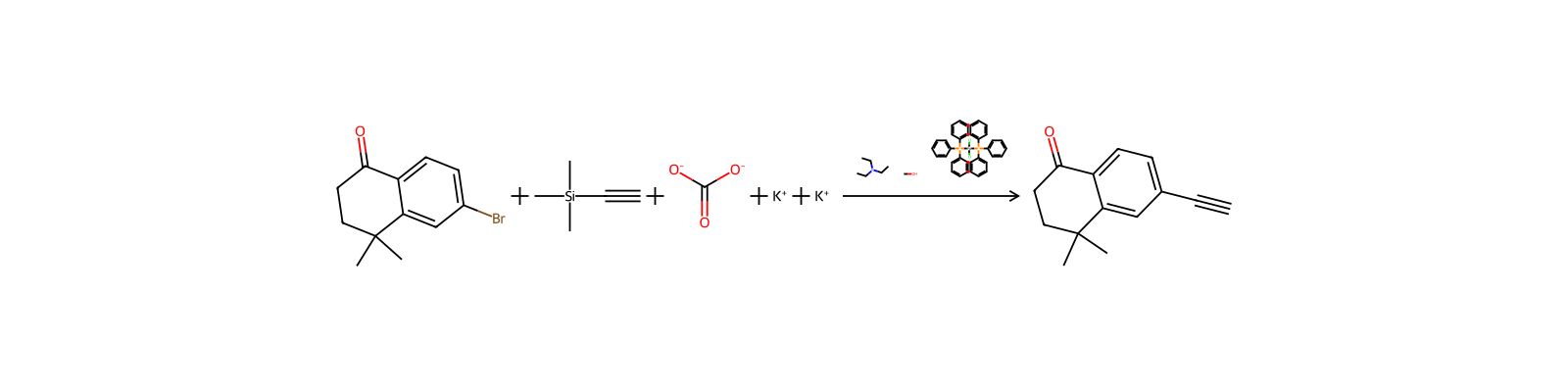
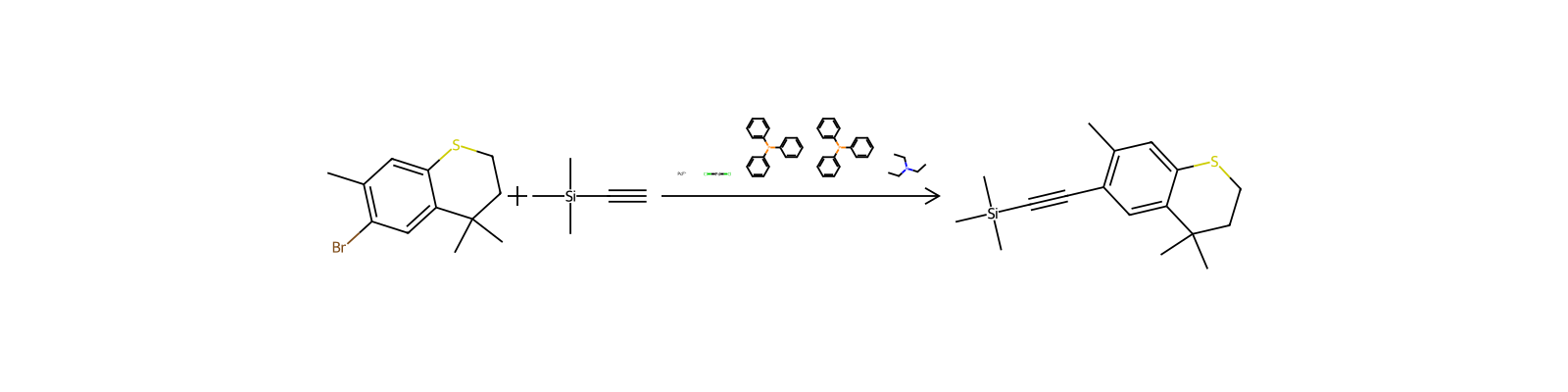
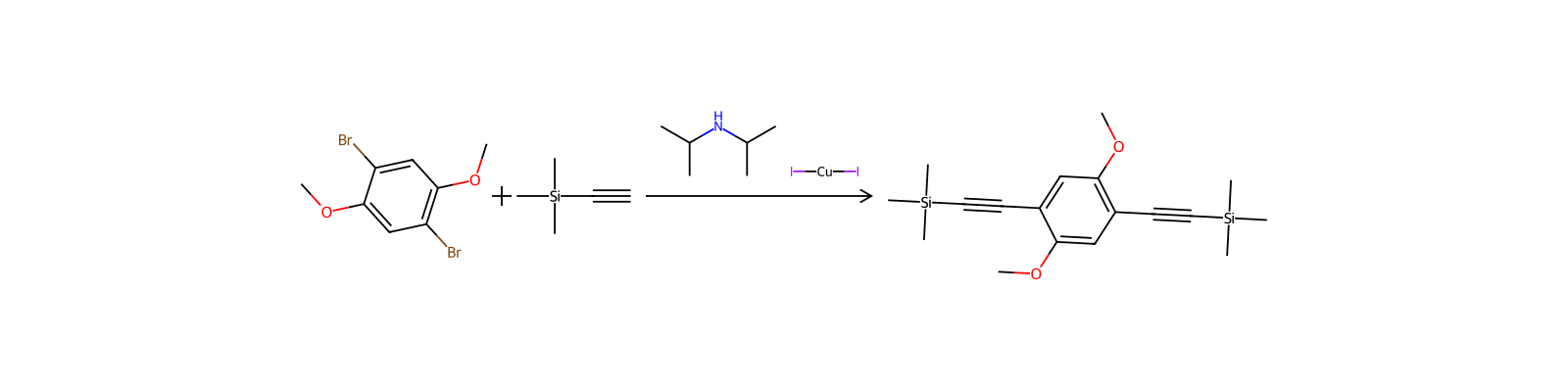
UsesEthynyltrimethylsilane was used in: microwave-assisted, one-pot, three-step Sonogashira cross-coupling-desilylation-cycloaddition reaction for the preparation of 1,4-disubstituted 1,2,3-triazoles synthesis of poly(ethynyltrimethylsilane) containing Pd (II) coordination sites pyrazole synthesis via 1,3-dipolar cycloaddition of diazo compounds to acetylenes
UsesTrimethylsilylacetylene is a valuable reagent used in ethynylation by palladium(0)-catalyzed coupling/condensation with aryl and vinyl halides and triflates, or by nucleophilic attack of the corresponding acetylide on electrophilic centers; reacts with alkyl iodides, tin hydrides,6 and dichloroketene in a regioselective and stereoselective manner, participating in the following synthesis reactions: Ethynylations, Palladium(0)-Catalyzed Coupling Reactions,Reaction of Trimethylsilylacetylides with Electrophiles, Radical-Initiated and Transition Metal-Catalyzed Additions, Cycloaddition Reactions, Ethynylations, Cycloaddition Reactions, Further Transformations etc.
Uses(Trimethylsilyl)acetylene is used in the preparation of trimethylsilanyl-propiolic acid ethyl ester by reacting with carbonochloridic acid ethyl ester as well as in the synthesis of iodoalkenes by radical addition of perfluoroalkyl iodides. It is used as a nucleophile in Friedel-Crafts type acylations and alkylations reactions, as a ligand in organometallic chemistry and an useful reagent in cycloaddition reactions. It acts as a precursor to lithium trimethylsilylacetylide It finds application in the synthesis of (±)-estrone.
General DescriptionLaser-induced polymerization of gaseous ethynyltrimethylsilane was used for efficient chemical vapour deposition of polycarbosilane films. Ethynyltrimethylsilane acts as substrate for nickel-catalyzed cross-coupling with benzonitriles.
Upstream & downstream products
Upstream raw materials
Downstream products
Suppliers50 total
国药集团化学试剂有限公司86-21-63210123 · [email protected]
梯希爱(上海)化成工业发展有限公司021-67121386 · [email protected]
衢州润东化工有限公司0570-8789886 18892685668 · [email protected]
上海阿拉丁生化科技股份有限公司400-6206333 13167063860 · [email protected]
爱斯特(成都)生物制药股份有限公司+86-28-85122536 85324413 · [email protected]
韶远科技(上海)有限公司021-50795510 4000665055 · [email protected]
科瑞迪化学400-821-5857 021-64326257 · [email protected]
Syntechem Co.,Ltd[email protected]
上海迈瑞尔生化科技有限公司4006356688 18621169109 · [email protected]
武汉易泰科技有限公司上海分公司18930552037 · [email protected]
北京东华力拓科技发展有限公司010-88425576 · [email protected]
阿法埃莎(中国)化学有限公司400-6106006 · [email protected]
南京纽安洁化工科技有限公司0515-82159099 13770142076
安耐吉化学&3A(安徽泽升科技股份有限公司)400-0056266 · [email protected]
石家庄斯迪亚诺精细化工有限公司0311-89250318 13582355795 · [email protected]
上海柏卡化学技术有限公司400-026-1533/(021) 6478-0600 · [email protected]
上海瀚鸿科技股份有限公司021-54306202 13764082696 · [email protected]
上海有德化工科技有限公司021-37910092 15821801668 · [email protected]
上海柯维化学技术有限公司021-64609169 18901607656 · [email protected]
上海萃森医药科技有限公司13472757003
上海龙云生物科技有限公司+86 (21) 33920504 · [email protected]
上海景颜化工科技有限公司13817811078 · [email protected]
嘉兴市艾森化工有限公司0573-85285100 18627885956 · [email protected]
池州捷峰生物科技有限公司0566-8928158 · [email protected]
上海西浦化工有限公司+86 (21) 6715-7650 · [email protected]
上海攀鸿化工科技有限公司021-56491756 13512199871 · [email protected]
杭州东帆化学有限公司86-0571-85151182
孝感深远化工有限公司15527621225; 15527621225 · [email protected]
山东西亚化学有限公司13355009207 13355009207 · [email protected]
四川库利南科技有限公司400-1166-196 18981987031 · [email protected]
天津希恩思生化科技有限公司400 638 7771 · [email protected]
南京斯贝源医药科技有限公司+86-25-68710855, +86-25-68710897 · [email protected]
南京维奥化工有限公司Please Send Email 18652950785 · [email protected]
常州创视电子科技有限公司+86 (519) 8829-2061 · [email protected]
河南多贝化工有限公司0370-2785118 17550508557 · [email protected]
艾科试剂4008-755-333 18080918076 · [email protected]
广州艾格生物科技有限公司86-20-28069315 28069316 · [email protected]
上海思域化工科技有限公司86-21-34053660 · [email protected]
赛默飞世尔科技(中国)有限公司800-810-5118 · [email protected]
北京伊诺凯科技有限公司400-810-7969 010-59572699 · [email protected]
上海特伯化学科技有限公司+86-21-60341587 · [email protected]
TOKYO CHEMICAL INDUSTRY CO., LTD.03-36680489 · [email protected]
上海贤鼎生物科技有限公司4009209199 · [email protected]
Shanghai MOF Chemical Tech Limited13661494087 18964793018 · [email protected]
深圳康特腾科技有限公司86-0755-86635001 · [email protected]
越林试剂021-62960152 · [email protected]
Clearsynth Labs Limited+91-22-26355700 · [email protected]
无锡中坤生化科技有限公司+86 0510-85629785
上海熙誉化学科技有限公司021-15000143735 15221126179 · [email protected]
苏州爱玛特生物科技有限公司0512-56316828 4008675858 · [email protected]
Related reactions
3,402 records





Linked notes
Loading…