Reaction equation

I[N:2]1[C:7]([OH:8])=[C:6]2[CH:9]=[C:10]([NH:12][C:13](=[O:18])[C:14]([CH3:17])([CH3:16])[CH3:15])[N:11]=[C:5]2[N:4]=[CH:3]1.[CH3:19][Si:20]([C:23]#[CH:24])([CH3:22])[CH3:21].C1(P(C2C=CC=CC=2)C2C=CC=CC=2)C=CC=CC=1.C(N(CC)CC)C>C(#N)C.[Pd](Cl)Cl>[CH3:19][Si:20]([C:23]#[C:24][N:2]1[C:7]([OH:8])=[C:6]2[CH:9]=[C:10]([NH:12][C:13](=[O:18])[C:14]([CH3:17])([CH3:16])[CH3:15])[N:11]=[C:5]2[N:4]=[CH:3]1)([CH3:22])[CH3:21]Participants
7




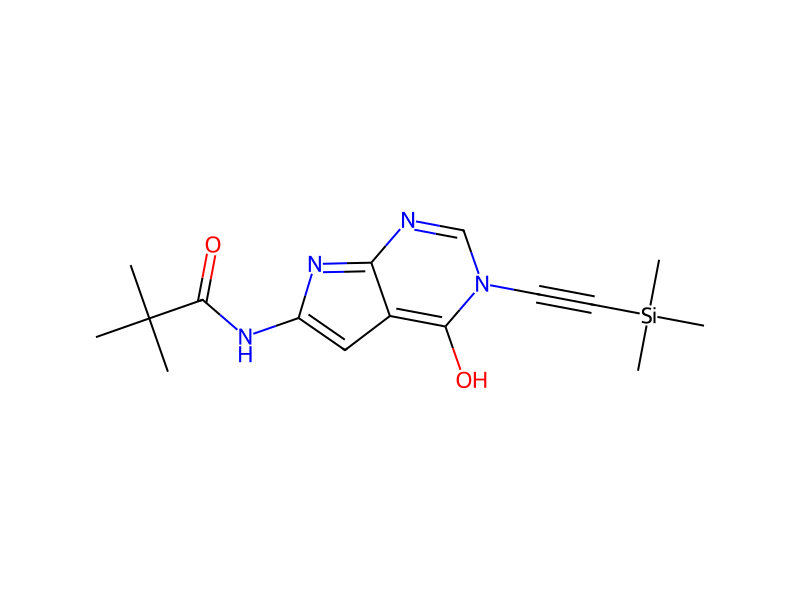


Procedure
A mixture of 2.0 g of 3-iodo-4-hydroxy-6-pivaloylaminopyrrolo[2,3-d]pyrimidine, 1.2 g. of trimethylsilylacetylene, 0.1 g of palladium chloride, 0.23 g of triphenylphosphine, 0.06 g of cuprous iodide, and 2.6 g of triethylamine in 100 mL of acetonitrile is heated in a sealed tube for 1.5 hours at 50° C. and then at reflux for 3 hours. The solvent is removed under reduced pressure and the residue triturated with 1:1 ethyl acetate:hexanes and filtered. The solid thus collected is dissolved in methylene chloride and this solution is passed through a pad of silica gel eluting with 1% methanol on methylene chloride. The eluate is concentrated to yield 3-trimethylsilylethynyl-4-hydroxy-6-pivaloylaminopyrrolo[2,3-d]pyrimidine.
Workup
- temperatureat reflux for 3 hours
- customThe solvent is removed under reduced pressure
- customthe residue triturated with 1:1 ethyl acetate
- filtrationhexanes and filtered
- customThe solid thus collected
- dissolutionis dissolved in methylene chloride
- concentrationThe eluate is concentrated
Sources & evidence
- ORD record
- ord-60b4f2f7c4364d6ea701f73a82cf4b0f
- Source dataset
- uspto-grants-1993_09
- Patent number
- US05248775
Linked notes
Loading…