
Lithium iodide
Completing data — refresh the page later to see the latest
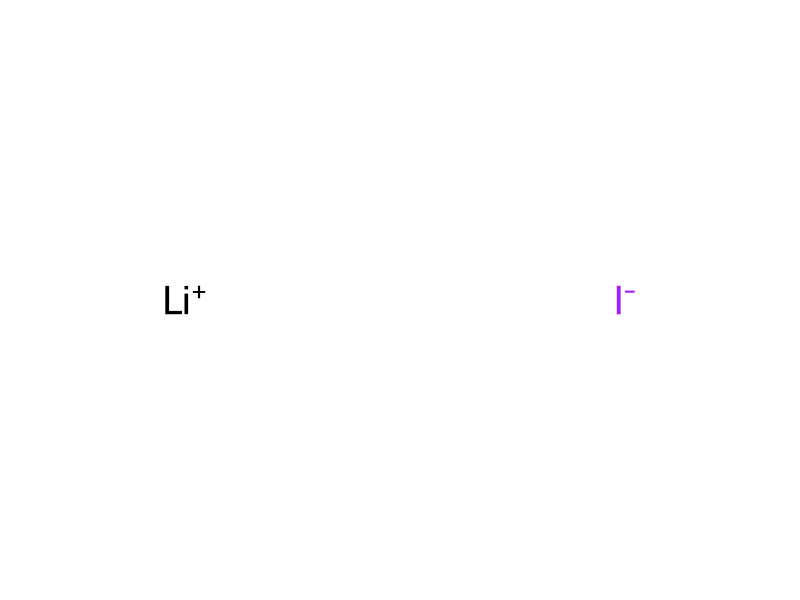
Basic information
- CAS
10377-51-2- Standard SMILES
[I-].[Li+]- InChIKey
HSZCZNFXUDYRKD-UHFFFAOYSA-M- Molecular formula
- ILi
- Average molar mass
- 133.9 g/mol
- Monoisotopic mass
- 133.92048
Names & identifiers
- Preferred name
- Lithium iodide
- IUPAC
- lithium iodide
- English name
- Lithium iodide anhydrous
- Molecular formula
- ILi
- Molecular weight
- 133.85
Names & synonyms
Lithium iodideLithium monoiodideLithium iodide (LiI)UNII-S6K2XET783S6K2XET783EINECS 233-822-5LITHIUM IODIDE [MI]DTXSID30908580RefChem:153730DTXCID301337657233-822-510377-51-2
Show more names
LiILithiumiodidTenephrolLithiumjodidithium iodideIodide lithiuMlithiumiodide(lii)lithiumiodide(bpc)
lithiumiodideLithium iodide, anhydrouslithium;iodideMFCD00011092Lithium iodide (6LiI)lLithiumiodid21752-61-4LiI.xH2O
Database identifiers
- CAS
10377-51-2、21752-61-4、29911-74-8- PubChem CID
- 66321
- DTXSID
DTXSID30908580- UNII
- S6K2XET783
- EC Number
- 233-822-5、244-572-1
- Nikkaji
- J43.854E
Properties
Computed structural propertiesFilling in
- Topological polar surface area
- 0 Ų
- Hydrogen bond donors
- 0
- Hydrogen bond acceptors
- 1
- Rotatable bonds
- 0
- Heavy atoms
- 2
- Formal charge
- 0
- Complexity
- 2
Experimental & physicochemical properties
Density4.06 @25 °C
Boiling Point1171 °C @760 [mm Hg]
Physical DescriptionTrihydrate: White, extremely hygroscopic solid; Soluble in water; [Hawley] White, light yellow, or pink odorless powder; Soluble in water; [MSDSonline]
Physicochemical properties
- Melting point
- 446 °C · 446 °C(lit.)
- Boiling point
- 1171 °C · 1171 °C
- Density
- 3.49 g/mL · 3.49 g/mL at 25 °C(lit.)
- bulk density
- 1000 kg/m3 · 1000kg/m3
- refractive index
- 1.955 · 1.955
- Flash point
- 1170 · 1170-1190°C
- storage temp.
- 30 °C · Store below +30°C.
- solubility
- 1640 g/l · 1640g/l soluble
- form
- powder
- color
- White to yellow to beige
- Specific Gravity
- 4.076 · 4.076
- Water Solubility
- Soluble in water, ethanol and acetone.
- Specific Heat Capacity
- 0.38 J/ · Cp(crystal): 0.38 J/(g·K), at 25℃
- Sensitive
- Hygroscopic
- Merck
- 14 · 14,5535
- Stability
- hygroscopic
- Major Application
- battery precursorscatalystsmaterial synthesis precursor
- InChI
- 1S/HI.Li/h1H;/q;+1/p-1
- InChIKey
- HSZCZNFXUDYRKD-UHFFFAOYSA-M
- SMILES
- [Li+].[I-]
- Indirect Additives used in Food Contact Substances
- LITHIUM IODIDE
- FDA 21 CFR
- 178.201 · 178.2010
- CAS DataBase Reference
- 10377 · 10377-51-2(CAS DataBase Reference)
- FDA UNII
- 6 K2XET783 · S6K2XET783
- EPA Substance Registry System
- Lithium iodide (10377-51-2)
- UNSPSC Code
- 12352302 · 12352302
- NACRES
- 23 · NA.23
- Symbol(GHS)
- 7 · GHS07
- Signal word
- Warning
- Hazard statements
- 315 · H315-H319
- Precautionary statements
- 264 · P264-P280a-P305+P351+P338-P321-P332+P313-P337+P313
- PPE
- 95 · dust mask type N95 (US), Eyeshields, Gloves
- Hazard Codes
- Xi
- Risk Statements
- 36 · 36/38-36/37/38-22
- Safety Statements
- 26 · 26-37/39
- WGK Germany
- 1 · 1
- F
- 3 · 3-8-10-23
- TSCA
- TSCA listed
- HS Code
- 2827600000 · 2827600000
- Storage Class
- 11 · 11 - Combustible Solids
- REACH Registrations
- Active
Safety & regulation
Safety information is for reference only and does not replace the supplier’s Safety Data Sheet (SDS), applicable regulations, or professional assessment.
GHS classification
GHS Classification
This chemical does not meet GHS hazard criteria for 17.2% (43 of 250) of reports.
Warning
H302 (14%): Harmful if swallowed [Warning Acute toxicity, oral];H315 (67.2%): Causes skin irritation [Warning Skin corrosion/irritation];H319 (72.4%): Causes serious eye irritation [Warning Serious eye damage/eye irritation];H335 (47.6%): May cause respiratory irritation [Warning Specific target organ toxicity, single exposure; Respiratory tract irritation];H400 (44%): Very toxic to aquatic life [Warning Hazardous to the aquatic environment, acute hazard]
P261, P264, P264+P265, P270, P271, P273, P280, P301+P317, P302+P352, P304+P340, P305+P351+P338, P319, P321, P330, P332+P317, P337+P317, P362+P364, P391, P403+P233, P405, and P501 (click each P-code to see the statement)
Aggregated GHS information provided per 250 reports by companies from 13 notifications to the ECHA C&L Inventory. Each notification may be associated with multiple companies.;Reported as not meeting GHS hazard criteria per 43 of 250 reports by companies.;There are 11 notifications provided by 207 of 250 reports by companies with hazard statement code(s).;Information may vary between notifications depending on impurities, additives, and other factors. The percentage value in parenthesis indicates the notified classification ratio from companies that provide hazard codes. Only hazard codes with percentage values above 10% are shown. For more detailed information, please visit ECHA C&L website.
Hazard information
Regulatory Information
Chemical: Lithium iodide (LiI)
Status: Active Update: 25-08-2022 https://echa.europa.eu/registration-dossier/-/registered-dossier/34023
Lithium iodide (LiI): Does not have an individual approval but may be used under an appropriate group standard
Other Safety InformationIMAP assessments - Lithium iodide (LiI): Human health tier I assessment
Hazards SummaryAn irritant; [MSDSonline] See Iodine for the TLV of Iodides.
Hazard Classes and Categories
Skin Irrit. 2 (100%);Eye Irrit. 2 (100%)
Acute Tox. 4 (14%);Skin Irrit. 2 (67.2%);Eye Irrit. 2 (72.4%);STOT SE 3 (47.6%);Aquatic Acute 1 (44%)
Safety & protection
Threshold Limit Values (TLV)0.01 [ppm], inhalable fraction and vapor (iodides)
Protective Action Criteria (PAC)
12 [mg/m3]
130 [mg/m3]
790 [mg/m3]
Toxicology
Adverse EffectsNeurotoxin - Other CNS neurotoxin;Nephrotoxin - The chemical is potentially toxic to the kidneys in the occupational setting.
Regulatory information
Regulatory Information
Chemical: Lithium iodide (LiI)
Status: Active Update: 25-08-2022 https://echa.europa.eu/registration-dossier/-/registered-dossier/34023
Lithium iodide (LiI): Does not have an individual approval but may be used under an appropriate group standard
Safety data
- F
- 3-8-10-23
- PPE
- dust mask type N95 (US), Eyeshields, Gloves
- wgk
- 1
- tsca
- TSCA listed
- hs_code
- 2827600000
- risk_code
- 36/38-36/37/38-22
- Signal word
- Warning
- Symbol(GHS)
- GHS07
- hazard_code
- Xi
- safety_code
- 26-37/39
- Storage Class
- 11 - Combustible Solids
- Hazard statements
- H315-H319
- REACH Registrations
- Active
- Precautionary statements
- P264-P280a-P305+P351+P338-P321-P332+P313-P337+P313
Chemistry & industry
Uses & manufacturing
Uses
Used in photography; [Merck Index] Trihydrate: Used in air conditioning and as a catalyst; [Hawley] Used in organic synthesis; [Ullmann]
Photographic Processing [Category: Other]
General Manufacturing Information
Lithium iodide (LiI): ACTIVE
Lithium iodide (6LiI): ACTIVE
Applications
DescriptionLithium iodide (chemical formula: LiI) is the compound of lithium and iodine. It can be used as an electrolyte in high-temperature batteries, long-life batteries which is required, e.g. by artificial pacemaker as well as in the electrolyte of dye-sensitized solar cells. In organic synthesis, it can be used for C-O bonds cleavage such as converting methyl esters to carboxylic acids. In addition, it can be used as a radio contrast agent for X-ray computed tomography imaging studies.
UsesLithium iodide can be used for the catalytic dehydrogenation of hydrocarbons. Oxidation of lithium iodide yields iodine which reacts with the hydrocarbon to form an organic iodide. The intermediate is dehydroiodinated to yield an olefin.For example, butane may be converted to butadiene.
UsesControls regioselectivity in palladium catalyzed allylic alkylation reactions.1
UsesIt is used as a absorbent in refrigeration process, as a catalyst, and in photography. It is also useful for organic synthesis, pessat iodination, cleavage of esters, ethers, epoxides, decarboethoxylation, carbonylation, and aldol condensation. It is used for manufacturing medicines and mineral waters. It is used in electochemicstry and redox reactions. Lithium iodide is also a catalyzed conjugate addition reaction of β-dicarbonyl compounds. It is also useful for tetrathioquinodimethane.
UsesControls regioselectivity in palladium-catalyzed allylic alkylation reactions.
Preparation methods
PreparationThe laboratory preparation of lithium iodide is carried out in much the same way as the industrial preparation. Lithium iodide is prepared by the reaction of lithium hydroxide monohydrate or lithium carbonate with hydriodic acid, which may be prepared in situ by the reduction of iodine. The iodide is usually not isolated as the anhydrous material but is used as a solution or as the solid lithium iodide trihydrate. Hydriodic acid may be prepared by the reaction of hydrogen sulfide and iodine. The hydriodic acid solution must be kept under an inert atmosphere to prevent air oxidation to iodine. After combination of the acid with the lithium compounds, the solution may be evaporated to yield lithium iodide trihydrate, LiI· 3H20. The anhydrous material may be made by extremely careful dehydration of the trihydrate under vacuum and with slow heating. The lithium iodide or its trihydrate must be handled under an inert atmosphere to avoid oxidation of the iodide ion to iodine.
PreparationThe trihydrate salt is obtained by neutralization of lithium hydroxide or lithium carbonate solution with pure hydriodic acid followed by concentration of the solution for crystallization: LiOH + HI → LiI + H2O When heated in a vacuum, the trihydrate dehydrates to anhydrous salt.
Upstream & downstream products
Downstream products
Related reactions
553 records






Compound notes
Loading…