HomeMCPWorkbenchSkills
HomeWorkbenchNotificationsMe
llms.txt · MCP GuidePrivacy Policy · Terms of Service · Supportv1.8.3
  1. Home
  2. /Compound

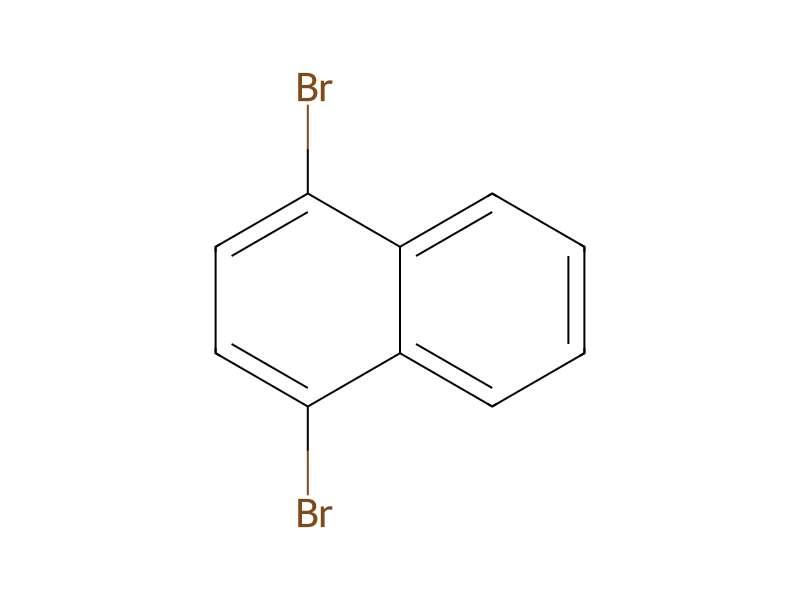
1,4-Dibromonaphthalene

HCID 66521
New reaction
Print
Basic informationNames & identifiersPropertiesSafety & regulationChemistry & industryRelated reactionsCompound notes
Substructure searchFind similar structures

Basic information

CAS
83-53-4
Standard SMILES
Brc1ccc(Br)c2ccccc12
InChIKey
IBGUDZMIAZLJNY-UHFFFAOYSA-N
Molecular formula
C10H6Br2
Average molar mass
285.96 g/mol
Monoisotopic mass
283.88363

Names & identifiers

Preferred name
1,4-Dibromonaphthalene
IUPAC
1,4-dibromonaphthalene
English name
1,4-dibromonaphthalene
Molecular formula
C10H6Br2
Molecular weight
285.96

Names & synonyms

1,4-DibromonaphthaleneNaphthalene, 1,4-dibromo-EINECS 201-484-8DTXSID6058893RefChem:73214DTXCID1048332201-484-8IBGUDZMIAZLJNY-UHFFFAOYSA-NInChI=1/C10H6Br2/c11-9-5-6-10(12)8-4-2-1-3-7(8)9/h1-683-53-4MFCD000418231,4-dibromonapthalene
Show more names
1,4-DBNSKL2521,4-DibromonaphthaL1,4-DIBROMONAPHTHALEGlycerol Impurity 58,4-dibromonaphthalene1,4-dibromonaphthylene
SCHEMBL198796CS-M3249CCG-40615SY001779SR-01000630744-11,4-dibromo-naphthalen1.4-dibromonaphthalene64FQP84RSZ

Database identifiers

CAS
83-53-4
PubChem CID
66521
DTXSID
DTXSID6058893
UNII
64FQP84RSZ
EC Number
201-484-8
Nikkaji
J32.572D

Properties

Computed structural properties

XLogP
4.8
Topological polar surface area
0 Ų
Hydrogen bond donors
0
Hydrogen bond acceptors
0
Rotatable bonds
0
Heavy atoms
12
Formal charge
0
Complexity
140

Experimental & physicochemical properties

SpringerMaterials Properties13C nuclear magnetic resonance spectrum

Physicochemical properties

Melting point
80 · 80-82 °C
Boiling point
288.1 °C · 288.1°C (rough estimate)
Density
1.8199 · 1.8199 (estimate)
vapor pressure
0 · 0-93.326Pa at 25℃
refractive index
1.6 · 1.6000 (estimate)
storage temp.
Sealed in dry,Room Temperature
solubility
Chloroform, DMSO (Slightly), Methanol (Slightly)
form
Crystalline Powder or Crystals
color
White to light beige
Water Solubility
347.9 ug/L · 347.9ug/L(25 ºC)
Henry's Law Constant
5.8 · 5.8×10-2 mol/(m3Pa) at 25℃, Ebert et al. (2023)

Safety & regulation

Safety information is for reference only and does not replace the supplier’s Safety Data Sheet (SDS), applicable regulations, or professional assessment.

GHS classification

GHS Classification · 4 items

Warning

H315 (69.2%): Causes skin irritation [Warning Skin corrosion/irritation]

P261, P264, P264+P265, P271, P280, P302+P352, P304+P340, P305+P351+P338, P319, P321, P332+P317, P337+P317, P362+P364, P403+P233, P405, and P501 (click each P-code to see the statement)

Aggregated GHS information provided per 13 reports by companies from 8 notifications to the ECHA C&L Inventory. Each notification may be associated with multiple companies.

Hazard information

Regulatory InformationREACH registered substance: 1,4-dibromonaphthalene (EC: 201-484-8)
Hazard Classes and CategoriesSkin Irrit. 2 (69.2%)

Safety data

tsca
TSCA listed
hs_code
2903999090
risk_code
36/37/38
Signal word
Warning
Symbol(GHS)
GHS07
hazard_code
Xi
safety_code
24/25-26
hazard_class
IRRITANT
Hazard statements
H315-H319-H335
REACH Registrations
Active
Precautionary statements
P261-P280a-P304+P340-P305+P351+P338-P405-P501a-P264-P280-P302+P352+P332+P313+P362+P364-P305+P351+P338+P337+P313

Chemistry & industry

Uses & manufacturing

General Manufacturing InformationNaphthalene, 1,4-dibromo-: ACTIVE

Applications

Uses1,4-Dibromonaphthalene is used in the annelation of PAHs. Also used in the synthesis of novel, orally active dual NK1/NK2 antagonists.

Preparation methods · 1 item

PreparationAn environment-friendly method was developed to synthesize 1,4-dibromonaphthalene (1,4-DBN) using 1,3-dialkylimidazolium and pyridinium ionic liquids as catalysts, over which the yields of 1,4-DBN were obtained as high as 100%.An environment-friendly method for synthesis of 1,4-dibromo-naphthalene in aqueous solution of ionic liquids

Upstream & downstream products

Upstream raw materials

Methanesulfonic acid, 1,1,1-trifluoro-, 4-chloro-1-naphthalenyl ester1,4-Dichloronaphthalene1-Bromo-4-chloronaphthalene

Downstream products

1,4-Dicyanonaphthalene1,4-Diaminonaphthalene9-(4-Bromonaphthalen-1-yl)-9H-carbazole1-(1-Bromonaphthalen-4-yl)ethanone

Related reactions

40 records
New reaction record
HRID 45776 reaction equation
HRID 45776As reactant
HRID 166688 reaction equation
HRID 166688As reactant
HRID 182805 reaction equation
HRID 182805As reactant
HRID 279423 reaction equation
HRID 279423As reactant
HRID 285756 reaction equation
HRID 285756As reactant
HRID 403065 reaction equation
HRID 403065As reactant
HRID 403068 reaction equation
HRID 403068As reactant
HRID 447689 reaction equation
HRID 447689As reactant
PreviousPage 1 of 5

Compound notes

On this pageBasic informationNames & identifiersPropertiesSafety & regulationChemistry & industryRelated reactionsCompound notes
InChI
InChI=1S/C10H6Br2/c11-9-5-6-10(12)8-4-2-1-3-7(8)9/h1-6H
InChIKey
IBGUDZMIAZLJNY-UHFFFAOYSA-N
SMILES
C1(Br)=C2C(C=CC=C2)=C(Br)C=C1
LogP
4.95 · 4.95-5.02
CAS DataBase Reference
83 · 83-53-4(CAS DataBase Reference)
EPA Substance Registry System
1 · Naphthalene, 1,4-dibromo- (83-53-4)
Symbol(GHS)
7 · GHS07
Signal word
Warning
Hazard statements
315 · H315-H319-H335
Precautionary statements
261 · P261-P280a-P304+P340-P305+P351+P338-P405-P501a-P264-P280-P302+P352+P332+P313+P362+P364-P305+P351+P338+P337+P313
Hazard Codes
Xi
Risk Statements
36 · 36/37/38
Safety Statements
24 · 24/25-26
TSCA
TSCA listed
HazardClass
IRRITANT
HS Code
2903999090 · 2903999090
REACH Registrations
Active
1-broMo-4-phthaldehyde
1,4-Naphthalenedicarboxylic acid