Reaction equation

[Br:1][C:2]1[C:11]2[C:6](=[CH:7][CH:8]=[CH:9][CH:10]=2)[C:5](Br)=[CH:4][CH:3]=1.[Li]CCCC.[I:18]I.OS([O-])=O.[Na+]>C1COCC1>[I:18][C:5]1[C:6]2[C:11](=[CH:10][CH:9]=[CH:8][CH:7]=2)[C:2]([Br:1])=[CH:3][CH:4]=1Participants
Reactant 4

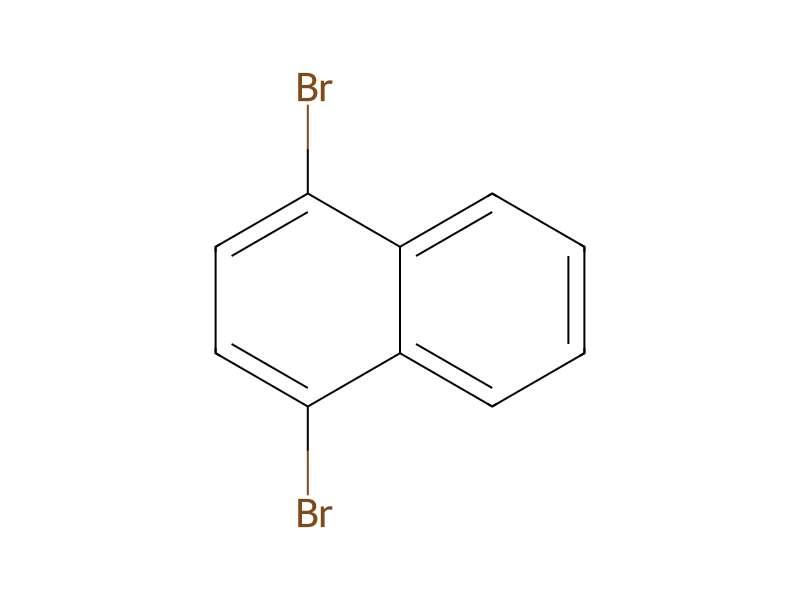


Product 1

Reagents, catalysts & solvents 1

Conditions
- Temperature
- -70 °C
Procedure
100 g (350 mmol) of 1,4-dibromonaphthalene are initially introduced in 1 l of THF, cooled to −70° C., and 235 ml of n-BuLi (1.6 M in hexane, 370 mmol) are added dropwise. After 1 h, 103 g of I2 (406 mmol) in 250 ml of THF are added dropwise, the mixture is stirred at −70° C. for a further 2 h, warmed to 0° C. and quenched by the addition of 50 ml (644 mmol) of aqueous NaHSO3 solution (w=39%). The phases are separated, and the aqueous phase is extracted once with MTB. The combined organic phases are washed with saturated sodium chloride solution, dried over sodium sulfate, filtered and evaporated in a rotary evaporator. The residue is purified by column chromatography (SiO2, heptane), and the further purification is carried out by recrystallisation from isopropanol, giving 1-iodo-4-bromonaphthalene as a yellow solid.
Workup
- temperaturewarmed to 0° C.
- customThe phases are separated
- extractionthe aqueous phase is extracted once with MTB
- washThe combined organic phases are washed with saturated sodium chloride solution
- dry with materialdried over sodium sulfate
- filtrationfiltered
- customevaporated in a rotary evaporator
- customThe residue is purified by column chromatography (SiO2, heptane)
- customthe further purification
- customis carried out by recrystallisation from isopropanol
Sources & evidence
- ORD record
- ord-3d0b8e4d202d4c0daf61019d5cc40b59
- Source dataset
- uspto-grants-2014_06
- Patent number
- US08747695B2
Linked notes
Loading…