
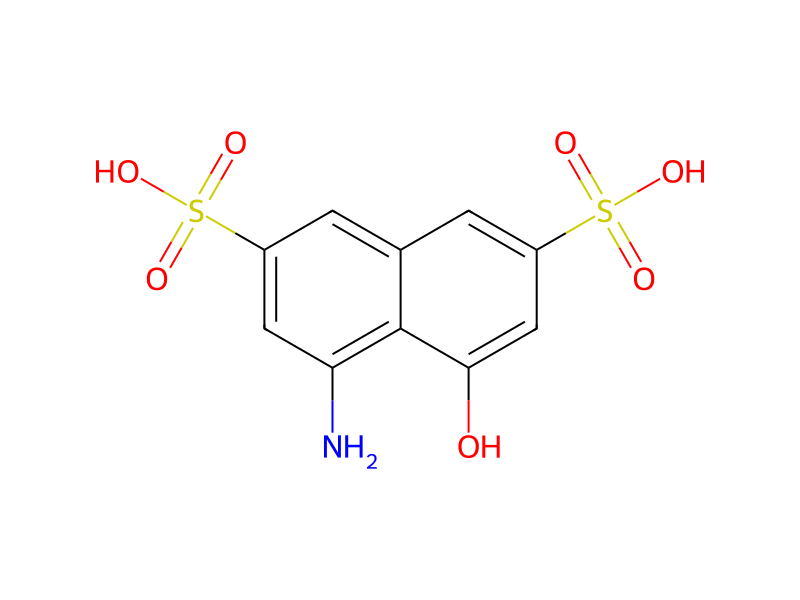
Basic information
- Standard SMILES
Nc1cc(S(=O)(=O)O)cc2cc(S(=O)(=O)O)cc(O)c12- InChIKey
APRRQJCCBSJQOQ-UHFFFAOYSA-N- Molecular formula
- C10H9NO7S2
- Average molar mass
- 319.3 g/mol
- Monoisotopic mass
- 318.98204397
Names & identifiers
- Preferred name
- H acid
- IUPAC
- 4-amino-5-hydroxynaphthalene-2,7-disulfonic acid
- English name
- 2,7-Naphthalenedisulfonic acid, 4-amino-5-hydroxy-, diazotized, coupled with diazotized 2-[(4-aminophenyl)amino]-5-nitrobenzenesulfonic acid, diazotized 4-nitrobenzenamine and resorcinol, potassium sodium salts
- Molecular weight
- 0
Names & synonyms
90-20-04-Amino-5-hydroxy-2,7-naphthalenedisulfonic acidH acid2,7-NAPHTHALENEDISULFONIC ACID, 4-AMINO-5-HYDROXY-1-Amino-8-naphthol-3,6-disulfonic acid1-Naphthol-8-amino-3,6-disulfonic acidC.I. 355704WUM31ES4USULFONPHTHOLNSC-190492RefChem:4350271-amino-8-nephthol-2, 2'-disulfonic acid
Show more names
2,7-Naphthalenedisulfonic acid, 4-amino-5-hydroxy-, diazotized, coupled with diazotized 2-(4-aminophenyl)amino-5-nitrobenzenesulfonic acid, diazotized 4-nitrobenzenamine and resorcinol, potassium sodium salts
201-975-74-amino-5-hydroxynaphthalene-2,7-disulfonic acidH-Acid1-Amino-8-hydroxynaphthalene-3,6-disulphonic acidKyselina HMFCD000357284-amino-5-hydroxy-naphthalene-2,7-disulfonic acidCHEMBL60494
Database identifiers
- CAS
90-20-0、90431-97-3、90432-00-1、98072-99-2- PubChem CID
- 7009
- DTXSID
DTXSID0046981- ChEMBL
CHEMBL60494- UNII
- 4WUM31ES4U
- EC Number
- 201-975-7、291-627-0、291-630-7、308-556-9
- Nikkaji
- J3.554H
Properties
Computed structural properties
- XLogP
- 0.2
- Topological polar surface area
- 172 Ų
- Hydrogen bond donors
- 4
- Hydrogen bond acceptors
- 8
- Rotatable bonds
- 2
- Heavy atoms
- 20
- Formal charge
- 0
- Complexity
- 561
Experimental & physicochemical properties
Physical DescriptionDry Powder
Safety & regulation
GHS classification
GHS Classification
This chemical does not meet GHS hazard criteria for 1.3% (2 of 150) of reports.
Danger
H302+H332 (69.3%): Harmful if swallowed or if inhaled [Warning Acute toxicity, oral; acute toxicity, inhalation];H302 (69.3%): Harmful if swallowed [Warning Acute toxicity, oral];H314 (26.7%): Causes severe skin burns and eye damage [Danger Skin corrosion/irritation];H315 (72%): Causes skin irritation [Warning Skin corrosion/irritation];H319 (72%): Causes serious eye irritation [Warning Serious eye damage/eye irritation];H332 (69.3%): Harmful if inhaled [Warning Acute toxicity, inhalation];H335 (72%): May cause respiratory irritation [Warning Specific target organ toxicity, single exposure; Respiratory tract irritation]
P260, P261, P264, P264+P265, P270, P271, P280, P301+P317, P301+P330+P331, P302+P352, P302+P361+P354, P304+P340, P305+P351+P338, P305+P354+P338, P316, P317, P319, P321, P330, P332+P317, P337+P317, P362+P364, P363, P403+P233, P405, and P501 (click each P-code to see the statement)
Aggregated GHS information provided per 150 reports by companies from 5 notifications to the ECHA C&L Inventory. Each notification may be associated with multiple companies.;Reported as not meeting GHS hazard criteria per 2 of 150 reports by companies.;There are 4 notifications provided by 148 of 150 reports by companies with hazard statement code(s).;Information may vary between notifications depending on impurities, additives, and other factors. The percentage value in parenthesis indicates the notified classification ratio from companies that provide hazard codes. Only hazard codes with percentage values above 10% are shown. For more detailed information, please visit ECHA C&L website.
Hazard information
Regulatory Information
Chemical: 2,7-Naphthalenedisulfonic acid, 4-amino-5-hydroxy-
Chemical: 2,7-Naphthalenedisulfonic acid, 4-amino-5-hydroxy-, diazotized, coupled with diazotized 2-[(4-aminophenyl)amino]-5-nitrobenzenesulfonic acid, diazotized 4-nitrobenzenamine and resorcinol, potassium sodium salts
2,7-Naphthalenedisulfonic acid, 4-amino-5-hydroxy- is listed on the EPA's Chemical Data Reporting (CDR) system. Manufacturers and importers of 2,7-Naphthalenedisulfonic acid, 4-amino-5-hydroxy- are required to report information about their production and use of this chemical to the EPA under the Toxic Substances Control Act (TSCA). (40 eCFR Part 711)
Status: Active Update: 13-03-2013 https://echa.europa.eu/registration-dossier/-/registered-dossier/11150
2,7-Naphthalenedisulfonic acid, 4-amino-5-hydroxy-, diazotized, coupled with diazotized 2-(4-aminophenyl)amino-5-nitrobenzenesulfonic acid, diazotized 4-nitrobenzenamine and resorcinol, potassium sodium salts: Does not have an individual approval but may be used as a component in a product covered by a group standard. It is not approved for use as a chemical in its own right.
Other Safety Information
IMAP assessments - 2,7-Naphthalenedisulfonic acid, 4-amino-5-hydroxy-, diazotized, coupled with diazotized 2-[(4-aminophenyl)amino]-5-nitrobenzenesulfonic acid, diazotized 4-nitrobenzenamine and resorcinol, potassium sodium salts: Human health tier I assessment
Hazard Classes and CategoriesAcute Tox. 4 (69.3%);Skin Corr. 1B (26.7%);Skin Irrit. 2 (72%);Eye Irrit. 2 (72%);Acute Tox. 4 (69.3%);STOT SE 3 (72%)
Regulatory information
Regulatory Information
Chemical: 2,7-Naphthalenedisulfonic acid, 4-amino-5-hydroxy-
Chemical: 2,7-Naphthalenedisulfonic acid, 4-amino-5-hydroxy-, diazotized, coupled with diazotized 2-[(4-aminophenyl)amino]-5-nitrobenzenesulfonic acid, diazotized 4-nitrobenzenamine and resorcinol, potassium sodium salts
2,7-Naphthalenedisulfonic acid, 4-amino-5-hydroxy- is listed on the EPA's Chemical Data Reporting (CDR) system. Manufacturers and importers of 2,7-Naphthalenedisulfonic acid, 4-amino-5-hydroxy- are required to report information about their production and use of this chemical to the EPA under the Toxic Substances Control Act (TSCA). (40 eCFR Part 711)
Status: Active Update: 13-03-2013 https://echa.europa.eu/registration-dossier/-/registered-dossier/11150
2,7-Naphthalenedisulfonic acid, 4-amino-5-hydroxy-, diazotized, coupled with diazotized 2-(4-aminophenyl)amino-5-nitrobenzenesulfonic acid, diazotized 4-nitrobenzenamine and resorcinol, potassium sodium salts: Does not have an individual approval but may be used as a component in a product covered by a group standard. It is not approved for use as a chemical in its own right.
Chemistry & industry
Uses & manufacturing
U.S. Production2023: 67,929 lb;2022: 114,088 lb;2021: 146,824 lb;2020: 181,550 lb
General Manufacturing Information2,7-Naphthalenedisulfonic acid, 4-amino-5-hydroxy-: ACTIVE
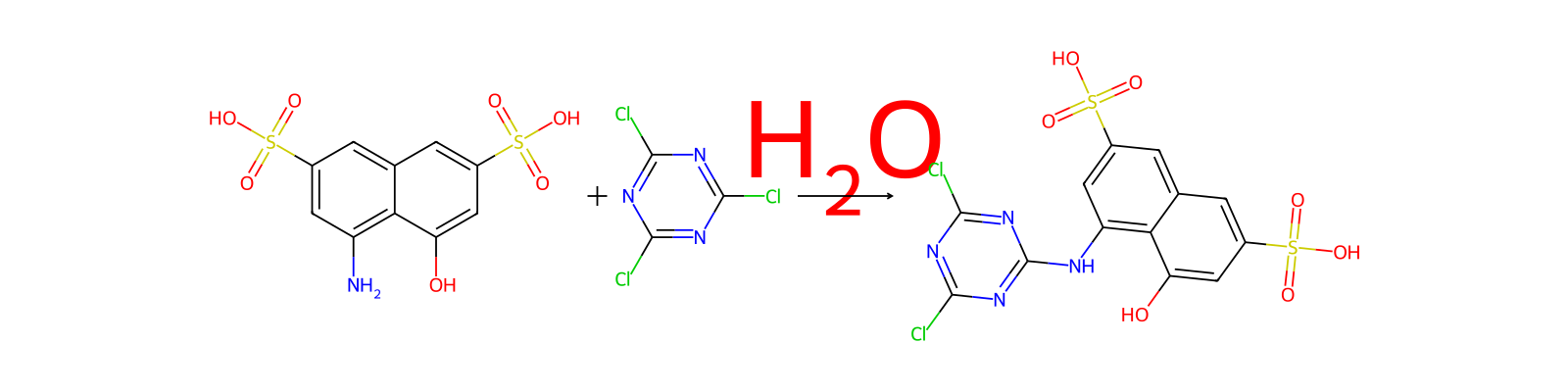
Related reactions
18 records






Linked notes
Loading…