
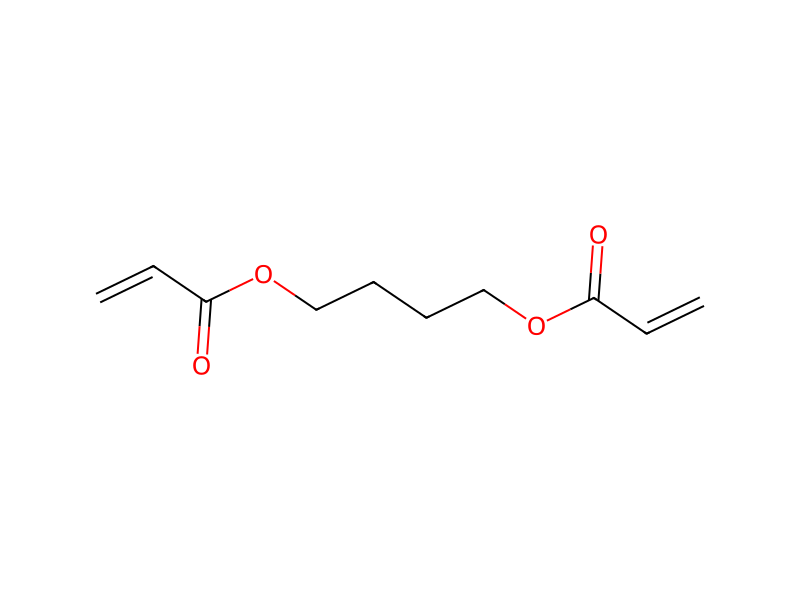
Basic information
- Standard SMILES
C=CC(=O)OCCCCOC(=O)C=C- InChIKey
JHWGFJBTMHEZME-UHFFFAOYSA-N- Molecular formula
- C10H14O4
- Average molar mass
- 198.22 g/mol
- Monoisotopic mass
- 198.08920893
Overview
RN given is for 1,4-butanediol diacrylate; structure
Names & identifiers
- Preferred name
- Butanediol diacrylate
- IUPAC
- 4-prop-2-enoyloxybutyl prop-2-enoate
- English name
- 1,4-Butanediol diacrylate
- Molecular formula
- C10H14O4
- Molecular weight
- 198.22
Names & synonyms
1,4-Butanediol diacrylate1070-70-8Butylene diacrylateTetramethylene glycol diacrylateButanediol diacrylate1,4-Butanediyl diacrylate52277-33-5Acrylic acid, tetramethylene ester2-Propenoic acid, 1,4-butanediyl esterCCRIS 7042DTXSID60447792-Propenoic acid, 1,1'-(1,4-butanediyl) ester
Show more names
BDDA1,4-Butylene diacrylateButane-1,4-diyl diacrylate1,4-butylenediacrylateTetramethylene acrylate1,4-BIS(ACRYLOYLOXY)BUTANEsr213butylenediacrylatebutanedioldiacrylate
EINECS 213-979-6SR 213BRN 177748753P6JR1A3RLAROMER BDDA2-Propenoic acid, butanediol diesterVISCOAT 195VISCOAT V 195
Database identifiers
- CAS
1070-70-8、31442-13-4、52277-33-5- PubChem CID
- 70613
- DTXSID
DTXSID6044779- ChEMBL
CHEMBL3182145- UNII
- 53P6JR1A3R
- EC Number
- 213-979-6、825-520-2
- Nikkaji
- J82.104G
Properties
Computed structural properties
- XLogP
- 1.9
- Topological polar surface area
- 52.6 Ų
- Hydrogen bond donors
- 0
- Hydrogen bond acceptors
- 4
- Rotatable bonds
- 9
- Heavy atoms
- 14
- Formal charge
- 0
- Complexity
- 196
Experimental & physicochemical properties
Physical DescriptionLiquid
Physicochemical properties
- Melting point
- -7 °C · -7°C
- Boiling point
- 83 °C/0.3 · 83 °C/0.3 mmHg (lit.)
- Density
- 1.051 g/mL · 1.051 g/mL at 25 °C (lit.)
- vapor pressure
- 0.83 hPa · 0.83 hPa (80 °C)
- refractive index
- 20 · n20/D 1.456(lit.)
- Flash point
- 230 °F · >230 °F
- storage temp.
- 2 · 2-8°C
- solubility
- 16.3 g/l · 16.3g/l
- form
- Liquid
- color
- Colorless
- Specific Gravity
- 1.055 · 1.055-1.105
- explosive limit
- 1.3 · 1.3-7%(V)
- Viscosity
- 8 cp · 8 cp (25C)
- Water Solubility
- Immiscible with water.
- InChI
- 1S/C10H14O4/c1-3-9(11)13-7-5-6-8-14-10(12)4-2/h3-4H,1-2,5-8H2
- InChIKey
- JHWGFJBTMHEZME-UHFFFAOYSA-N
- SMILES
- C=CC(=O)OCCCCOC(=O)C=C
- LogP
- 1.9 at · 1.9 at 23℃
- CAS DataBase Reference
- 1070 · 1070-70-8(CAS DataBase Reference)
- EWG's Food Scores
- 2 · 2
- FDA UNII
- 53 P6JR1A3R · 53P6JR1A3R
- EPA Substance Registry System
- 1 · 1,4-Butanediol diacrylate (1070-70-8)
- UNSPSC Code
- 12162002 · 12162002
- NACRES
- 23 · NA.23
- Symbol(GHS)
- 5 · GHS05,GHS06
- Signal word
- Danger
- Hazard statements
- 302 · H302+H332-H311-H314-H317-H412
- Precautionary statements
- 273 · P273-P280-P301+P312-P303+P361+P353-P304+P340+P310-P305+P351+P338
- Hazard Codes
- C
- Risk Statements
- 21 · 21-34-43-23
- Safety Statements
- 26 · 26-36/37/39-45
- RIDADR
- 1760 · UN 1760 8/PG 2
- WGK Germany
- 1 · 1
- RTECS
- 3130000 · UD3130000
- Autoignition Temperature
- 285 °C · 285 °C
- TSCA
- TSCA listed
- HS Code
- 2916 · 2916 12 00
- HazardClass
- 8 · 8
- PackingGroup
- II
- Storage Class
- 6.1 A · 6.1A - Combustible acute toxic Cat. 1 and 2very toxic hazardous materials
- Hazard Classifications
- 3 DermalAcute · Acute Tox. 3 DermalAcute Tox. 4 InhalationAcute Tox. 4 OralAquatic Chronic 3Eye Dam. 1Skin Corr. 1BSkin Sens. 1A
- Toxicity
- 50 · mouse,LD50,oral,1gm/kg (1000mg/kg),Gigiena i Sanitariya. For English translation, see HYSAAV. Vol. 55(6), Pg. 86, 1990.
- REACH Registrations
- Active
Safety & regulation
GHS classification
GHS Classification
Danger
H312: Harmful in contact with skin [Warning Acute toxicity, dermal]
P260, P261, P264, P272, P280, P301+P330+P331, P302+P352, P302+P361+P354, P304+P340, P305+P354+P338, P316, P317, P321, P333+P317, P362+P364, P363, P405, and P501 (click each P-code to see the statement)
Danger
H302 (59.2%): Harmful if swallowed [Warning Acute toxicity, oral]
P260, P261, P262, P264, P264+P265, P270, P271, P272, P273, P280, P301+P317, P301+P330+P331, P302+P352, P302+P361+P354, P304+P340, P305+P351+P338, P305+P354+P338, P316, P317, P321, P330, P333+P317, P337+P317, P361+P364, P362+P364, P363, P405, and P501 (click each P-code to see the statement)
Hazard information
Regulatory Information
Chemical: Poly(oxy-1,4-butanediyl), .alpha.-(1-oxo-2-propenyl)-.omega.-[(1-oxo-2-propenyl)oxy]-
Chemical: 2-Propenoic acid, 1,4-butanediyl ester
2-Propenoic acid, 1,1'-(1,4-butanediyl) ester is listed on the EPA's Chemical Data Reporting (CDR) system. Manufacturers and importers of 2-Propenoic acid, 1,1'-(1,4-butanediyl) ester are required to report information about their production and use of this chemical to the EPA under the Toxic Substances Control Act (TSCA). (40 eCFR Part 711)
FRI - indicates a polymeric substance containing no free-radical initiator in its Inventory name but is considered to cover the designated polymer made with any free-radical initiator regardless of the amount used.
Status: Active Update: 22-05-2018 https://echa.europa.eu/registration-dossier/-/registered-dossier/25214
1,4-Butanediol diacrylate: Does not have an individual approval but may be used under an appropriate group standard
Hazard Classes and Categories
Acute Tox. 4 (59.2%)
Skin Irrit. 2 (100%)
Acute toxicity - category 4
Acute Tox. 4 *
Safety data
- wgk
- 1
- tsca
- TSCA listed
- rtecs
- UD3130000
- ridadr
- UN 1760 8/PG 2
- hs_code
- 2916 12 00
- Toxicity
- mouse,LD50,oral,1gm/kg (1000mg/kg),Gigiena i Sanitariya. For English translation, see HYSAAV. Vol. 55(6), Pg. 86, 1990.
- risk_code
- 21-34-43-23
- Signal word
- Danger
- Symbol(GHS)
- GHS05,GHS06
- hazard_code
- C
- safety_code
- 26-36/37/39-45
- hazard_class
- 8
- Storage Class
- 6.1A - Combustible acute toxic Cat. 1 and 2very toxic hazardous materials
- packing_group
- II
- Hazard statements
- H302+H332-H311-H314-H317-H412
- REACH Registrations
- Active
- Hazard Classifications
- Acute Tox. 3 DermalAcute Tox. 4 InhalationAcute Tox. 4 OralAquatic Chronic 3Eye Dam. 1Skin Corr. 1BSkin Sens. 1A
- Autoignition Temperature
- 285 °C
- Precautionary statements
- P273-P280-P301+P312-P303+P361+P353-P304+P340+P310-P305+P351+P338
Chemistry & industry
Uses & manufacturing
U.S. Production2023: <50,000 lb
Consumer UsesMonomers
Industry UsesMonomers
General Manufacturing Information
Miscellaneous Manufacturing
2-Propenoic acid, 1,1'-(1,4-butanediyl) ester: ACTIVE
2-Propenoic acid, diester with butanediol: INACTIVE
Poly(oxy-1,4-butanediyl), .alpha.-(1-oxo-2-propen-1-yl)-.omega.-[(1-oxo-2-propen-1-yl)oxy]-: ACTIVE
Applications
DescriptionA positive patch test was observed in a male process worker in a paint factory, sensitized to an epoxy diacrylate (1,4-butanediol diacrylate) contained in raw materials of UV -light-curable paint. The positive reaction was probably due to a cross reactivity.
Usescross-linking monomer for use in inks, adhesives, textile product modifiers, photo resists, etc.
Uses1,4-Butanediol diacrylate is used as a multifunctional crosslinker. It is used in drying technology for paintings, coatings, inks, resins and adhesives. It serves as an intermediate product for polymer synthesis in the chemical industry.
Uses1,4-Butanediol diacrylate may be used as a multifunctional crosslinker.
Upstream & downstream products
Upstream raw materials
Downstream products
Suppliers50 total
梯希爱(上海)化成工业发展有限公司021-67121386 · [email protected]
湖北永阔科技有限公司027-59223108 15972152991 · [email protected]
上海阿拉丁生化科技股份有限公司400-6206333 13167063860 · [email protected]
湖北万得化工有限公司15377098680 15377098680 · [email protected]
武汉欣扬瑞和化学科技有限公司13720274133 · [email protected]
武汉欣扬瑞和化学科技有限公司153-07155313 15307155313 · [email protected]
河北创海生物科技有限公司+86-86-13131129325 · [email protected]
Dayang Chem (Hangzhou) Co.,Ltd.+86-0571-88938639 17705817739 · [email protected]
上海迈瑞尔生化科技有限公司4006356688 18621169109 · [email protected]
北京华威锐科化工有限公司0757-86329057 18934348241 · [email protected]
阿法埃莎(中国)化学有限公司400-6106006 · [email protected]
上海德默医药科技有限公司400-021-7337 2355568890 · [email protected]
安耐吉化学&3A(安徽泽升科技股份有限公司)400-0056266 · [email protected]
广东云星生物技术有限公司0751-18902340975/189023400307 18902340307 · [email protected]
上海瀚鸿科技股份有限公司021-54306202 13764082696 · [email protected]
上海钰康生物科技有限公司+86-18930848214 +86-021-56762820 · [email protected]
湖北广奥生物科技有限公司027-02702759223056 18162699093 · [email protected]
武汉丰泰威远科技有限公司027-87465837 19945049750 · [email protected]
山东西亚化学有限公司13355009207 13355009207 · [email protected]
玛雅试剂+86 (573) 82222445 (0)18006601000 452520369 · [email protected]
四川库利南科技有限公司400-1166-196 18981987031 · [email protected]
Xiamen AmoyChem Co., Ltd+86-86-5926051114 · [email protected]
Syntor Fine Chemicals Ltd.+44 (0) 1928 579865 · [email protected]
TCI AMERICA800-4238616 · [email protected]
TOKYO CHEMICAL INDUSTRY CO., LTD.03-36680489 · [email protected]
TCI Europe320-37350700 · [email protected]
广州吉昕泰新材料科技有限公司13710082414 13924128221 · [email protected]
北京奥秘佳得医药科技有限公司+86-13522808617 · [email protected]
成都零六生物科技有限公司400-1166-196 13458535857 · [email protected]
杭州宇昊化工科技有限公司0571-82693216 · [email protected]
上海麦克林生化科技股份有限公司15221275939 15221275939 · [email protected]
杭州杰恒化工有限公司0571-87396432 · [email protected]
Sigma-Aldrich西格玛奥德里奇(上海)贸易有限公司021-61415566 800-8193336 · [email protected]
康迪斯化工(湖北)有限公司13343438265 · [email protected]
九鼎化学(上海)科技有限公司4009209199 · [email protected]
Henan Alfa Chemical Co., Ltd+8618339805032 · [email protected]
广东翁江化学试剂有限公司0751-2815987 13927875076 · [email protected]
厦门志信化学有限公司+86-5922680277 +86-13806087780 · [email protected]
广东翁江化学试剂有限公司0751-2886766 13927870850 · [email protected]
上海玻尔化学试剂有限公司19102157732 · [email protected]
上海珈得尔化学技术有限公司021-4007787-550 400-7787-550 · [email protected]
北京华威锐科化工科技有限公司89508211 18501085097 · [email protected]
上海炎泽化工有限公司15345144255 19901447308 · [email protected]
上海源叶生物科技有限公司13636370518 · [email protected]
武汉市承天精细化工有限公司18164098996 · [email protected]
湖北齐飞医药化工有限公司027-59322506 18071128681 · [email protected]
武汉克米克生物医药技术有限公司027-13163388153 13163388153 · [email protected]
山东西亚化学有限公司4009903999 13395398332 · [email protected]
成都华纯科技有限公司400-1166-196 15982826727 · [email protected]
武汉卡诺斯科技有限公司18064039730 · [email protected]
Related reactions
1 records
Linked notes
Loading…