
Sodium Citrate Dihydrate
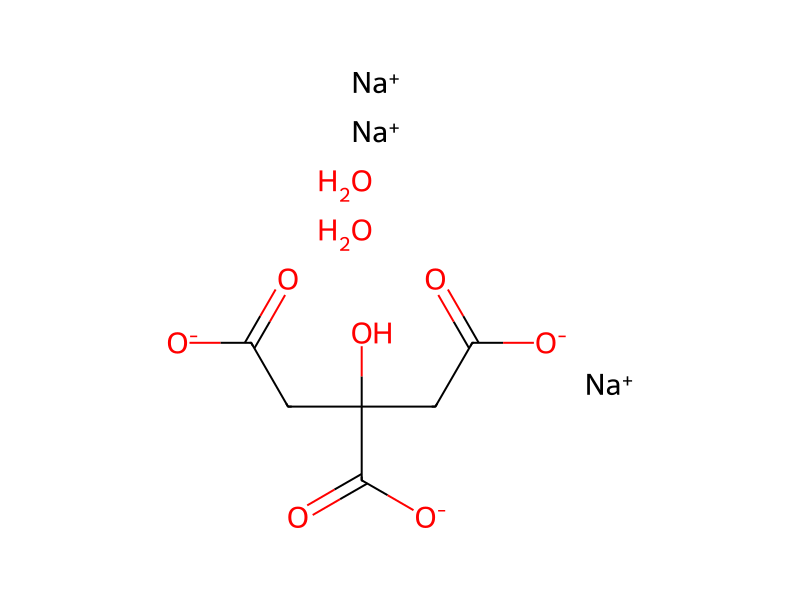
Basic information
- CAS
6132-04-3- Standard SMILES
O.O.O=C([O-])CC(O)(CC(=O)[O-])C(=O)[O-].[Na+].[Na+].[Na+]- InChIKey
NLJMYIDDQXHKNR-UHFFFAOYSA-K- Molecular formula
- C6H9Na3O9
- Average molar mass
- 294.1 g/mol
- Monoisotopic mass
- 293.99396471
Overview
Sodium citrate dihydrate is the dihydrate of trisodium citrate. It has a role as an anticoagulant. It contains a sodium citrate.
Names & identifiers
- Preferred name
- Sodium Citrate Dihydrate
- IUPAC
- trisodium;2-hydroxypropane-1,2,3-tricarboxylate;dihydrate
- English name
- Trisodium citrate dihydrate
- Molecular formula
- C6H9Na3O9
- Molecular weight
- 294.1
Names & synonyms
Trisodium citrate dihydrateSodium citrate dihydrate6132-04-3Sodium citrate hydrateB22547B95KCitric acid, trisodium salt, dihydrateSodium citrate hydrousEmetrol Chewables OrangeNauzeneDTXSID1049437CHEBI:32142N-1560
Show more names
CITRIC ACID MONOSODIUM CITRATE TRIBASIC DIHYDRATETRI-SODIUM CITRATE DIHYDRATESODIUM CITRATE, DIHYDRATESodiuM Citrate (AS)SODIUM CITRATE TRISODIUM SALT DIHYDRATENATRII CITRASTRI-SODIUM CITRATE 2H2OSodiumCitrateTribasicUspACIDUM CITRICUM MONOHYDRICUM
Natrii citras, dehydrateAnticoagulant Sodium CitrateTricitrasolEmetrol PowderEmetrol ChewablesNauzene ChewablesCVS HealthRefChem:6335
Database identifiers
- CAS
6132-04-3
Properties
Computed structural properties
- Topological polar surface area
- 143 Ų
- Hydrogen bond donors
- 3
- Hydrogen bond acceptors
- 9
- Rotatable bonds
- 2
- Heavy atoms
- 18
- Formal charge
- 0
- Complexity
- 211
Experimental & physicochemical properties
Chemical ClassesMetals -> Organic Acids, Metal Salts
SolubilitySolubility in water, g/100ml: 77
Animal DrugsPharmaceuticals -> UK Veterinary Medicines Directorate List
Decomposition150 °C
Physical Description
White odorless solid; [Merck Index] Colorless odorless crystalline powder; [Alfa Aesar MSDS]
WHITE SOLID IN VARIOUS FORMS.
Physicochemical properties
- Melting point
- 300 °C · >300 °C(lit.)
- Density
- 1.76 · 1.76
- bulk density
- 600 kg/m3 · 600kg/m3
- FEMA
- 3026 · 3026 | SODIUM CITRATE
- Flash point
- 173.9 °C · 173.9 °C
- storage temp.
- 5 °C · Store at +5°C to +30°C.
- solubility
- 2 O: · H2O: 100 mg/mL
Safety & regulation
Safety information is for reference only and does not replace the supplier’s Safety Data Sheet (SDS), applicable regulations, or professional assessment.
GHS classification
GHS Classification
This chemical does not meet GHS hazard criteria for 97% (520 of 536) of all reports.
Not Classified
Aggregated GHS information provided per 536 reports by companies from 4 notifications to the ECHA C&L Inventory.
Hazard information
Regulatory Information
Chemical: 1,2,3-Propanetricarboxylic acid, 2-hydroxy-, trisodium salt, dihydrate
Trisodium citrate dihydrate: Does not have an individual approval but may be used under an appropriate group standard
Other Safety InformationIMAP assessments - 1,2,3-Propanetricarboxylic acid, 2-hydroxy-, trisodium salt, dihydrate: Human health tier I assessment
Fire HazardsCombustible.
Hazards SummaryAn eye and respiratory tract irritant; [ICSC] May cause irritation; [Alfa Aesar MSDS] See Sodium citrate, anhydrous.
EPA Safer ChemicalChemical: Sodium citrate, dihydrate
Chemical DangersThe solution in water is a weak base.
Hazard Classes and CategoriesNot Classified
Safety & protection
Fire FightingUse water spray, powder.
Chemistry & industry
Pharmacology
FDA Pharmacological Classification
SODIUM CITRATE DIHYDRATE
Anti-coagulant [EPC]; Acidifying Activity [MoA]; Calculi Dissolution Agent [EPC]; Decreased Coagulation Factor Activity [PE]; Calcium Chelating Activity [MoA]
TRISODIUM CITRATE DIHYDRATE
Anti-coagulant [EPC]; Acidifying Activity [MoA]; Calculi Dissolution Agent [EPC]; Calcium Chelating Activity [MoA]; Decreased Coagulation Factor Activity [PE]
MeSH Pharmacological Classification
Agents that prevent BLOOD CLOTTING.
A chemical system that functions to control the levels of specific ions in solution. When the level of hydrogen ion in solution is controlled the system is called a pH buffer.
Substances capable of inhibiting, retarding or arresting the process of fermentation, acidification or other deterioration of foods.
Uses & manufacturing
Uses
Used in blood collection (anticoagulant), photography, and food production (sequestering agent, emulsifier, and acidulant); [Merck Index] Permitted for use as an inert ingredient in non-food pesticide products; [EPA]
Photographic Processing [Category: Other]
Household ProductsInformation on 307 consumer products that contain Sodium citrate dihydrate in the following categories is provided:
Use Classification
EPA Safer Chemical Functional Use Classes -> Chelating Agents;Preservatives and Antioxidants;Processing Aids and Additives
Safer Chemical Classes -> Green circle - The chemical has been verified to be of low concern
Applications
UsesIt can be used as Ph adjusting agents and emulsifying enhancers applied to jam, candy, jelly and ice cream; its combination with citric acid has an effect of alleviating tour; it also has effects on forming complex with metal ions. China rules that it can be applied to various types of food with appropriate usage according to the absolute necessity.It can be used as a food additive, as complex agent and buffering agent in electroplating industry; at the field of pharmaceutical industry, it is used for the manufacturing of anti-clotting drugs; and used as the detergent additives in light industry.It is used as the analysis agents used for chromatography analysis and can also used for preparing bacterial culture medium; moreover, it can also be applied into pharmaceutical industry.The product can be used for the flavoring processing of food, as stabilizers, buffers and deputy complex-forming agents in non-toxic electroplating industry; at pharmaceutical industry, it is used as anti-clotting agent, phlegm drugs and diuretics drugs. It can also be used in brewing, injection, newspaper and movies medicines.
Related reactions
38 records






Compound notes
Loading…