Basic information
- Standard SMILES
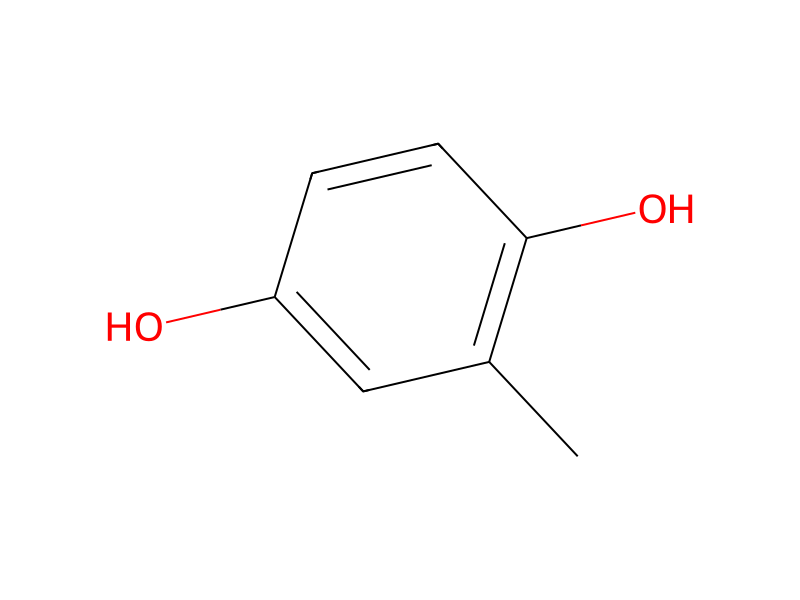
Cc1cc(O)ccc1O- InChIKey
CNHDIAIOKMXOLK-UHFFFAOYSA-N- Molecular formula
- C7H8O2
- Average molar mass
- 124.14 g/mol
- Monoisotopic mass
- 124.0524295
Overview
Toluquinol is a member of the class of hydroquinones that is hydroquinone in which one of the benzene hydrogens has been replaced by a methyl group. It has a role as an angiogenesis inhibitor, an anti-inflammatory agent and a Penicillium metabolite.
Names & identifiers
- Preferred name
- Methylhydroquinone
- IUPAC
- 2-methylbenzene-1,4-diol
- English name
- 2-Methylhydroquinone
- Molecular formula
- C7H8O2
- Molecular weight
- 124.14
Names & synonyms
Methylhydroquinone95-71-62-Methylhydroquinone2-methylbenzene-1,4-diol2,5-DihydroxytolueneToluhydroquinonep-ToluhydroquinoneToluquinolp-Toluquinolp-ToluhydroquinolTolylhydroquinone2,5-Toluenediol
Show more names
THQ
2-Methyl-1,4-benzenediol1,4-Benzenediol, 2-methyl-1,4-Dihydroxy-2-methylbenzene2-Methyl-1,4-hydroquinoneDTXSID4020876332W51E0OCNSC-4962DTXCID00876
Database identifiers
- CAS
95-71-6- PubChem CID
- 7253
- DTXSID
DTXSID4020876- ChEMBL
CHEMBL450917- ChEBI
CHEBI:133842- UNII
- 332W51E0OC
- EC Number
- 202-443-7
- Nikkaji
- J4.712K
Properties
Computed structural properties
- XLogP
- 1
- Topological polar surface area
- 40.5 Ų
- Hydrogen bond donors
- 2
- Hydrogen bond acceptors
- 2
- Rotatable bonds
- 0
- Heavy atoms
- 9
- Formal charge
- 0
- Complexity
- 92.9
Experimental & physicochemical properties
Chemical ClassesOther Classes -> Phenols
Vapor Pressure0.0028 [mmHg]
Physical Description
Dry Powder
Off-white solid with a slight odor; [Eastman Chemical MSDS]
Physicochemical properties
- Melting point
- 128 · 128-130 °C(lit.)
- Boiling point
- 285 °C · 285°C
- Density
- 1.1006 · 1.1006 (rough estimate)
- vapor pressure
- 0.004 Pa · 0.004Pa at 25℃
- refractive index
- 1.4922 · 1.4922 (estimate)
- Flash point
- 172 °C · 172 °C
- storage temp.
- 30 °C · Store below +30°C.
- solubility
- 77 g/l · 77g/l
- pka
- 1 · pK1:10.03;pK2:11.62 (25°C)
- form
- Crystalline Powder
- color
- Grayish-white to light beige
- Water Solubility
- 77 g/L · 77 g/L (25 ºC)
- BRN
- 2041489 · 2041489
- Stability
- Stable. Combustible. Incompatible with oxidizing agents, strong bases.
- InChI
- 1S/C7H8O2/c1-5-4-6(8)2-3-7(5)9/h2-4,8-9H,1H3
- InChIKey
- CNHDIAIOKMXOLK-UHFFFAOYSA-N
- SMILES
- Cc1cc(O)ccc1O
- LogP
- 0.9 at · 0.9 at 27℃
- CAS DataBase Reference
- 95 · 95-71-6(CAS DataBase Reference)
- EWG's Food Scores
- 1 · 1
- FDA UNII
- 332 W51E0OC · 332W51E0OC
- NIST Chemistry Reference
- 1 · 1,4-Benzenediol, 2-methyl-(95-71-6)
- EPA Substance Registry System
- 2 · 2-Methylhydroquinone (95-71-6)
- UNSPSC Code
- 12352104 · 12352104
- NACRES
- 24 · NA.24
- Symbol(GHS)
- 7 · GHS07
- Signal word
- Warning
- Hazard statements
- 302 · H302-H315-H319-H335-H312
- Precautionary statements
- 280 · P280-P304+P340-P405-P501a-P301+P312+P330-P305+P351+P338-P261
- target organs
- Respiratory system
- Hazard Codes
- Xi,Xn
- Risk Statements
- 36 · 36/37/38-22
- Safety Statements
- 26 · 26-36
- RIDADR
- 2811 · 2811
- WGK Germany
- 2 · 2
- RTECS
- 6700000 · MX6700000
- Autoignition Temperature
- 851 °F · 851 °F
- TSCA
- TSCA listed
- HazardClass
- 6.1 · 6.1(b)
- PackingGroup
- III
- HS Code
- 29072900 · 29072900
- Storage Class
- 8 A · 8A - Combustible corrosive hazardous materials
- Hazard Classifications
- 1 Aquatic · Aquatic Acute 1Aquatic Chronic 1Eye Dam. 1Skin Corr. 1ASkin Sens. 1STOT SE 3
- Toxicity
- 50 orally · LD50 orally in Rabbit: 200 - 400 mg/kg
- REACH Registrations
- Active
Safety & regulation
GHS classification
GHS Classification
This chemical does not meet GHS hazard criteria for 1.1% (5 of 467) of reports.
Danger
H302 (94%): Harmful if swallowed [Warning Acute toxicity, oral]
P203, P261, P264, P264+P265, P270, P271, P272, P273, P280, P301+P317, P302+P352, P304+P340, P305+P351+P338, P305+P354+P338, P317, P318, P319, P321, P330, P332+P317, P333+P317, P337+P317, P362+P364, P391, P403+P233, P405, and P501 (click each P-code to see the statement)
Aggregated GHS information provided per 467 reports by companies from 28 notifications to the ECHA C&L Inventory. Each notification may be associated with multiple companies.
Hazard information
Regulatory Information
Chemical: 1,4-Benzenediol, 2-methyl-
1,4-Benzenediol, 2-methyl- is listed on the EPA's Chemical Data Reporting (CDR) system. Manufacturers and importers of 1,4-Benzenediol, 2-methyl- are required to report information about their production and use of this chemical to the EPA under the Toxic Substances Control Act (TSCA). (40 eCFR Part 711)
Status: Active Update: 05-01-2022 https://echa.europa.eu/registration-dossier/-/registered-dossier/27614
Methylhydroquinone: Does not have an individual approval but may be used under an appropriate group standard
Hazards SummaryA skin and eye irritant; Dust causes eye and respiratory tract irritation; Harmful by ingestion; [Eastman Chemical MSDS] See Hydroquinone.
Hazard Classes and CategoriesAcute Tox. 4 (94%)
Safety data
- wgk
- 2
- tsca
- TSCA listed
- rtecs
- MX6700000
- ridadr
- 2811
- hs_code
- 29072900
- Toxicity
- LD50 orally in Rabbit: 200 - 400 mg/kg
- risk_code
- 36/37/38-22
- Signal word
- Warning
- Symbol(GHS)
- GHS07
- hazard_code
- Xi,Xn
- safety_code
- 26-36
- hazard_class
- 6.1(b)
- Storage Class
- 8A - Combustible corrosive hazardous materials
- packing_group
- III
- target organs
- Respiratory system
- Hazard statements
- H302-H315-H319-H335-H312
- REACH Registrations
- Active
- Hazard Classifications
- Aquatic Acute 1Aquatic Chronic 1Eye Dam. 1Skin Corr. 1ASkin Sens. 1STOT SE 3
- Autoignition Temperature
- 851 °F
- Precautionary statements
- P280-P304+P340-P405-P501a-P301+P312+P330-P305+P351+P338-P261
Chemistry & industry
Uses & manufacturing
UsesUsed as an inhibitor; [Eastman Chemical MSDS]
U.S. Production2023: 22,046 lb
Industry UsesCorrosion inhibitor
General Manufacturing Information
All Other Chemical Product and Preparation Manufacturing
1,4-Benzenediol, 2-methyl-: ACTIVE
Applications
UsesAntioxidant, polymerization inhibitor.
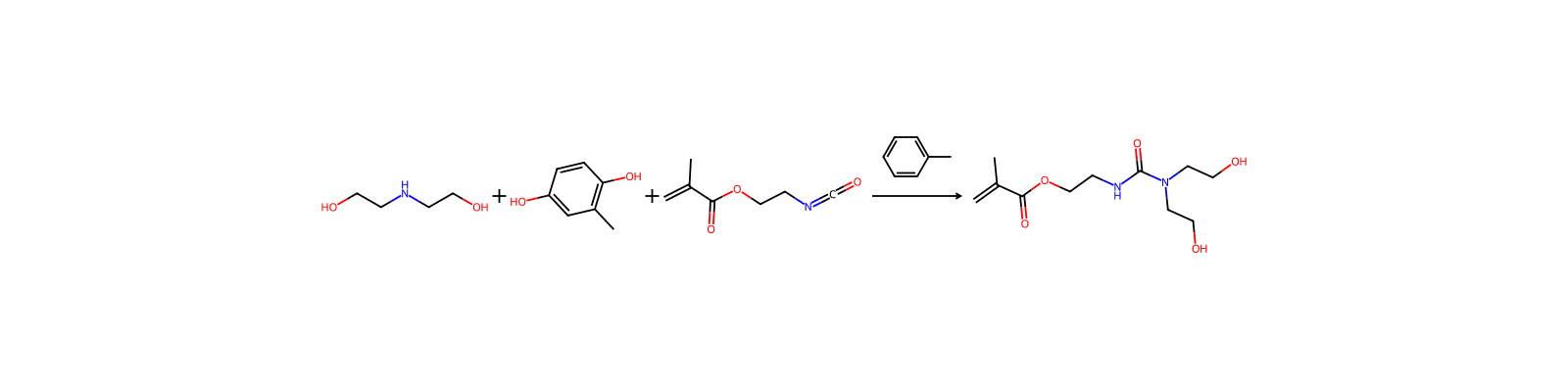
UsesMethylhydroquinone is used as stabilizer and antioxidant in aerylic monomers to prevent polymerization.
UsesMethylhydroquinone is a marine fungus metabolite, showing activity as an angiosupressor that interferes with the Akt pathway. Allows for screening of novel inhibitors of angiogenesis.
General DescriptionMethylhydroquinone is produced by the oxidation of o-cresol by the mutants G103S, G103S/A107G, and G103S/A107T.
Upstream & downstream products
Downstream products
Suppliers50 total
国药集团化学试剂有限公司86-21-63210123 · [email protected]
梯希爱(上海)化成工业发展有限公司021-67121386 · [email protected]
衢州润东化工有限公司0570-8789886 18892685668 · [email protected]
上海阿拉丁生化科技股份有限公司400-6206333 13167063860 · [email protected]
韶远科技(上海)有限公司021-50795510 4000665055 · [email protected]
Syntechem Co.,Ltd[email protected]
天津中信凯泰化工有限公司022-66880623 · [email protected]
阿法埃莎(中国)化学有限公司400-6106006 · [email protected]
安耐吉化学&3A(安徽泽升科技股份有限公司)400-0056266 · [email protected]
上海瀚鸿科技股份有限公司021-54306202 13764082696 · [email protected]
上海尚饮思生化医药有限公司021-021-57872719 13761402923 · [email protected]
嘉兴市艾森化工有限公司0573-85285100 18627885956 · [email protected]
上海隆盛化工有限公司58099637 13585536065 · [email protected]
合肥天健化工有限公司551-65418679 15856988503;15837135945 · [email protected]
云南西力生物技术股份有限公司0871-65217109 · [email protected]
山东西亚化学有限公司13355009207 13355009207 · [email protected]
玛雅试剂+86 (573) 82222445 (0)18006601000 452520369 · [email protected]
四川库利南科技有限公司400-1166-196 18981987031 · [email protected]
天津希恩思生化科技有限公司400 638 7771 · [email protected]
河南多贝化工有限公司0370-2785118 17550508557 · [email protected]
斯百全化学(上海)有限公司021-021-021-67601398-809-809-809 15221380277 · [email protected]
北京泰亚杰科技有限公司021-33690831-8001 13552411790;18616022633 · [email protected]
艾科试剂4008-755-333 18080918076 · [email protected]
上海思域化工科技有限公司86-21-34053660 · [email protected]
赛默飞世尔科技(中国)有限公司800-810-5118 · [email protected]
北京伊诺凯科技有限公司400-810-7969 010-59572699 · [email protected]
江苏艾康生物医药研发有限公司025-66113011 13913916777 · [email protected]
上海健超生物科技有限公司150-2103-5486 18017383231 · [email protected]
TCI AMERICA800-4238616 · [email protected]
TOKYO CHEMICAL INDUSTRY CO., LTD.03-36680489 · [email protected]
TCI Europe320-37350700 · [email protected]
越林试剂021-62960152 · [email protected]
无锡市乾丰化工科技有限公司0510-82860650 · [email protected]
北京环宇世纪化学科技有限公司hysj_bj.com
上海湄水化工科技有限公司021-60549325 18616193163
上海将来实业股份有限公司400-0066400 13621662912 · [email protected]
上海将来实业股份有限公司021-61552785 · [email protected]
安徽科迪达化工有限公司0554-2106669 · [email protected]
上海笛柏生物科技有限公司400-008-9730,021-54359730 400-008-9730 · [email protected]
上海石洋化工有限公司021-56795766 · [email protected]
成都零六生物科技有限公司400-1166-196 13458535857 · [email protected]
雷丁试剂0510-85629785 18013409632 · [email protected]
湖南华腾制药有限公司400-8592883 · [email protected]
上海御略医药科技有限公司021-60345187 13671753212 · [email protected]
上海麦克林生化科技股份有限公司15221275939 15221275939 · [email protected]
杭州杰恒化工有限公司0571-87396432 · [email protected]
上海有朋化工有限公司021-69005955 13701776567 · [email protected]
北京海力扬化学科技有限公司13718199399 · [email protected]
北京欣赛维化学科技有限公司010-56218822 13717722232 · [email protected]
四川海诺威科技有限公司13708085536 13708085536 · [email protected]
Additional notes
DefinitionChEBI: A member of the class of hydroquinones that is hydroquinone in which one of the benzene hydrogens has been replaced by a methyl group.
Related reactions
67 records


Linked notes
Loading…