
HRID 4468As product
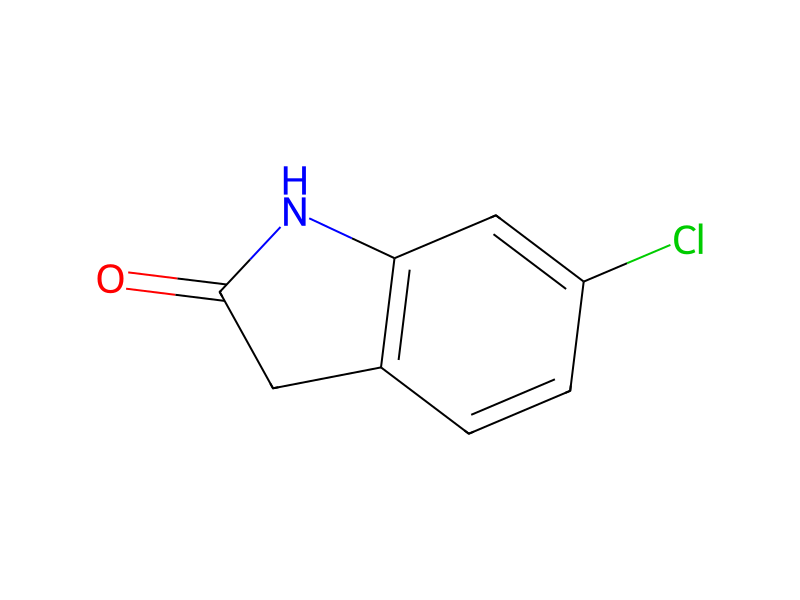
56341-37-8O=C1Cc2ccc(Cl)cc2N1CENVPIZOTHULGJ-UHFFFAOYSA-N6-Chlorooxindole is a member of indoles.
56341-37-8DTXSID00353003CHEMBL1232568CHEBI:194669Safety information is for reference only and does not replace the supplier’s Safety Data Sheet (SDS), applicable regulations, or professional assessment.
Warning
H302 (100%): Harmful if swallowed [Warning Acute toxicity, oral]
P261, P264, P270, P272, P273, P280, P301+P317, P302+P352, P321, P330, P333+P317, P362+P364, P391, and P501 (click each P-code to see the statement)
Aggregated GHS information provided per 115 reports by companies from 6 notifications to the ECHA C&L Inventory. Each notification may be associated with multiple companies.
Warning
H302 (100%): Harmful if swallowed [Warning Acute toxicity, oral]
Acute Tox. 4 (100%)
Acute Tox. 4 (100%)
Description6-Chlorooxindole is an organic compound that has been used in the pharmaceutical industry as a hydrogen bond donor and a dihydrate salt. It is an aromatic heterocycle with two rings, one of which is an oxindole ring. 6-Chlorooxindole has been shown to be stable at low pH and high temperatures, with the exception of hydrochloric acid. It is also soluble in water and can be prepared in a variety of ways, including by reacting benzene with nitrous acid or by heating oxindole with sodium hydroxide. 6-Chlorooxindole can be found as a component in some pharmaceutical preparations such as carbamazepine and ziprasidone. It can also be found as a component of the drug chlorpromazine.
Uses6-Chlorooxindole is a useful research chemical used in the design of potent non-peptide MDM2 inhibitors.
PreparationSTEP A: 3-(2-nitro-4-chlorophenyl)pyruvic acid To a cooled mixture prepared by adding 13.6 g. of sodium to 300 ml. of ethanol is added a solution of 100 g. of 4-chloro-2-nitrotoluene and 84 g of diethyloxalate in 150 ml of ethanol while maintaining the temperature below 20℃. The resulting mixture is refluxed for one hour, cooled, 400 ml. of water added and the resulting mixture refluxed for 90 minutes. The ethanol is then evaporated to a small volume and the resulting precipi tate containstan and black material and the black mate rial is mechanically separated and discarded and the remainder (filtrate plus tan precipitate) used in the next step. STEP B: 4-chloro-2-nitro-phenylacetic acid The filtrate of Step A, above, is adjusted to pH 8-9 with 2 N sodium hydroxide and is heated at 35-40℃. while adding a 3-6% aqueous hydrogen peroxide solution until samples no longer turn dark on treatment with 2N sodium hydroxide. The tan precipitate is suspended in 1500 ml of water, adjusted to pH 8-9 and similarly treated with aqueous hydrogen peroxide. The combined reaction mixtures are then acidified with concentrated hydrochloride acid to obtain a precipitate which are re covered by filtration, washed 3 times with water and dried in vacuo. The crude product (mp 145-150° C) is recrystallized from ether to obtain 4-chloro-2-nitro phenylacetic acid, m.p. 156-159℃. STEP C: The product of Step B, above, is subjected to reductive cyclization analogously to Step B of Example 1 to obtain 6-chloro-oxindole, m.p. 185-189℃.

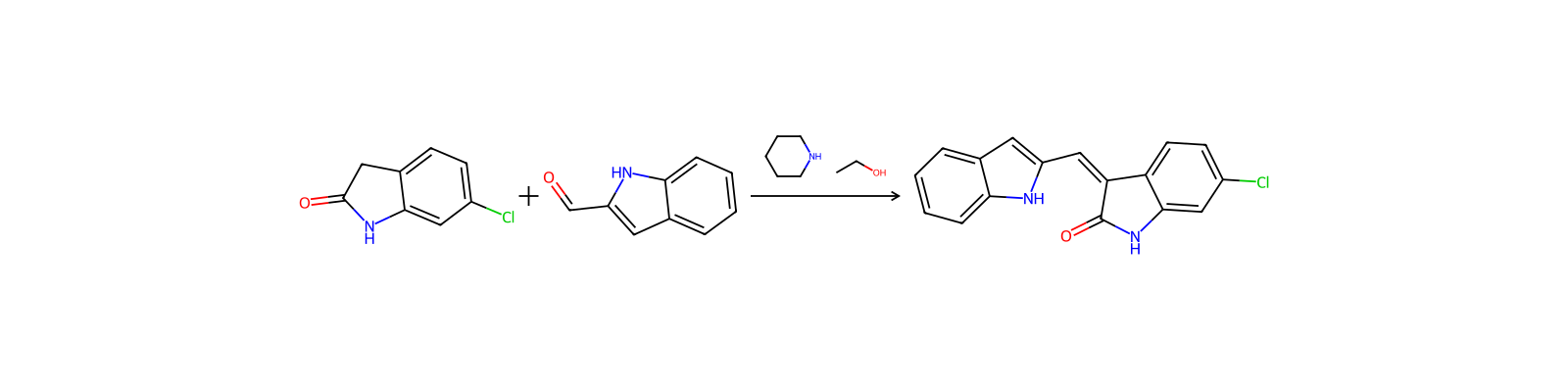


DefinitionChEBI: 6-Chlorooxindole is a member of indoles.