Reaction equation
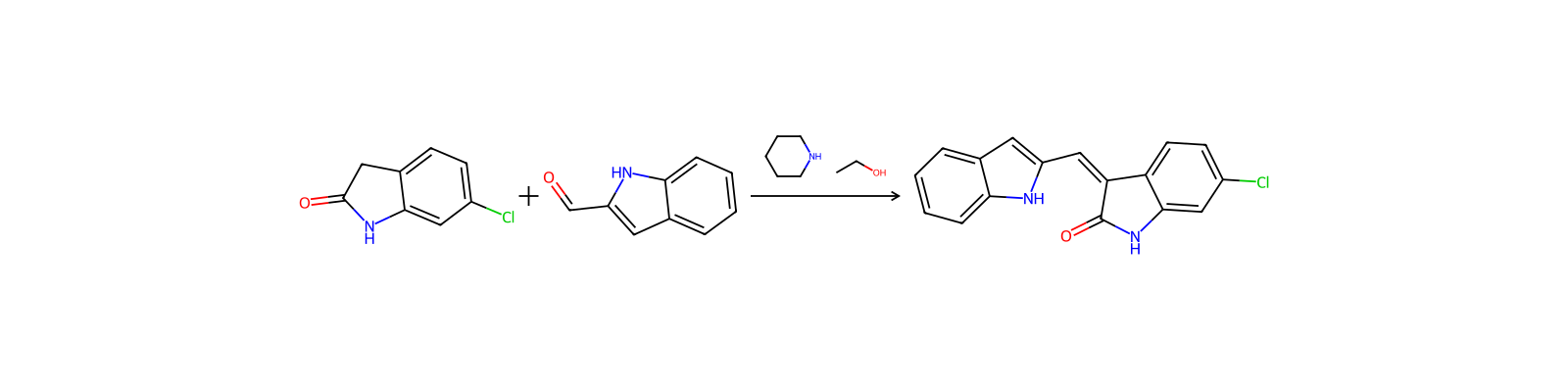
[Cl:1][C:2]1[CH:10]=[C:9]2[C:5]([CH2:6][C:7](=[O:11])[NH:8]2)=[CH:4][CH:3]=1.[NH:12]1[C:20]2[C:15](=[CH:16][CH:17]=[CH:18][CH:19]=2)[CH:14]=[C:13]1[CH:21]=O>N1CCCCC1.C(O)C>[Cl:1][C:2]1[CH:10]=[C:9]2[C:5]([C:6](=[CH:21][C:13]3[NH:12][C:20]4[C:15]([CH:14]=3)=[CH:16][CH:17]=[CH:18][CH:19]=4)[C:7](=[O:11])[NH:8]2)=[CH:4][CH:3]=1Participants
5
Reactant 2

Product 1

Reagents, catalysts & solvents 2


Procedure
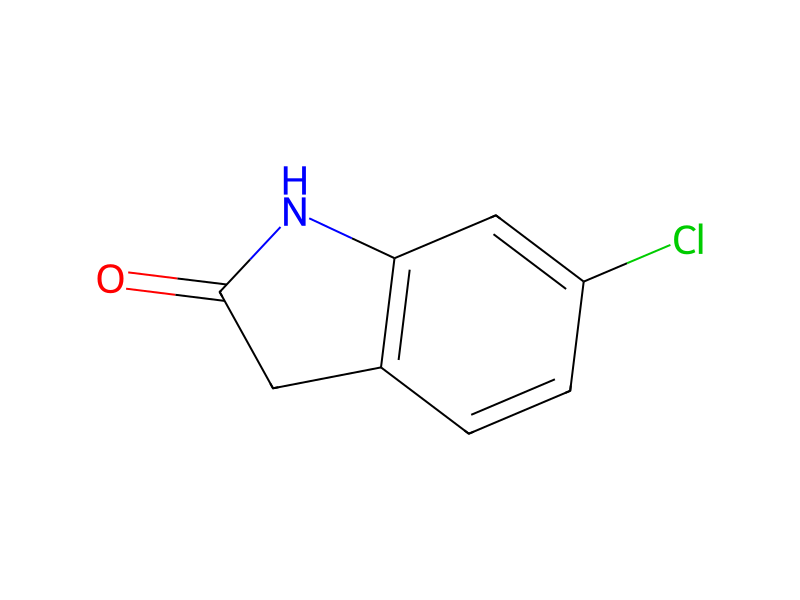
A mixture of 6-chloro-2-oxindole (41 mg) (commercially available), indole-2-carbaldehyde (42 mg) (prepared according to Synthetic Communications, 1993, 23, 3109) and piperidine (1 drop) in ethanol (3 mL) was held in a sealed tube at 95° C. for 3 hours. The mixture was cooled to room temperature. The solid was collected by vacuum filtration, washed with cold ethanol and dried in vacuum oven to give 62 mg (87% yield) of 6-chloro-3-(1H-indol-2-ylmethylene)-1,3-dihydroindol-2-one as a shiny orange solid.
Workup
- filtrationThe solid was collected by vacuum filtration
- washwashed with cold ethanol
- customdried in vacuum oven
Sources & evidence
- ORD record
- ord-1e89f92e0b244e2aaec6e141d1a75b76
- Source dataset
- uspto-grants-2005_02
- Patent number
- US06855730B2
Linked notes
Loading…