
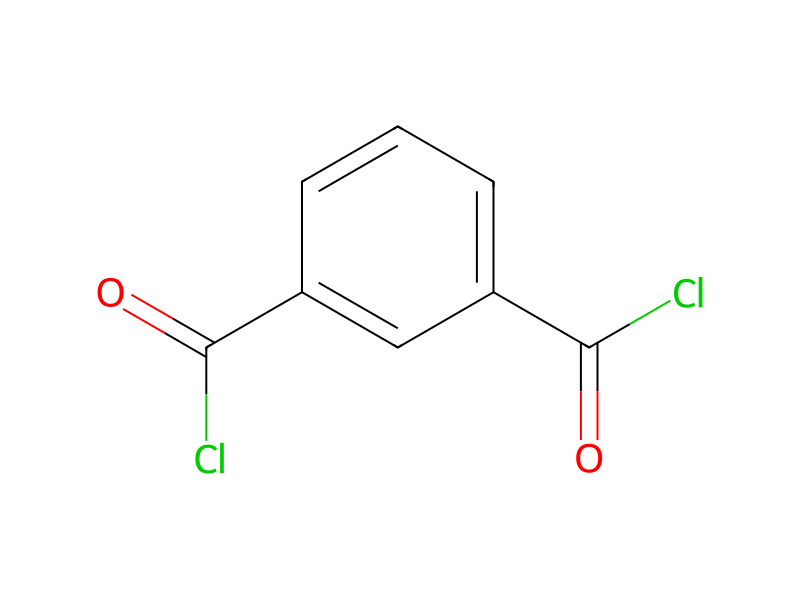
Basic information
- Standard SMILES
O=C(Cl)c1cccc(C(=O)Cl)c1- InChIKey
FDQSRULYDNDXQB-UHFFFAOYSA-N- Molecular formula
- C8H4Cl2O2
- Average molar mass
- 203.02 g/mol
- Monoisotopic mass
- 201.95883473
Names & identifiers
- Preferred name
- Isophthaloyl chloride
- IUPAC
- benzene-1,3-dicarbonyl chloride
- English name
- 1,3-Benzenedicarbonyl chloride
- Molecular formula
- C8H4Cl2O2
- Molecular weight
- 0
Names & synonyms
Isophthaloyl chlorideIsophthaloyl dichloride99-63-81,3-Benzenedicarbonyl dichloridem-Phthaloyl chlorideIsophthalic acid chloridem-Phthalic dichlorideIsophthalic acid dichlorideIsophthalic chloride1,3-BENZENEDICARBONYL CHLORIDEIsophthalyl dichlorideIsothaloyl chloride
Show more names
Isophthalyl chloridem-Benzenedicarbonyl chlorideDichlorid kyseliny isoftalovemeta-Phthalyl dichloridem-Phthaloyl dichlorideDTXSID30266416A3LDJ6CL31,3-Benzenedicarboxylic acid, dichloride
Database identifiers
- CAS
99-63-8- PubChem CID
- 7451
- DTXSID
DTXSID3026641- ChEMBL
CHEMBL1885739- UNII
- 6A3LDJ6CL3
- EC Number
- 202-774-7
- Nikkaji
- J4.971I
Properties
Computed structural properties
- XLogP
- 3.6
- Topological polar surface area
- 34.1 Ų
- Hydrogen bond donors
- 0
- Hydrogen bond acceptors
- 2
- Rotatable bonds
- 2
- Heavy atoms
- 12
- Formal charge
- 0
- Complexity
- 183
Experimental & physicochemical properties
Chemical ClassesToxic Gases & Vapors -> Other Toxic Gases & Vapors
SpringerMaterials PropertiesBoiling point
Density1.3880 @ 17 °C/4 °C
Color/Form
CRYSTALLINE SOLID
PRISMS FROM ETHER
Solubility
SOL IN ETHER & OTHER ORG SOLVENTS
SLIGHTLY SOL IN WATER & ALCOHOL
Flash Point356 °F OC
Boiling Point276 °C
Melting Point43-44 °C
Food Contact SubstancesFCS -> FDA Inventory of Food Contact Substances Listed in 21 CFR
Refractive IndexINDEX OF REFRACTION: 1.570 @ 47 °C/D
Physical Description
Large Crystals; Dry Powder
Solid; [Hawley] White crystalline solid; [MSDSonline]
Other Experimental PropertiesREACTIVE WITH WATER & ALCOHOL
Physicochemical properties
- Symbol(GHS)
- 5 · GHS05,GHS06
- Signal word
- Danger
- Hazard statements
- 312 · H312-H314-H331
- Precautionary statements
- 260 · P260-P271-P280-P303+P361+P353-P304+P340+P310-P305+P351+P338
Safety & regulation
GHS classification
GHS Classification
This chemical does not meet GHS hazard criteria for 0.4% (1 of 269) of reports.
Danger
H312 (99.6%): Harmful in contact with skin [Warning Acute toxicity, dermal]
P260, P261, P264, P264+P265, P271, P280, P301+P330+P331, P302+P352, P302+P361+P354, P304+P340, P305+P354+P338, P316, P317, P321, P362+P364, P363, P403+P233, P405, and P501 (click each P-code to see the statement)
Aggregated GHS information provided per 269 reports by companies from 11 notifications to the ECHA C&L Inventory. Each notification may be associated with multiple companies.
Warning
Hazard information
Regulatory Information
Chemical: 1,3-Benzenedicarbonyl dichloride
Regulation (EC) No 1935/2004 (amended)
1,3-Benzenedicarbonyl dichloride is listed on the EPA's Chemical Data Reporting (CDR) system. Manufacturers and importers of 1,3-Benzenedicarbonyl dichloride are required to report information about their production and use of this chemical to the EPA under the Toxic Substances Control Act (TSCA). (40 eCFR Part 711)
Status: Active Update: 07-05-2021 https://echa.europa.eu/registration-dossier/-/registered-dossier/13191
Isophthaloyl dichloride: Does not have an individual approval but may be used under an appropriate group standard
Hazards Summary
Reacts with water; [Hawley] A skin and eye irritant; [HSDB] Evolves HCl upon reaction with water; A moderate to severe skin irritant; [CHEMINFO] A corrosive substance that can cause injury to the skin, eyes, and respiratory tract; Inhalation may cause edema and chemical pneumonitis; [MSDSonline]
Hazard Classes and Categories
Acute Tox. 4 (99.6%)
Acute toxicity (Dermal) - Category 4
Toxicology
Adverse EffectsDermatotoxin - Skin burns.
Human Toxicity ExcerptsIRRITANT TO EYES & SKIN.
Toxicity DataLC (rat) > 31,000 mg/m3/4h
Safety data
- Signal word
- Danger
- Symbol(GHS)
- GHS05,GHS06
- Hazard statements
- H312-H314-H331
- Precautionary statements
- P260-P271-P280-P303+P361+P353-P304+P340+P310-P305+P351+P338
Chemistry & industry
Uses & manufacturing
Uses
Used in dyes, synthetic fibers, resins, films, and glass coatings; [HSDB]
Textiles (Fiber & Fabric Manufacturing) [Category: Industry]
INTERMEDIATE; DYES; SYNTHETIC FIBERS; RESINS; FILMS; PROTECTIVE COATINGS; LABORATORY REAGENT
NONTHROMBOGENIC GLASS COATING
U.S. Production2023: 100,000 - <250,000 lb
Industry UsesIntermediate
General Manufacturing Information
Plastics Material and Resin Manufacturing
1,3-Benzenedicarbonyl dichloride: ACTIVE
Suppliers50 total
国药集团化学试剂有限公司86-21-63210123 · [email protected]
梯希爱(上海)化成工业发展有限公司021-67121386 · [email protected]
上海阿拉丁生化科技股份有限公司400-6206333 13167063860 · [email protected]
Shandong chuangyingchemical Co., Ltd.18853181302 · [email protected]
合肥翰刚医药科技有限公司+8618062405514 · [email protected]
武汉欣扬瑞和化学科技有限公司153-07155313 15307155313 · [email protected]
Hebei shuoxi biotechnology co. LTD+8613081092107
河北创海生物科技有限公司+86-86-13131129325 · [email protected]
河北展药生物科技有限公司15369953316 +8615369953316 · [email protected]
山东前元高分子材料有限公司18678041314 18765609661 · [email protected]
Dayang Chem (Hangzhou) Co.,Ltd.+86-0571-88938639 17705817739 · [email protected]
科瑞迪化学400-821-5857 021-64326257 · [email protected]
Syntechem Co.,Ltd[email protected]
上海迈瑞尔生化科技有限公司4006356688 18621169109 · [email protected]
阿法埃莎(中国)化学有限公司400-6106006 · [email protected]
安耐吉化学&3A(安徽泽升科技股份有限公司)400-0056266 · [email protected]
上海瀚鸿科技股份有限公司021-54306202 13764082696 · [email protected]
河北缤享新材料科技有限公司+8618633865755 · [email protected]
Hebei shenghao import and export trade co. LTD+8618431136903
山东西亚化学有限公司13355009207 13355009207 · [email protected]
玛雅试剂+86 (573) 82222445 (0)18006601000 452520369 · [email protected]
HONG KONG IPURE BIOLOGY CO.,LIMITED86 18062405514 18062405514 · [email protected]
四川库利南科技有限公司400-1166-196 18981987031 · [email protected]
天津希恩思生化科技有限公司400 638 7771 · [email protected]
Xiamen AmoyChem Co., Ltd+86-86-5926051114 · [email protected]
南京化学试剂股份有限公司025-58369808 17895012682 · [email protected]
艾科试剂4008-755-333 18080918076 · [email protected]
上海思域化工科技有限公司86-21-34053660 · [email protected]
赛默飞世尔科技(中国)有限公司800-810-5118 · [email protected]
北京伊诺凯科技有限公司400-810-7969 010-59572699 · [email protected]
上海遐瑞医药科技有限公司+86 21 61551611
TCI AMERICA800-4238616 · [email protected]
TOKYO CHEMICAL INDUSTRY CO., LTD.03-36680489 · [email protected]
TCI Europe320-37350700 · [email protected]
上海贤鼎生物科技有限公司4009209199 · [email protected]
北京环宇世纪化学科技有限公司hysj_bj.com
上海将来实业股份有限公司400-0066400 13621662912 · [email protected]
上海将来实业股份有限公司021-61552785 · [email protected]
安徽科迪达化工有限公司0554-2106669 · [email protected]
HBCChem, Inc.+1-510-219-6317 · [email protected]
日照力德士化工有限公司010-51268198 · [email protected]
郑州阿尔法化工有限公司0371-53732842 15981811963 · [email protected]
美岚实业(上海)有限公司021-58958189 · [email protected]
上海爱蝶实业有限公司021-58957966 18930537195 · [email protected]
广拓化学(上海)有限公司021-60899189-8001 18918189673 · [email protected]
上海御略医药科技有限公司021-60345187 13671753212 · [email protected]
上海麦克林生化科技股份有限公司15221275939 15221275939 · [email protected]
杭州杰恒化工有限公司0571-87396432 · [email protected]
上海有朋化工有限公司021-69005955 13701776567 · [email protected]
上海凯赛化工有限公司021-33516722 13701817765 · [email protected]
Related reactions
66 records


Linked notes
Loading…