Reaction equation

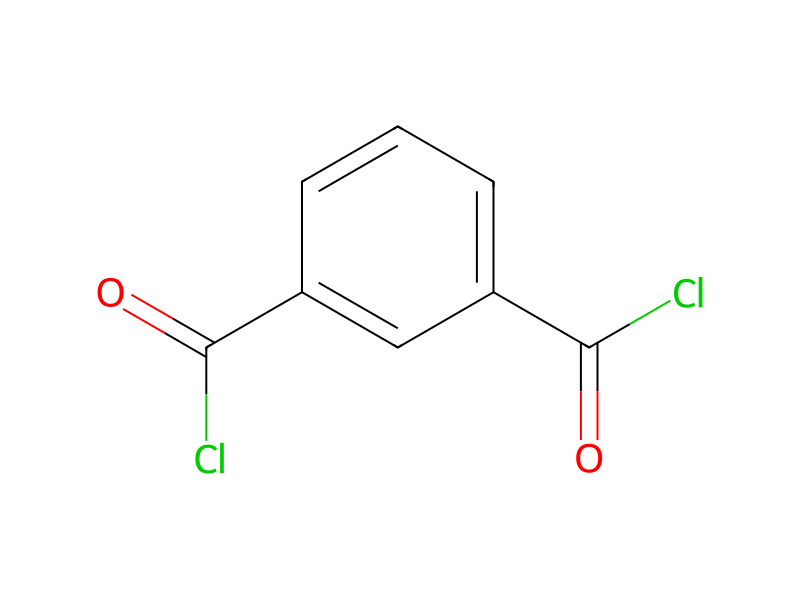
[Cl-].[Cl-].[Cl-].[Al+3].[C:5](Cl)(=[O:15])[C:6]1[CH:14]=[CH:13][CH:12]=[C:8]([C:9](Cl)=[O:10])[CH:7]=1.[F:17][C:18]1[CH:23]=[CH:22][CH:21]=[CH:20][CH:19]=1.[OH-].[Na+]>ClCCl>[F:17][C:18]1[CH:23]=[CH:22][C:21]([C:5]([C:6]2[CH:14]=[CH:13][CH:12]=[C:8]([C:9](=[O:10])[C:21]3[CH:22]=[CH:23][C:18]([F:17])=[CH:19][CH:20]=3)[CH:7]=2)=[O:15])=[CH:20][CH:19]=1Participants
Reactant 4



Product 1

Reagents, catalysts & solvents 1

Procedure
Aluminum trichloride (6.53 g, 49.5 mmol) was added to a solution of isophthaloyl dichloride (5.0 g, 24.8 mmol) in dichloromethane (100 mL). After heating at reflux for 30 min, the monofluorobenzene (2.835 g, 29.5 mmol) was added and stirring was continued at reflux. After stirring over 12 h, the reaction mixture was poured onto the crushed ice. The resulting solution was neutralized with 10% NaOH (100 mL), and extracted with dichloromethane (3×100 mL). The combined organic layer was washed with water, followed by brine and dried over Na2SO4. After the organic layer was concentrated under reduced pressure, purification using flash chromatography (silica gel, hexanes:ethyl acetate, 60:40) afforded 1,3-bis-(4-fluorobenzoyl)benzene 12 (3.37 g, 10.5 mmol) as a white solid in a 42% yield; 1H NMR (500 MHz, CDCl3): δ 8.130 (t, J=1.5 Hz, 1H, ArH), 8.00 (dd, J=7.5 Hz, 1.5 Hz, 1H, ArH), 7.87 (m, 4H, ArH), 7.64 (t, J=8.0 Hz, 1H, ArH), 7.18 (m, 4H, ArH).
Workup
- temperatureAfter heating
- temperatureat reflux for 30 min
- temperatureat reflux
- stirringAfter stirring over 12 h
- extractionextracted with dichloromethane (3×100 mL)
- washThe combined organic layer was washed with water
- dry with materialdried over Na2SO4
- concentrationAfter the organic layer was concentrated under reduced pressure, purification
Sources & evidence
- ORD record
- ord-59a11b20ad254b64b27ab5d58f00effe
- Source dataset
- uspto-grants-2014_11
- Patent number
- US08877967B2
Linked notes
Loading…