
HRID 2928As reactant
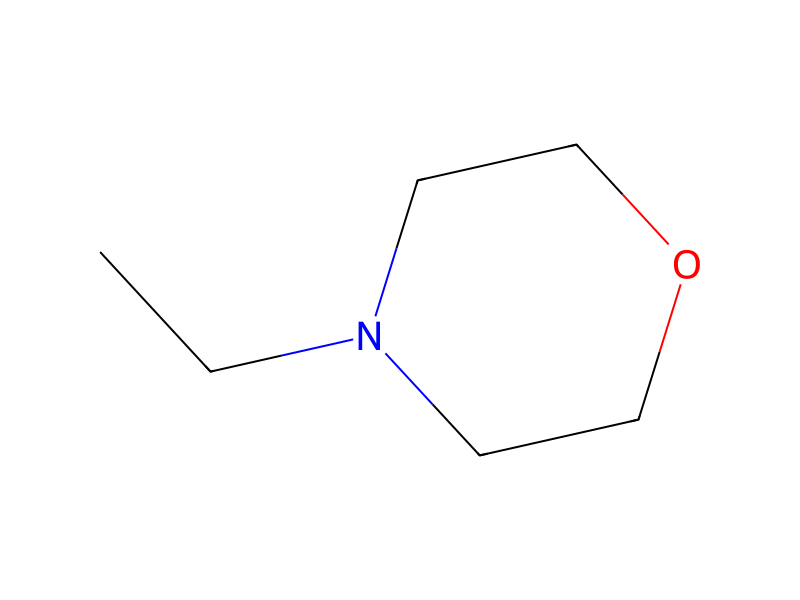
100-74-3CCN1CCOCC1HVCNXQOWACZAFN-UHFFFAOYSA-NN-ethyl morpholine appears as a colorless liquid with a strong ammonia-like odor. Severely irritates skin, eyes, and mucous membranes. Moderately soluble in water and less dense than water. Flash point 83 °F.
100-74-3DTXSID5025312CHEMBL3561880Nitrogen Compounds -> Morpholines
Flammable agents - 3rd degree
AMMONIACAL ODOR
Ammonia-like odor.
0.916 at 68 °F (USCG, 1999) - Less dense than water; will float
0.8996 @ 20 °C/4 °C
Relative density (water = 1): 0.99
0.90
COLORLESS LIQUID
Colorless liquid.
greater than or equal to 100 mg/mL at 68 °F (NTP, 1992)
SOL IN ALL PROPORTIONS IN WATER, ETHANOL & ETHER; SOL IN ACETONE
Solubility in water: miscible
Miscible
82 °F (NTP, 1992)
Safety information is for reference only and does not replace the supplier’s Safety Data Sheet (SDS), applicable regulations, or professional assessment.
This chemical does not meet GHS hazard criteria for 1% (5 of 484) of reports.
Danger
H226 (99%): Flammable liquid and vapor [Warning Flammable liquids]
P210, P233, P240, P241, P242, P243, P260, P261, P262, P264, P264+P265, P270, P271, P280, P301+P317, P301+P330+P331, P302+P352, P302+P361+P354, P303+P361+P353, P304+P340, P305+P351+P338, P305+P354+P338, P316, P317, P319, P321, P330, P332+P317, P337+P317, P361+P364, P362+P364, P363, P370+P378, P403+P233, P403+P235, P405, and P501 (click each P-code to see the statement)
Aggregated GHS information provided per 484 reports by companies from 16 notifications to the ECHA C&L Inventory. Each notification may be associated with multiple companies.
Danger
Chemical: Morpholine, 4-ethyl-
Morpholine, 4-ethyl- is listed on the EPA's Chemical Data Reporting (CDR) system. Manufacturers and importers of Morpholine, 4-ethyl- are required to report information about their production and use of this chemical to the EPA under the Toxic Substances Control Act (TSCA). (40 eCFR Part 711)
REACH registered substance: 4-ethylmorpholine (EC: 202-885-0)
4-Ethylmorpholine: Does not have an individual approval but may be used under an appropriate group standard
The New Jersey Worker and Community Right to Know Act requires public and private employers to provide information about hazardous substances at their workplaces. (N.J.S.A. 34:5A-1 et. seq.)
Special Hazards of Combustion Products: Irritating vapors and toxic gases, such as ammonia, nitrogen oxides, and carbon monoxide, may be formed when involved in fire.
Flammable. Gives off irritating or toxic fumes (or gases) in a fire. Above 32 °C explosive vapour/air mixtures may be formed.
Used as a catalyst in the production of polyurethane foam; [ACGIH]
Plastic Composites Manufacturing [Category: Industry]
URETHANE FOAM CATALYST
INTERMEDIATE FOR DYESTUFFS, PHARMACEUTICALS, RUBBER ACCELERATORS & EMULSIFYING AGENTS; SOLVENT FOR DYES, RESINS, OILS
COMMONLY USED SUBSTRATE FOR ENZYME REACTIONS
Plastics Product Manufacturing
Morpholine, 4-ethyl-: ACTIVE
UsesCatalyst in polyurethane foam production
UsesN-Ethylmorpholine is a component of the buffer used in basic peptide separation through anion-exchange chromatography. Further, it acts as a catalyst in the preparation of polyurethane foam.





32 °C
90 °F (32 °C) (OPEN CUP)
32 °C
(oc) 90 °F
280 to 282 °F at 760 mmHg (NTP, 1992)
138-139 °C @ 763 MM HG
138 °C
281 °F
-81 °F (NTP, 1992)
-62.78 °C
-63 °C
-81 °F
4 (NTP, 1992) - Heavier than air; will sink (Relative to Air)
4.0 (AIR= 1)
Relative vapor density (air = 1): 4.0
Permissible Exposure Limit: Table Z-1 8-hr Time-Weighted Avg: 20 ppm (94 mg/cu m). Skin Designation.
Vacated 1989 OSHA PEL TWA 5 ppm (23 mg/cu m), skin designation, is still enforced in some states.
Excerpt from ERG Guide 128 [Flammable Liquids (Water-Immiscible)]:
Use water spray, alcohol-resistant foam. In case of fire: keep drums, etc., cool by spraying with water.
Fresh air, rest. Refer for medical attention.
Remove contaminated clothes. Rinse and then wash skin with water and soap. Refer for medical attention .
First rinse with plenty of water for several minutes (remove contact lenses if easily possible), then refer for medical attention.
Rinse mouth. Give one or two glasses of water to drink.
EYES: First check the victim for contact lenses and remove if present. Flush victim's eyes with water or normal saline solution for 20 to 30 minutes while simultaneously calling a hospital or poison control center. Do not put any ointments, oils, or medication in the victim's eyes without specific instructions from a physician. IMMEDIATELY transport the victim after flushing eyes to a hospital even if no symptoms (such as redness or irritation) develop.
(General first aid procedures)
ALCOHOL FOAM, FOAM, CARBON DIOXIDE, DRY CHEMICAL.
WATER MAY BE INEFFECTIVE.
1) REMOVE ALL IGNITION SOURCES. 2) VENTILATE AREA OF SPILL OR LEAK. 3) FOR SMALL QUANTITIES, ABSORB ON PAPER TOWELS. EVAPORATE IN SAFE PLACE (SUCH AS A FUME HOOD). ALLOW SUFFICIENT TIME FOR EVAPORATING VAPORS TO COMPLETELY CLEAR HOOD DUCTWORK. BURN PAPER IN SUITABLE LOCATION AWAY FROM COMBUSTIBLE MATERIALS.
Cover with the 9:1 mixture of sand and soda ash. After mixing, transfer into a paper carton, stuffed with ruffled paper. Burn in an open furnace with the utmost care or in the furnace with afterburner and scrubber.
SRP: At the time of review, criteria for land treatment or burial (sanitary landfill) disposal practices are subject to significant revision. Prior to implementing land disposal of waste residue (including waste sludge), consult with environmental regulatory agencies for guidance on acceptable disposal practices.
LARGE QUANTITIES CAN BE COLLECTED & ATOMIZED IN A SUITABLE COMBUSTION CHAMBER EQUIPPED WITH AN APPROPRIATE EFFLUENT GAS CLEANING DEVICE.
Personal protection: filter respirator for organic gases and vapours adapted to the airborne concentration of the substance. Ventilation. Remove all ignition sources. Collect leaking and spilled liquid in sealable containers as far as possible. Absorb remaining liquid in sand or inert absorbent. Then store and dispose of according to local regulations.
...GOOD VENTILATION IS VERY IMPORTANT. /MORPHOLINE/
SRP: The scientific literature for the use of contact lenses in industry is conflicting. The benefit or detrimental effects of wearing contact lenses depend not only upon the substance, but also on factors including the form of the substance, characteristics and duration of the exposure, the uses of other eye protection equipment, and the hygiene of the lenses. However, there may be individual substances whose irritating or corrosive properties are such that the wearing of contact lenses would be harmful to the eye. In those specific cases, contact lenses should not be worn. In any event, the usual eye protection equipment should be worn even when contact lenses are in place.
The worker should immediately wash the skin when it becomes contaminated.
Work clothing that becomes wet should be immediately removed due to its flammability hazard.
Take off the clothing followed by drying and washing or disposing. Dispose shoes by incineration.
TERRESTRIAL FATE: Using a structure estimation method based on molecular connectivity indexes(1), the Koc for N-ethylmorpholine can be estimated to be about 12(SRC). According to a suggested classification scheme(2), this estimated Koc value suggests that N-ethylmorpholine has very high soil mobility(SRC). Insufficient data are available to predict the relative importance or rate of biodegradation in soil(SRC). Volatilization of N-ethylmorpholine is expected from dry soils(SRC) based on an experimental vapor pressure of 5 mm Hg(3,SRC), but not important from moist soils(SRC) based on an estimated Henry's Law constant of 2.74X10⁻⁸ atm-cu m/mole(4,SRC).
AQUATIC FATE: Based on a suggested classification scheme(2), N-Ethylmorpholine will be essentially non-volatile from water(SRC) based upon an estimated Henry's Law constant of 2.74X10⁻⁸ atm-cu m/mol(1,SRC). Insufficient data are available to predict the relative importance or rate of biodegradation in natural waters(SRC).
ATMOSPHERIC FATE: Based on an experimental vapor pressure of approximately 5 mm Hg at 25 °C(1), and a suggested classification scheme(2), N-ethylmorpholine will exist primarily in the vapor phase in the atmosphere(SRC). It will degrade in the ambient atmosphere by reaction with photochemically produced hydroxyl radicals with an estimated half-life of 2.5 hours(3,SRC). Removal of atmospheric N-ethylmorpholine may occur through wet deposition(SRC).
The substance can be absorbed into the body by inhalation of its vapour, through the skin and by ingestion.
inhalation, skin absorption, ingestion, skin and/or eye contact
Cough. Sore throat.
Redness.
Redness. Pain. Blurred vision.
irritation eyes, nose, throat; visual disturbance: corneal edema, blue-gray vision, colored haloes
Using a structure estimation method based on molecular connectivity indexes(1), the Koc for N-ethylmorpholine can be estimated to be about 12(SRC). According to a suggested classification scheme(2), this estimated Koc value suggests that N-ethylmorpholine has very high soil mobility(SRC).
... Ten humans exposed at 100 ppm N-ethylmorpholine for 2.5 min experienced irritation to the eyes, nose, and throat and olfactory fatigue. Irritation was slight with the same duration of exposure at 50 ppm and absent at 25 ppm.
Corneal edema was observed in workers exposed at 40 ppm and more N-ethylmorpholine for several hr. The lesions appeared near the end of the work shift and cleared within 3 to 4 hr after cessation of exposure. Other investigators have also reported that corneal edema caused by amine vapors is reversible. Distortion of vision is experienced at concn below those which produce eye or respiratory irritation. Another study reported that workers exposed at concn generally in the 3 to 4 ppm N-ethylmorpholine range, and never above 11 ppm, complained of drowsiness, optical halos, and foggy vision.
... An epidemic of neurogenic urinary retention from a company, employing 141 and 75 people at 2 different plants, manufacturing polyurethane foam products ... Abnormalities in vision, upper respiratory irritation, dermatitis, and pulmonary abnormalities also occurred but appeared to be related to the presence of other chemicals including N-ethylmorpholine and toluene diisocyanate.
The Henry's Law constant for N-ethylmorpholine can be estimated to be 2.47X10⁻⁸ atm-cu m/mole(SRC) using a structure estimation method(1). This value of Henry's Law constant indicates that N-ethylmorpholine will be essentially non-volatile from water(2).
ALL /N-SUBSTITUTED MORPHOLINES TESTED INCLUDING N-ETHYL MORPHOLINE/ EXHIBITED A LOW DEGREE OF ORAL TOXICITY ... N-ETHYL DERIVATIVES PRESENT THE HIGHEST POTENTIAL HAZARD FROM VAPOR EXPOSURE ... .
TESTED IN LIQUID FORM BY APPLYING A DROP FULL-STRENGTH TO RABBIT'S EYE... CAUSES THE CORNEA TO BECOME HAZY IN ABOUT FIVE MINUTES & EPITHELIUM TO SLOUGH FROM THE SURFACE. STANDARDIZED TESTING & GRADING ON RABBIT EYES GIVES A GRADE 7 INJURY ON A SCALE OF 1 TO 10. /MOST SEVERE INJURIES ARE RATED 10/
A DIRECT MUTAGENIC EFFECT WAS FOUND WITH N-ETHYLMORPHOLINE IN MUTAGENICITY TESTS WITH SALMONELLA TYPHIMURIUM STRAINS TA1535 & TA100, WITH & WITHOUT METABOLIC ACTIVATION BY LIVER PREPN FROM SPRAGUE-DAWLEY RATS. TESTS INDICATE OCCURRENCE OF AN ALKYLATING IMPURITY IN N-ETHYLMORPHOLINE.
... 1 of 6 rats died after a 4-hr inhalation exposure at 2000 ppm.
The rate constant for the vapor-phase reaction of N-ethylmorpholine with photochemically produced hydroxyl radicals has been estimated to be approximately 1.49X10⁻¹⁰ cu cm/molecule-sec at 25 °C which corresponds to an atmospheric half-life of about 2.5 hours at an atmospheric concentration of 5x10+5 hydroxyl radicals per cu cm(1,SRC).
...HAS PECULIARLY DISTURBING ACTION ON CORNEAL EPITHELIUM...CAUSING TRANSIENT EDEMA OF CORNEAL EPITHELIUM IN WORKERS EXPOSED TO 40 PPM OR MORE IN AIR DURING WORK DAY, CAUSING ONSET OF BLUE-GREY VISION OR COLORED HALOS AROUND LIGHTS A FEW HOURS AFTER EXPOSURE.
Occupational exposure to morpholines, such as N-ethylmorpholine, can occur through inhalation, dermal contact and ingestion(1).
UsesIntermediate for dyestuffs, pharmaceuticals; rubber accelerators and emulsifying agents; solvent for dyes, resins, oils; catalyst in making polyurethane foams.
General DescriptionN-Ethylmorpholine appears as a colorless liquid with a strong ammonia-like odor. Severely irritates skin, eyes, and mucous membranes. Moderately soluble in water and less dense than water. Flash point 83°F.
PreparationN-Ethylmorpholine is synthesized by the reaction of morpholine with bromoethane.