HomeMCPWorkbenchSkills
HomeWorkbenchNotificationsMe
llms.txt · MCP GuidePrivacy Policy · Terms of Service · Supportv1.8.3
  1. Home
  2. /Compound

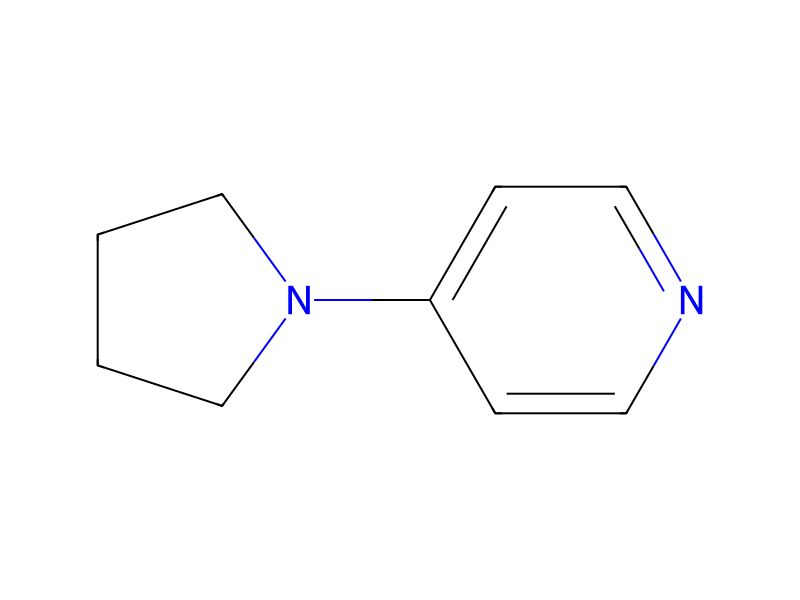
4-Pyrrolidinopyridine

HCID 75567
New reaction
Print
Basic informationNames & identifiersPropertiesSafety & regulationChemistry & industryRelated reactionsCompound notes
Substructure searchFind similar structures

Basic information

CAS
2456-81-7
Standard SMILES
c1cc(N2CCCC2)ccn1
InChIKey
RGUKYNXWOWSRET-UHFFFAOYSA-N
Molecular formula
C9H12N2
Average molar mass
148.2 g/mol
Monoisotopic mass
148.10004839

Names & identifiers

Preferred name
4-Pyrrolidinopyridine
IUPAC
4-pyrrolidin-1-ylpyridine
English name
4-Pyrrolidinopyridine
Molecular formula
C9H12N2
Molecular weight
148.21

Names & synonyms

4-Pyrrolidinopyridine2456-81-7Pyridine, 4-(1-pyrrolidinyl)-4-pyrrolidino-pyridineDH59VKG9S4DTXSID90179299RefChem:526685DTXCID70101790219-534-24-(Pyrrolidin-1-yl)pyridine4-pyrrolidin-1-ylpyridine4-(1-Pyrrolidinyl)pyridine
Show more names
4-PPY4-PyrroL4-(1-PYRROLIDINO)PYRIDINEIOSTEROLidinopyridineTIMTEC-BB SBB004083Pyrrolidinyl pyridine
MFCD000064154-pyrrolidinylpyridineEINECS 219-534-2CHEMBL47548331-(4-Pyridyl)pyrrolidine4-(1-Pyrrolidinyl)pyridin4-pyrrolidin-1-yl-pyridine4-(1-Pyrrolidinyl)-pyridine; 4-(1-Pyrrolidino)pyridine; 4-(1-Pyrrolidinyl)pyridine; 4-(N-Pyrrolidinyl)pyridine

Database identifiers

CAS
2456-81-7
PubChem CID
75567
DTXSID
DTXSID90179299
ChEMBL
CHEMBL4754833
UNII
DH59VKG9S4
EC Number
219-534-2
Nikkaji
J174K

Properties

Computed structural properties

XLogP
1.5
Topological polar surface area
16.1 Ų
Hydrogen bond donors
0
Hydrogen bond acceptors
2
Rotatable bonds
1
Heavy atoms
11
Formal charge
0
Complexity
113

Physicochemical properties

Melting point
54 · 54-58 °C(lit.)
Boiling point
171 · 171-173 °C (20.2527 mmHg)
Density
1.0628 · 1.0628 (rough estimate)
refractive index
1.5378 · 1.5378 (estimate)
Flash point
230 °F · >230 °F
storage temp.
Keep in dark place,Inert atmosphere,Room temperature
solubility
0.1 g/mL, · methanol: 0.1 g/mL, clear
pka
9.58 · 9.58±0.10(Predicted)
form
Crystalline Mass, Crystals and/or Chunks
color
White to yellow to light brown
PH
10.5 · 10.5 (3g/l, H2O, 21℃)
Water Solubility
3 g/L · 3 g/L (21 ºC)
BRN
472443 · 472443
InChI
1S/C9H12N2/c1-2-8-11(7-1)9-3-5-10-6-4-9/h3-6H,1-2,7-8H2
InChIKey
RGUKYNXWOWSRET-UHFFFAOYSA-N

Safety & regulation

Safety information is for reference only and does not replace the supplier’s Safety Data Sheet (SDS), applicable regulations, or professional assessment.

GHS classification

GHS Classification · 4 items

Danger

H301 (100%): Toxic if swallowed [Danger Acute toxicity, oral]

P260, P264, P270, P280, P301+P316, P301+P330+P331, P302+P361+P354, P304+P340, P305+P354+P338, P316, P321, P330, P363, P405, and P501 (click each P-code to see the statement)

Aggregated GHS information provided per 47 reports by companies from 5 notifications to the ECHA C&L Inventory. Each notification may be associated with multiple companies.

Hazard information

Regulatory Information4-(1-Pyrrolidinyl) pyridine: Does not have an individual approval but may be used under an appropriate group standard
Hazard Classes and CategoriesAcute Tox. 3 (100%)

Safety data

F
8-10-23
PPE
Eyeshields, Faceshields, Gloves, type P3 (EN 143) respirator cartridges
wgk
3
ridadr
UN 2923 8/PG 3
hs_code
29333999
risk_code
25-34-41-23/24/25
Signal word
Danger
Symbol(GHS)
GHS05,GHS06
hazard_code
T
safety_code
26-36/37/39-45
hazard_class
8
Storage Class
6.1C - Combustible acute toxic Cat.3toxic compounds or compounds which causing chronic effects

Chemistry & industry

Applications · 2 items

Description4-Pyrrolidinopyridine is the pyridine derivative. It can be used as catalyst employed in polymerization reactions or Hypernucleophilic acylation catalyst. For example, it can be used as the catalyst for the geometry-selective (E-selective) acylation of tetrasubstituted α, α'-alkenediols. It can also be used as the ligand in metal complexes such as the Chloride and pseudohalide hydride-carbonyl ruthenium(II) complexes.

UsesCatalyst employed in polymerization reactions. Ligand in metal complexes.

Upstream & downstream products

Downstream products

2-Dimethylaminopyridine3-broMo-4-(pyrrolidin-1-yl)pyridine

Related reactions

169 records
New reaction record
HRID 5281 reaction equation
HRID 5281As reactant
HRID 5544 reaction equation
HRID 5544As reactant
HRID 22602 reaction equation
HRID 22602As reactant
HRID 45088 reaction equation
HRID 45088As reactant
HRID 48900 reaction equation
HRID 48900As catalyst
HRID 63693 reaction equation
HRID 63693As reactant
HRID 80826 reaction equation
HRID 80826As reactant
HRID 81717 reaction equation
HRID 81717As reactant
PreviousPage 1 of 22

Compound notes

On this pageBasic informationNames & identifiersPropertiesSafety & regulationChemistry & industryRelated reactionsCompound notes
SMILES
C1CCN(C1)c2ccncc2
CAS DataBase Reference
2456 · 2456-81-7(CAS DataBase Reference)
FDA UNII
59 VKG9S4 · DH59VKG9S4
Comptox DTXSID
90179299 · DTXSID90179299
UNSPSC Code
12352100 · 12352100
NACRES
22 · NA.22
Symbol(GHS)
5 · GHS05,GHS06
Signal word
Danger
Hazard statements
301 · H301-H314
Precautionary statements
260 · P260-P270-P280-P303+P361+P353-P304+P340+P310-P305+P351+P338
PPE
3 · Eyeshields, Faceshields, Gloves, type P3 (EN 143) respirator cartridges
Hazard Codes
T
Risk Statements
25 · 25-34-41-23/24/25
Safety Statements
26 · 26-36/37/39-45
RIDADR
2923 · UN 2923 8/PG 3
WGK Germany
3 · 3
F
8 · 8-10-23
HazardClass
8 · 8
PackingGroup
II
HS Code
29333999 · 29333999
Storage Class
6.1 C · 6.1C - Combustible acute toxic Cat.3toxic compounds or compounds which causing chronic effects
Hazard Classifications
3 OralSkin · Acute Tox. 3 OralSkin Corr. 1B
packing_group
II
Hazard statements
H301-H314
Hazard Classifications
Acute Tox. 3 OralSkin Corr. 1B
Precautionary statements
P260-P270-P280-P303+P361+P353-P304+P340+P310-P305+P351+P338