
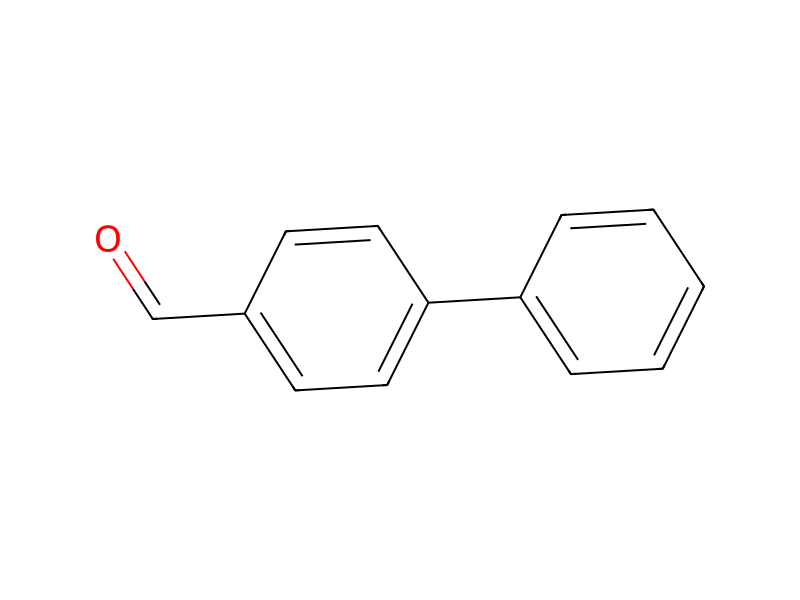
Basic information
- CAS
3218-36-8- Standard SMILES
O=Cc1ccc(-c2ccccc2)cc1- InChIKey
ISDBWOPVZKNQDW-UHFFFAOYSA-N- Molecular formula
- C13H10O
- Average molar mass
- 182.22 g/mol
- Monoisotopic mass
- 182.07316494
Names & identifiers
- Preferred name
- (1,1'-Biphenyl)-4-carboxaldehyde
- IUPAC
- 4-phenylbenzaldehyde
- English name
- 4-Biphenylcarboxaldehyde
- Molecular formula
- C13H10O
- Molecular weight
- 182.22
Names & synonyms
3218-36-84-Biphenylaldehyde[1,1'-Biphenyl]-4-carboxaldehyde(1,1'-Biphenyl)-4-carboxaldehydeNSC-46066883W14Y55SDTXSID9073961RefChem:518558DTXCID5038464221-742-34-Phenylbenzaldehyde4-Biphenylcarboxaldehyde
Show more names
4-BenzaldehydeBiphenyl-4-Carboxyaldehyde4-Biphenylcarboxaldehyde,99%4BPA-4-carboxaL
[1,1'-Biphenyl]-4-carbaldehydeBiphenyl-4-carboxaldehydep-Phenylbenzaldehyde4-FormylbiphenylBiphenyl-4-carbaldehyde4-Biphenylylcarboxaldehydep-Biphenylylaldehydep-Biphenylaldehyde
Database identifiers
- CAS
3218-36-8- PubChem CID
- 76689
- DTXSID
DTXSID9073961- ChEMBL
CHEMBL341478- UNII
- 883W14Y55S
- EC Number
- 221-742-3
- Nikkaji
- J101.929E
Properties
Computed structural properties
- XLogP
- 3.4
- Topological polar surface area
- 17.1 Ų
- Hydrogen bond donors
- 0
- Hydrogen bond acceptors
- 1
- Rotatable bonds
- 2
- Heavy atoms
- 14
- Formal charge
- 0
- Complexity
- 174
Experimental & physicochemical properties
SpringerMaterials PropertiesAngular frequency
Physicochemical properties
- Melting point
- 57 · 57-59 °C (lit.)
- Boiling point
- 184 °C/11 · 184 °C/11 mmHg (lit.)
- Density
- 1 · 1,107 g/cm3
- vapor pressure
- 0.025 Pa · 0.025Pa at 25℃
- refractive index
- 1.5994 · 1.5994 (estimate)
- Flash point
- 172 °C · 172°C
- storage temp.
- Keep in dark place,Sealed in dry,Room Temperature
- solubility
- Chloroform (Slightly), Ethyl Acetate (Slightly)
- form
- Crystals or Crystalline Powder
- color
- White to light yellow
- Water Solubility
- 17 mg/L · 17mg/L at 20℃
- Sensitive
- Air Sensitive
- BRN
- 606693 · 606693
- InChI
- 1S/C13H10O/c14-10-11-6-8-13(9-7-11)12-4-2-1-3-5-12/h1-10H
- InChIKey
- ISDBWOPVZKNQDW-UHFFFAOYSA-N
- SMILES
- O=Cc1ccc(cc1)-c2ccccc2
- LogP
- 2.98 at · 2.98 at 20℃
- CAS DataBase Reference
- 3218 · 3218-36-8(CAS DataBase Reference)
- EWG's Food Scores
- 1 · 1
- FDA UNII
- 883 W14Y55S · 883W14Y55S
- NIST Chemistry Reference
- 1 · [1,1'-Biphenyl]-4-carboxaldehyde(3218-36-8)
- EPA Substance Registry System
- 1 · [1,1'-Biphenyl]-4-carboxaldehyde (3218-36-8)
- UNSPSC Code
- 12352100 · 12352100
- NACRES
- 22 · NA.22
- Symbol(GHS)
- 7 · GHS07
- Signal word
- Warning
- Hazard statements
- 302 · H302
- Precautionary statements
- 301 · P301+P312+P330
- PPE
- 95 · dust mask type N95 (US), Eyeshields, Gloves
- Hazard Codes
- Xi
- Risk Statements
- 36 · 36/37/38
- Safety Statements
- 26 · 26-36
- WGK Germany
- 1 · 1
- RTECS
- 1767000 · DV1767000
- F
- 10 · 10-23
- Hazard Note
- Irritant
- TSCA
- TSCA listed
- HS Code
- 29122990 · 29122990
- Storage Class
- 11 · 11 - Combustible Solids
- Hazard Classifications
- 4 Oral · Acute Tox. 4 Oral
- REACH Registrations
- Active
Safety & regulation
GHS classification
GHS Classification
Warning
H302 (12%): Harmful if swallowed [Warning Acute toxicity, oral]
P261, P264, P264+P265, P270, P271, P280, P301+P317, P302+P352, P304+P340, P305+P351+P338, P319, P321, P330, P332+P317, P337+P317, P362+P364, P403+P233, P405, and P501 (click each P-code to see the statement)
Aggregated GHS information provided per 50 reports by companies from 8 notifications to the ECHA C&L Inventory. Each notification may be associated with multiple companies.
Hazard information
Regulatory Information
PMN - indicates a commenced PMN (Pre-Manufacture Notices) substance.
Status: Active Update: 23-10-2020 https://echa.europa.eu/registration-dossier/-/registered-dossier/11602
Hazard Classes and CategoriesAcute Tox. 4 (12%)
Safety data
- F
- 10-23
- PPE
- dust mask type N95 (US), Eyeshields, Gloves
- wgk
- 1
- tsca
- TSCA listed
- rtecs
- DV1767000
- hs_code
- 29122990
- risk_code
- 36/37/38
- Signal word
- Warning
- Symbol(GHS)
- GHS07
- hazard_code
- Xi
- hazard_note
- Irritant
- safety_code
- 26-36
- Storage Class
- 11 - Combustible Solids
- Hazard statements
- H302
- REACH Registrations
- Active
- Hazard Classifications
- Acute Tox. 4 Oral
- Precautionary statements
- P301+P312+P330
Chemistry & industry
Uses & manufacturing
General Manufacturing Information[1,1'-Biphenyl]-4-carboxaldehyde: ACTIVE
Applications
Uses4-Biphenylcarboxaldehyde is used in biological studies to evaluate the effects of common chemical substituents on ligand potency.
Upstream & downstream products
Downstream products
Suppliers100 total
梯希爱(上海)化成工业发展有限公司021-67121386 · [email protected]
湖北永阔科技有限公司027-59223108 15972152991 · [email protected]
山东旭晨化工科技有限公司0533-15715337262 15715337262 · [email protected]
上海阿拉丁生化科技股份有限公司400-6206333 13167063860 · [email protected]
湖北万得化工有限公司15377098680 15377098680 · [email protected]
武汉欣扬瑞和化学科技有限公司153-07155313 15307155313 · [email protected]
INTATRADE GmbH+49 3493/605464 · [email protected]
河北创海生物科技有限公司+86-86-13131129325 · [email protected]
T&W GROUP021-61551611 13296011611 · [email protected]
Baoji Guokang Healthchem co.,ltd+8615604608665 15604608665 · [email protected]
昂吉(上海)环保新材料科技有限公司 (河北福德)021-33589580; 17301695670 · [email protected]
上海赫文斯化工有限公司15721252604 17321035817 · [email protected]
Dayang Chem (Hangzhou) Co.,Ltd.+86-0571-88938639 17705817739 · [email protected]
韶远科技(上海)有限公司021-50795510 4000665055 · [email protected]
科瑞迪化学400-821-5857 021-64326257 · [email protected]
上海迈瑞尔生化科技有限公司4006356688 18621169109 · [email protected]
北京华威锐科化工有限公司0757-86329057 18934348241 · [email protected]
武汉易泰科技有限公司上海分公司18930552037 · [email protected]
阿法埃莎(中国)化学有限公司400-6106006 · [email protected]
安耐吉化学&3A(安徽泽升科技股份有限公司)400-0056266 · [email protected]
浦拉司科技(上海)有限责任公司21-58661250 18217085189 · [email protected]
上海瀚鸿科技股份有限公司021-54306202 13764082696 · [email protected]
上海钰康生物科技有限公司+86-18930848214 +86-021-56762820 · [email protected]
郑州研德生物科技有限公司0371-63682289 15538176268 · [email protected]
湖北广奥生物科技有限公司027-02702759223056 18162699093 · [email protected]
上海三牧化工技术有限公司021-38681880 13817889927
山东西亚化学有限公司13355009207 13355009207 · [email protected]
上海耐士化工科技有限公司400-188-0725 +86 21 34310725 13611771617
武汉吉业升化工有限公司027-13545242311 13545242311 · [email protected]
赛默飞世尔科技(中国)有限公司800-810-5118 · [email protected]
北京伊诺凯科技有限公司400-810-7969 010-59572699 · [email protected]
上海特伯化学科技有限公司+86-21-60341587 · [email protected]
江苏艾康生物医药研发有限公司025-66113011 13913916777 · [email protected]
TCI AMERICA800-4238616 · [email protected]
TOKYO CHEMICAL INDUSTRY CO., LTD.03-36680489 · [email protected]
TCI Europe320-37350700 · [email protected]
上海贤鼎生物科技有限公司4009209199 · [email protected]
上海笛柏生物科技有限公司400-008-9730,021-54359730 400-008-9730 · [email protected]
郑州鸿晟医药科技有限公司0371-0371-13526885213 15637198702 · [email protected]
北京福源坊科技有限公司010-57903446 15869909019 · [email protected]
陕西缔都医药化工有限公司+86-029-81138252 +86-173 9270 1263 · [email protected]
上海御略医药科技有限公司021-60345187 13671753212 · [email protected]
上海鑫圭生物科技有限公司15121041756 · [email protected]
杭州杰恒化工有限公司0571-87396432 · [email protected]
上海嵩爰化工科技有限公司010-1234567 18521000990 · [email protected]
武汉弘德悦欣医药科技有限公司027-83855396 15271852016
湖北巨胜科技有限公司027-59599241 18871490274 · [email protected]
Sigma-Aldrich西格玛奥德里奇(上海)贸易有限公司021-61415566 800-8193336 · [email protected]
上海昕凯医药科技有限公司21-619849051-1 18521059765 · [email protected]
Henan Alfa Chemical Co., Ltd+8618339805032 · [email protected]
Related reactions
117 records


Compound notes
Loading…