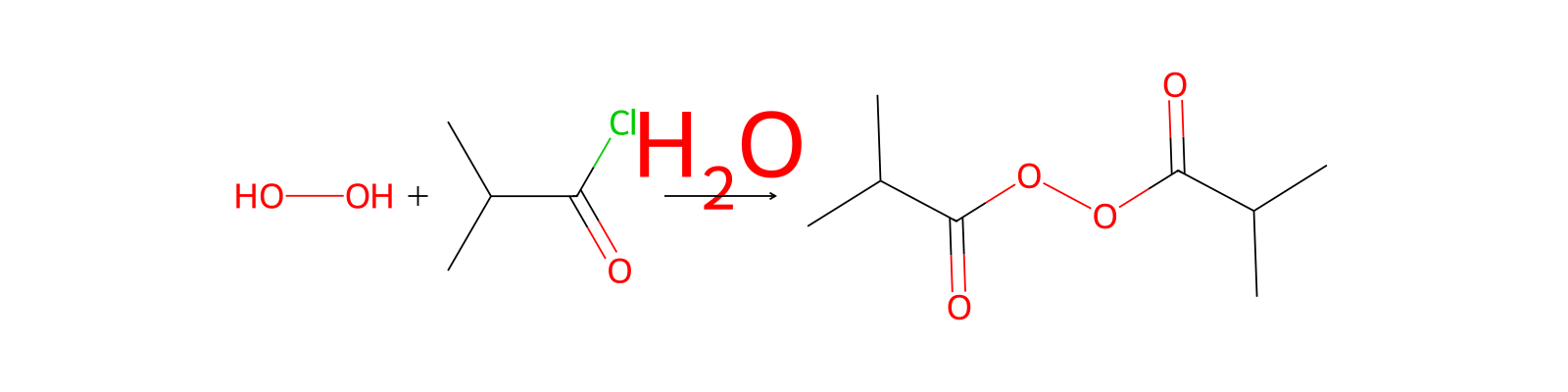
Peroxide, bis(2-methyl-1-oxopropyl)
Completing data — refresh the page later to see the latest
Basic information
- CAS
3437-84-1- Standard SMILES
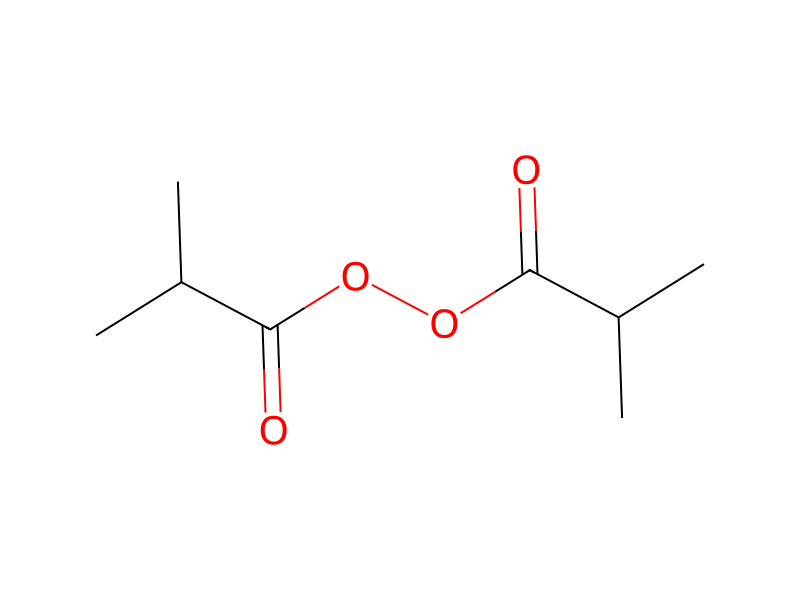
CC(C)C(=O)OOC(=O)C(C)C- InChIKey
RPBWMJBZQXCSFW-UHFFFAOYSA-N- Molecular formula
- C8H14O4
- Average molar mass
- 174.19 g/mol
- Monoisotopic mass
- 174.08920893
Overview
This liquid peroxide is particularly sensitive to temperature rises and contamination. Above a given "Control Temperature" they decompose violently.
Names & identifiers
- Preferred name
- Peroxide, bis(2-methyl-1-oxopropyl)
- IUPAC
- 2-methylpropanoyl 2-methylpropaneperoxoate
- English name
- Diisobutyryl peroxide
- Molecular formula
- C8H14O4
- Molecular weight
- 174.19
Names & synonyms
Peroxide, bis(2-methyl-1-oxopropyl)3437-84-1isobutyryl peroxidediisobutyryl peroxideBisisobutyryl peroxideEINECS 222-340-0EC 222-340-025V73818UNDTXSID0063024isobutyroyl peroxideRefChem:860356TRIGONOX 187C30
Show more names
Diisobutyroyl peroxidediisobutyryl peroxide, 33-52%Bis(2-methyl-1-oxopropyl) peroxidePeroxide,bis(2-methyl-1-oxopropyl)
DTXCID0038833222-340-02-methylpropanoyl 2-methylpropaneperoxoatediisopropylperoxyanhydrideUNII-25V73818UNbis(2-methyl-1-oxopropyl)peroxidediisobutanoyl peroxidedi-iso-butyryl peroxide
Database identifiers
- CAS
3437-84-1- PubChem CID
- 76969
- DTXSID
DTXSID0063024- UNII
- 25V73818UN
- EC Number
- 222-340-0
- Nikkaji
- J1.256D
Properties
Computed structural propertiesFilling in
- XLogP
- 2.3
- Topological polar surface area
- 52.6 Ų
- Hydrogen bond donors
- 0
- Hydrogen bond acceptors
- 4
- Rotatable bonds
- 5
- Heavy atoms
- 12
- Formal charge
- 0
- Complexity
- 152
Experimental & physicochemical properties
Physical DescriptionThis liquid peroxide is particularly sensitive to temperature rises and contamination. Above a given "Control Temperature" they decompose violently.
Physicochemical properties
- Boiling point
- 225.17 °C · 225.17°C (rough estimate)
- Density
- 1.0817 · 1.0817 (rough estimate)
- vapor pressure
- 1.2 · 1.2-2.41hPa at 20-25℃
- refractive index
- 1.422 · 1.4220 (estimate)
- Water Solubility
- 49.1 g/L · 49.1g/L at 25℃
- InChI
- InChI=1S/C8H14O4/c1-5(2)7(9)11-12-8(10)6(3)4/h5-6H,1-4H3
- InChIKey
- RPBWMJBZQXCSFW-UHFFFAOYSA-N
- SMILES
- O(C(=O)C(C)C)OC(=O)C(C)C
- LogP
- 0.94 · 0.94-2.6 at 20-25℃
- FDA UNII
- 25 V73818UN · 25V73818UN
- EPA Substance Registry System
Safety & regulation
Safety information is for reference only and does not replace the supplier’s Safety Data Sheet (SDS), applicable regulations, or professional assessment.
GHS classification
GHS Classification
Danger
H241 (100%): Heating may cause a fire or explosion [Danger Self-reactive substances and mixtures; Organic peroxides]
P210, P234, P235, P240, P260, P261, P264, P264+P265, P272, P280, P301+P316, P301+P330+P331, P302+P352, P302+P361+P354, P304+P340, P305+P351+P338, P305+P354+P338, P316, P321, P331, P333+P317, P337+P317, P362+P364, P363, P370+P380+P375[+P378], P403, P405, P410, P411, P420, and P501 (click each P-code to see the statement)
Aggregated GHS information provided per 5 reports by companies from 2 notifications to the ECHA C&L Inventory. Each notification may be associated with multiple companies.
Hazard information
Regulatory InformationStatus: Active Update: 12-06-2019 https://echa.europa.eu/registration-dossier/-/registered-dossier/11632
DOT LabelOrganic Peroxide
Fire HazardsExcerpt from ERG Guide 148 [Organic Peroxides (Heat and Contamination Sensitive / Temperature Controlled)]:
Health HazardsExcerpt from ERG Guide 148 [Organic Peroxides (Heat and Contamination Sensitive / Temperature Controlled)]:
Reactive GroupPeroxides, Organic
Reactivity AlertsExplosive
Reactivity Profile
Most of the isolated diacyl peroxides are solids with relatively low decomposition temperatures, and are explosive, and sensitive to shock, heat, or friction. Several, particularly the lower members, will detonate on the slightest disturbance. Autocatalytic, self-accelerating decomposition, which is promoted by tertiary amines, is involved. A sample of DIISOBUTYRYL PEROXIDE in ether was being evaporated to dryness with a stream of air when it exploded violently, [MCA Case History No. 579]. Can generate electrostatic charges. REF [Handling Chemicals Safely, 1980. p. 250].
Chemistry & industry
Uses & manufacturing
General Manufacturing InformationPeroxide, bis(2-methyl-1-oxopropyl): ACTIVE
Applications
UsesDiisobutyryl peroxide is used as a polymer initiator in industries such as polyvinyl chloride, ethylene, and plexiglass.
General DescriptionDiisobutyryl peroxide(in solution,content≤52%) is particularly sensitive to temperature rises and contamination. Above a given "Control Temperature" they decompose violently.
Upstream & downstream products
Downstream products
Related reactions
3 records


Compound notes
Loading…