Hydrogen Peroxide → Diethyl peroxydicarbonate
Reaction equation

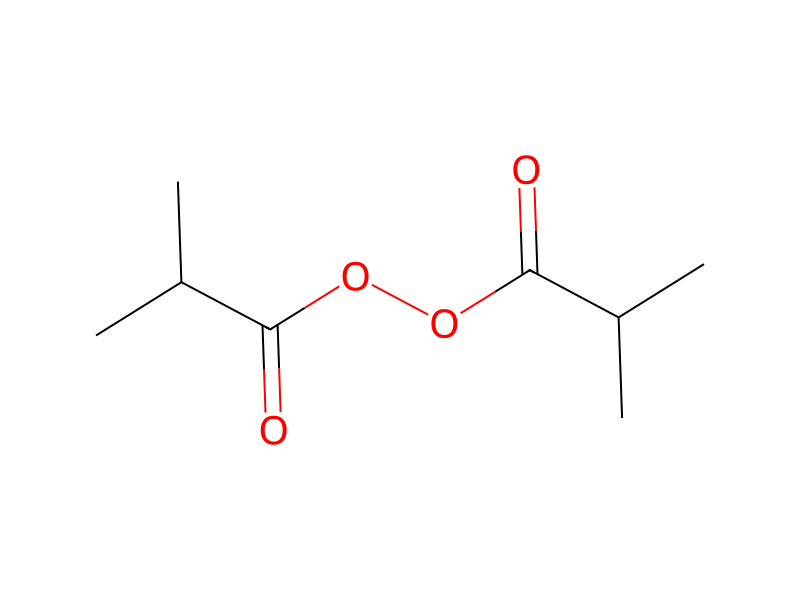
[CH:1](Cl)=[CH2:2].C(O[O:10][C:11](=[O:15])C(C)C)(=O)C(C)C.C([O:21][C:22]([O:24][CH2:25][CH3:26])=[O:23])(=O)OCC.[OH:27]O>>[C:22]([O:21][O:10][C:11]([O:15][CH2:1][CH3:2])=[O:27])([O:24][CH2:25][CH3:26])=[O:23]Participants
5



Procedure
The data of Example III shows that the combined use of isobutyric anhydride and hydrogen peroxide in amounts sufficient to produce theoretically 4.0 × 10⁻⁴ moles of diisobutyryl peroxide can initiate the polymerization of vinyl chloride at 50° C. The data further shows that the peroxide is exhausted early in the polymerization. The data of Example IV shows that the combined use of diethyl pyrocarbonate and hydrogen peroxide in amounts sufficient to produce theoretically 3.35 × 10⁻⁴ moles of diethyl peroxydicarbonate can initiate the polymerization of vinyl chloride at 50° C. and provide high conversions. Thus, by combining the initiation systems of Examples III and IV as, for example, in Example I (4.5 × 10⁻⁴ total moles of theoretical initiator), a smooth and continuous polymerization to high conversions is obtained.