
Basic information
- Standard SMILES
CCCCNc1ccc(C(=O)OCCOCCOCCOCCOCCOCCOCCOCCOCCOC)cc1- InChIKey
MAFMQEKGGFWBAB-UHFFFAOYSA-N- Molecular formula
- C30H53NO11
- Average molar mass
- 603.7 g/mol
- Monoisotopic mass
- 603.36186152
Overview
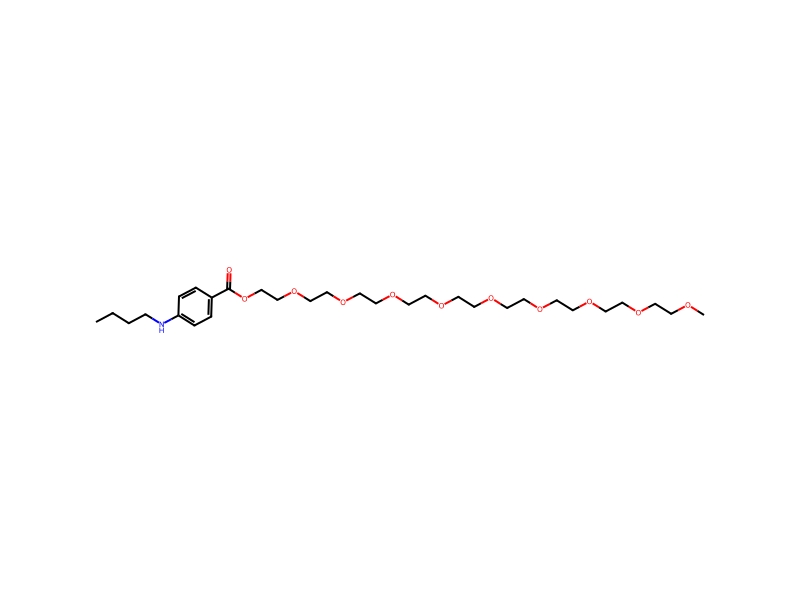
Benzonatate is the ester obtained by formal condensation of 4-butylaminobenzoic acid with nonaethylene glycol monomethyl ether. Structurally related to procaine and benzocaine, it has an anaesthetic effect on the stretch sensors in the lungs, and is used as a non-narcotic cough suppressant. It has a role as an anaesthetic and an antitussive. It is a benzoate ester, a substituted aniline and a secondary amino compound. It is functionally related to a 4-(butylamino)benzoic acid and a nonaethylene glycol monomethyl ether.
Names & identifiers
- Preferred name
- Benzonatate
- IUPAC
- 2-[2-[2-[2-[2-[2-[2-[2-(2-methoxyethoxy)ethoxy]ethoxy]ethoxy]ethoxy]ethoxy]ethoxy]ethoxy]ethyl 4-(butylamino)benzoate
- English name
- Benzonatate
- Molecular formula
- C30H53NO11
- Molecular weight
- 603.74
Names & synonyms
Benzonatate104-31-4BenzononatineTessalonBenzonatatumBenzonatatoTessalon PerlesZonatuss2,5,8,11,14,17,20,23,26-nonaoxaoctacosan-28-yl 4-(butylamino)benzoateDTXSID90226552,5,8,11,14,17,20,23,26-Nonaoxaoctacosan-28-yl p-(butylamino)benzoatenonaethyleneglycol monomethyl ether p-n-butylaminobenzoate
Show more names
km65exangittesalontessalinventussinenzonatatetessalon-ciba
NSC-7601284-(butylamino)benzoic acid 3,6,9,12,15,18,21,24,27-nonaoxaoctacos-1-yl esterBenzoic acid, 4-(butylamino)-, 2,5,8,11,14,17,20,23,26-nonaoxaoctacos-28-yl esterCHEBI:3032DTXCID902655p-butylaminobenzoic acid omega-O-methylnonaethyleneglycol ester3,6,9,12,15,18,21,24,27-nonaoxaoctacosyl 4-butylaminobenzoate2-[2-[2-[2-[2-[2-[2-[2-(2-methoxyethoxy)ethoxy]ethoxy]ethoxy]ethoxy]ethoxy]ethoxy]ethoxy]ethyl 4-butylaminobenzoate
Database identifiers
- CAS
104-31-4- PubChem CID
- 7699
- DTXSID
DTXSID9022655- ChEMBL
CHEMBL1374379- ChEBI
CHEBI:3032- EC Number
- 203-194-7
- Nikkaji
- J5.030J
Properties
Computed structural properties
- XLogP
- 2.4
- Topological polar surface area
- 121 Ų
- Hydrogen bond donors
- 1
- Hydrogen bond acceptors
- 12
- Rotatable bonds
- 33
- Heavy atoms
- 42
- Formal charge
- 0
- Complexity
- 565
Experimental & physicochemical properties
Drugs
Pharmaceuticals -> Listed in ZINC15
Pharmaceuticals
LogP
log Kow = 2.45
1.2
2.45
Color/FormColorless to faintly yellow oil
Solubility
Soluble in most organic solvents except aliphatic hydrocarbons
1.59e-03 g/L
Human Drugs
Breast Feeding; Lactation; Milk, Human; Antitussive Agents
FDA approved drugs -> Active ingredient
FDA approved drugs -> Active ingredient
Physical DescriptionLiquid
Physicochemical properties
- Boiling point
- 649 · 649.0±55.0 °C(Predicted)
- Density
- 1.096 · 1.096±0.06 g/cm3(Predicted)
- storage temp.
- Refrigerator, under inert atmosphere
- solubility
- Chloroform (Slightly), Methanol (Slightly)
- pka
- 2.2 · 2.20±0.39(Predicted)
- form
- Oil
- color
- Light Yellow to Light Brown
- BCS Class
- 3 · 3
- InChI
- 1S/C30H53NO11/c1-3-4-9-31-29-7-5-28(6-8-29)30(32)42-27-26-41-25-24-40-23-22-39-21-20-38-19-18-37-17-16-36-15-14-35-13-12-34-11-10-33-2/h5-8,31H,3-4,9-27H2,1-2H3
- InChIKey
- MAFMQEKGGFWBAB-UHFFFAOYSA-N
- SMILES
- C(OCCOCCOCCOCCOCCOCCOCCOCCOCCOC)(=O)C1=CC=C(NCCCC)C=C1
- CAS DataBase Reference
- 104 · 104-31-4(CAS DataBase Reference)
- FDA UNII
- 5 P4DHS6ENR · 5P4DHS6ENR
- ATC code
- 5 DB01 · R05DB01
- UNSPSC Code
- 41116107 · 41116107
- NACRES
- 25 · NA.25
- Symbol(GHS)
- 7 · GHS07
- Signal word
- Warning
- Hazard statements
- 302 · H302-H319-H335-H315
- Precautionary statements
- 264 · P264-P280-P305+P351+P338-P337+P313P-P264-P270-P301+P312-P330-P501-P264-P280-P302+P352-P321-P332+P313-P362
- WGK Germany
- 3 · WGK 3
- Storage Class
- 11 · 11 - Combustible Solids
- Hazard Classifications
- 3 · Aquatic Chronic 3
- Hazardous Substances Data
- 104 · 104-31-4(Hazardous Substances Data)
- Toxicity
- 50 oral · LD50 oral in mouse: 400mg/kg
Safety & regulation
GHS classification
GHS Classification
Warning
H302 (50%): Harmful if swallowed [Warning Acute toxicity, oral]
P261, P264, P264+P265, P270, P271, P273, P280, P301+P317, P302+P352, P304+P340, P305+P351+P338, P319, P321, P330, P332+P317, P337+P317, P362+P364, P403+P233, P405, and P501 (click each P-code to see the statement)
Aggregated GHS information provided per 2 reports by companies from 2 notifications to the ECHA C&L Inventory. Each notification may be associated with multiple companies.
Hazard information
Fire PotentialThis material is assumed to be combustible.
FDA Requirements
The Approved Drug Products with Therapeutic Equivalence Evaluations identifies currently marketed prescription drug products, including benzonatate, approved on the basis of safety and effectiveness by FDA under sections 505 of the Federal Food, Drug, and Cosmetic Act.
Toxic Combustion ProductsEmits toxic fumes under fire conditions.
Hazard Classes and CategoriesAcute Tox. 4 (50%)
Safety & protection
Fire Fighting Procedures
Water spray, dry chemical, carbon dioxide, or foam as appropriate for surrounding fire and materials. ... As with all fires, evacuate personnel to a safe area. Firefighters should use self-contained breathing equipment and protective clothing.
Storage Conditions
Store in tight, light-resistant container as defined in the USP-NF. This material should be handled and stored per label instructions to ensure product integrity.
Commercially available benzonatate liquid-filled capsules should be stored in tight, light-resistant containers at a controlled room temperature of 15-30 °C.
Cleanup Methods
Wear approved respiratory protection, chemically compatible gloves, and protective clothing. Wipe up spillage or collect spillage using a high- efficiency vacuum cleaner. Avoid breathing vapor. Ventilate area and wash spill site. Place spillage in appropriately labeled container for disposal.
Disposal Methods
SRP: Expired or waste pharmaceuticals shall carefully take into consideration applicable DEA, EPA, and FDA regulations. It is not appropriate to dispose by flushing the pharmaceutical down the toilet or discarding to trash. If possible return the pharmaceutical to the manufacturer for proper disposal being careful to properly label and securely package the material. Alternatively, the waste pharmaceutical shall be labeled, securely packaged and transported by a state licensed medical waste contractor to dispose by burial in a licensed hazardous or toxic waste landfill or incinerator.
SRP: At the time of review, regulatory criteria for small quantity disposal are subject to significant revision, however, household quantities of waste pharmaceuticals may be managed as follows: Mix with wet cat litter or coffee grounds, double bag in plastic, discard in trash.
Preventive Measures
SRP: Local exhaust ventilation should be applied wherever there is an incidence of point source emissions or dispersion of regulated contaminants in the work area. Ventilation control of the contaminant as close to its point of generation is both the most economical and safest method to minimize personnel exposure to airborne contaminants. Ensure that the local ventilation moves the contaminant away from the worker.
Engineering controls such as exhaust ventilation are recommended.
As a general rule, when handling USP Reference Standards avoid all contact and inhalation of dust, mists, and/or vapors associated with the material. Wash thoroughly after handling.
Toxicology
Interactions
Benzonatate is chemically related to anesthetic agents of the para-amino-benzoic acid class (e.g. procaine; tetracaine) and has been associated with adverse CNS effects possibly related to a prior sensitivity to related agents or interaction with concomitant medication.
Human Toxicity Excerpts
/SIGNS AND SYMPTOMS/ The signs and symptoms of overdose of benzonatate have been reported within 15-20 minutes. If capsules are chewed or dissolved in the mouth, oropharyngeal anesthesia will develop rapidly, which may cause choking and airway compromise. CNS stimulation may cause restlessness and tremors which may proceed to clonic convulsions followed by profound CNS depression. Convulsions, coma, cerebral edema and cardiac arrest leading to death have been reported within 1 hour of ingestion.
/SIGNS AND SYMPTOMS/ Accidental ingestion of Tessalon resulting in death has been reported in children below age 10. Signs and symptoms of overdose have been reported within 15-20 minutes and death has been reported within one hour of ingestion. If accidental ingestion occurs, seek medical attention immediately
/CASE REPORTS/ A 12-month-old male presented to the emergency department of a rural hospital following ingestion of an unknown amount of benzonatate. Upon arrival, the child was seizing and in full cardiac arrest. Resuscitative measures were unsuccessful and the child died shortly after arriving at the emergency department.
/CASE REPORTS/ A 17-year-old woman with no previous medical history presented to the Emergency Department (ED) status post cardiac arrest. One to two hours prior, the patient had ingested at least ten 200 mg Tessalon capsules as part of a suicide attempt. The patient was sedated, intubated, and given magnesium as prophylaxis against recurrent dysrhythmias. Emergent gastric lavage was performed and well tolerated. A 24 hr hypothermia protocol with 6 hr cooling period was initiated. Toxicological studies, chest radiograph, and a computed tomography scan of the head were all unremarkable. The patient was admitted to the Pediatric Intensive Care Unit for further work-up and supportive care. The patient was extubated and able to follow some commands 1 week post-admission. The patient developed blindness and experienced generalized confabulations, which did not resolve. Ingestion of Tessalon, a seemingly innocuous and widely prescribed antitussive, may pose a risk to patients due to its potential for the rapid development of life-threatening adverse events and limited treatment options in the overdose setting.
For more Human Toxicity Excerpts (Complete) data for Benzonatate (7 total), please visit the HSDB record page.
Drug Induced Liver Injury
Drug Induced Liver Injury Rank (DILIrank 2.0)
Benzonatate
vLess-DILI-concern
0
No match
DOI:10.1016/j.drudis.2016.02.015
Populations at Special RiskSafety and effectiveness in children below the age of 10 have not been established. Accidental ingestion resulting in death has been reported in children below age 10. Keep out of reach of children.
Probable Routes of Human ExposureNIOSH (NOES Survey 1981-1983) has statistically estimated that 197 workers (59 of these were female) were potentially exposed to benzonatate in the US(1).
Antidote and Emergency Treatment
In case of overdose, seek medical attention immediately. Evacuate gastric contents and administer copious amounts of activated charcoal slurry. Even in the conscious patient, cough and gag reflexes may be so depressed as to necessitate special attention to protection against aspiration of gastric contents and orally administered materials. Convulsions should be treated with a short-acting barbiturate given intravenously and carefully titrated for the smallest effective dosage. Intensive support of respiration and cardiovascular-renal function is an essential feature of the treatment of severe intoxication from overdosage. Do not use CNS stimulants.
Emergency and supportive measures. Maintain an open airway and assist ventilation if necessary. Treat coma, seizures, hypotension, arrhythmias, and anaphylaxis if they occur. ... Monitor vital signs and ECG for at least 6 hours /Anesthetics, local/.
Decontamination. Parenteral exposure: Decontamination is not feasible. Ingestion:. Administer activated charcoal orally if conditions are appropriate. Gastric lavage is not necessary after small to moderate ingestins if activated charcoal can be given promptly. /Anesthetics, local/.
/SRP:/ Immediate first aid: Ensure that adequate decontamination has been carried out. If patient is not breathing, start artificial respiration, preferably with a demand valve resuscitator, bag-valve-mask device, or pocket mask, as trained. Perform CPR if necessary. Immediately flush contaminated eyes with gently flowing water. Do not induce vomiting. If vomiting occurs, lean patient forward or place on the left side (head-down position, if possible) to maintain an open airway and prevent aspiration. Keep patient quiet and maintain normal body temperature. Obtain medical attention. /Poisons A and B/
For more Antidote and Emergency Treatment (Complete) data for Benzonatate (6 total), please visit the HSDB record page.
Effects During Pregnancy and Lactation◉ Summary of Use during Lactation
Regulatory information
FDA Requirements
The Approved Drug Products with Therapeutic Equivalence Evaluations identifies currently marketed prescription drug products, including benzonatate, approved on the basis of safety and effectiveness by FDA under sections 505 of the Federal Food, Drug, and Cosmetic Act.
Safety data
- wgk
- WGK 3
- Toxicity
- LD50 oral in mouse: 400mg/kg
- Signal word
- Warning
- Symbol(GHS)
- GHS07
- Storage Class
- 11 - Combustible Solids
- Hazard statements
- H302-H319-H335-H315
- Hazard Classifications
- Aquatic Chronic 3
- Precautionary statements
- P264-P280-P305+P351+P338-P337+P313P-P264-P270-P301+P312-P330-P501-P264-P280-P302+P352-P321-P332+P313-P362
- Hazardous Substances Data
- 104-31-4(Hazardous Substances Data)
Chemistry & industry
Pharmacology
ATC Code
R - Respiratory system
QR - Respiratory system
Protein BindingThere is limited information on the protein binding profile of benzonatate.
Pharmacodynamics
Benzonatate suppresses cough associated with both acute and chronic respiratory conditions. Its works by desensitizing the pulmonary stretch receptors involved in the cough reflex. There are limited clinical trials of benzonatate; however, earlier studies demonstrated inhibition of experimentally-induced cough and subjectively-measured pathological cough by benzonatate. Benzonatate has no inhibitory effects on the respiratory center in recommended dosage. Its onset of action is within 15 to 20 minutes following administration and its duration of effect is about 3 to 8 hours.
Mechanism of Action
Benzonatate is a local anesthetic drug that acts peripherally by anesthetizing and reducing the activity of vagal stretch receptors or nerve fibres located in the respiratory passages, lungs, and pleura. Once the stretch receptors are stimulated, they send impulses to the cough centre located in the medulla via an afferent pathway consisting of sensory nerve fibres or the vagus nerve. The efferent signal is then generated that sends impulses to the expiratory muscles to produce a cough. Anesthetizing these receptors by benzonatate results in the inhibition of the cough reflex activity and cough production. Benzonatate also inhibits the transmission of impulses of the cough reflex in the vagal nuclei of the medulla. There are several proposed mechanisms of benzonatate; it is also a potent voltage-gated sodium channel inhibitor.
Benzonatate apparently inhibits cough production by anesthetizing stretch receptors of vagal afferent fibers in the bronchi, alveoli, and pleura that mediate the cough reflex; the drug also suppresses transmission of the cough reflex at the level of the medulla where the afferent impulse is transmitted to the motor nerves. The relationship between local anesthetic action and peripheral action on sensory nerve endings is not clear.
Biological Half-LifeThe half life of benzonatate following oral administration of 100 mg in healthy Chinese volunteers was 1.01 ± 0.41 h.
Metabolism/MetabolitesBenzonatate is hydrolyzed to the major metabolite 4-(butylamino)benzoic acid (BABA) by plasma butyrylcholinesterase (BChE).
FDA Pharmacological Classification
5P4DHS6ENR
BENZONATATE
Physiologic Effects [PE] - Decreased Tracheobronchial Stretch Receptor Activity
Established Pharmacologic Class [EPC] - Non-narcotic Antitussive
Benzonatate is a Non-narcotic Antitussive. The physiologic effect of benzonatate is by means of Decreased Tracheobronchial Stretch Receptor Activity.
BENZONATATE
MeSH Pharmacological ClassificationAgents that suppress cough. They act centrally on the medullary cough center. EXPECTORANTS, also used in the treatment of cough, act locally.
Absorption, Distribution and Excretion
Following oral administration, benzonatate enters the systemic circulation via gastrointestinal absorption. The Cmax of benzonatate following oral administration of 100 mg in healthy Chinese volunteers was 1063 ± 460 ng/mL.
There is limited information on the route of elimination of benzonatate.
There is limited information on the volume of distribution of benzonatate.
There is limited information on the clearance of benzonatate.
Cellular LocationsMembrane
Uses & manufacturing
Uses
MEDICATION
Use (kg) in USA (2002): 10600
Methods of Manufacturing
Ethyl p-(butylamino)benzoate is transesterified with a polyethylene glycol monomethyl ether fraction in a methanol solution of sodium methoxide. The crude ester is purified by extracting its benzene solution with sodium carbonate solution, the ester being retained in the benzene.
Formulations/PreparationsTable: Benzonatate Preparations [Table#7770]
Applications
DescriptionBenzonatate is a reversible voltage-gated sodium channel blocker. It blocks Nav1.7 currents in a concentration- and voltage-dependent manner (IC50s = 5.9 and 1.4 μM at holding potentials of -100 and -70 mV, respectively) and inhibits action potential firing in catecholamine A differentiated (CAD) cells. Benzonatate also blocks 80% of Nav1.3 currents in N1E-115 cells when used at a concentration of 100 μM. In vivo, benzonatate (0.85 mg/min) reduces the frequency, but has no effect on the amplitude, of the cough reflex in anesthetized dogs. Formulations containing benzonatate have been used as antitussive agents for the treatment of coughs.
HistoryBenzonatate is used to relieve cough. Benzonatate is in a class of medications called antitussives (cough suppressants). It works by reducing the cough reflex in the lungs and air passages. It was first synthesized in 1956 and was introduced as an antitussive in the United States in 1958.Availability worldwide is limited, with the drug remaining marketed only in the United States and Mexico. In 2023, it was the 122nd most commonly prescribed medication in the United States, with more than 5 million prescriptions. A 2023 systematic review found that there is inadequate evidence to support the effectiveness and safety of benzonatate for cough and highlighted rising safety concerns.
UsesAntitussive
Upstream & downstream products
Upstream raw materials
Suppliers50 total
国药集团化学试剂有限公司86-21-63210123 · [email protected]
北京华美互利生物化工010-56205725 · [email protected]
Career Henan Chemica Co+86-0371-86658258 +86-13203830695 · [email protected]
武汉英诺医药科技有限公司+86-027-59232304 15387063101 · [email protected]
成都超九八生物科技有限公司13348960310 13348960310 · [email protected]
武汉敬康恩生物医药科技有限公司13720134139 086-15871494362 13720134139 · [email protected]
上海麦克林生化科技股份有限公司021-50706066 15221275939 · [email protected]
咸宁深蓝生物医药研发有限公司18171815831 · [email protected]
上海毕得医药科技股份有限公司400-1647117 13681763483 · [email protected]
普善实业(陕西)有限公司029-81310890 18165209495 · [email protected]
Dayang Chem (Hangzhou) Co.,Ltd.+86-0571-88938639 17705817739 · [email protected]
上海微佳禾生物科技有限公司17502176150; 17502176150 · [email protected]
LGM Pharma1-(800)-881-8210 · [email protected]
Syntechem Co.,Ltd[email protected]
Protheragen-ING+86-15618352007 · [email protected]
United Life Science020-82099279 18988941402 · [email protected]
銳迪國際科技有限公司18024082417 · [email protected]
武汉丰泰威远科技有限公司+86-27-8746-5837 +86-18627785180 · [email protected]
NANJING YINGWEN BIOTECHNOLOGY CO LTD+86-13382787392 · [email protected]
武汉丰泰威远科技有限公司027-87465837 19945049750 · [email protected]
邯郸市泽池贸易有限公司19293117057 · [email protected]
南京生利德生物科技有限公司025-57798810 18652991625 · [email protected]
武汉鹏胤药业有限公司13163333255 · [email protected]
上海倍卓生物科技有限公司021-61119791,13386096464 · [email protected]
上海丽康新材料有限公司+86-16631818819 +86-17736933208 · [email protected]
PT CHEM GROUP LIMITED+86-85511178; +86-85511178 · [email protected]
上海湄水化工科技有限公司021-60549325 18616193163
HBCChem, Inc.+1-510-219-6317 · [email protected]
Wuhan Jingkang en Biomedical Technology Co., Ltd+86-0086-13720134139 · [email protected]
Chongqing jooe co., ltd+86-15223382610 · [email protected]
青岛海智微元生物科技有限公司18317699790 18317699790 · [email protected]
梯尔希(南京)药物研发有限公司18012923235 · [email protected]
上海楼岚生物科技有限公司021-52996696,15000506266 15000506266
深圳振强药物研发有限公司+86-0755-66853366 +86-13670046396 · [email protected]
上海昕凯医药科技有限公司21-619849051-1 18521059765 · [email protected]
上海陶术生物科技股份有限公司+1-781-999-5354; +1-00000000000 · [email protected]
西安美川生物科技有限公司029-89275612 +8618991951683 · [email protected]
北京建强伟业科技有限公司(FUSION弗珍试剂品牌)0531-88924771 15614660963 · [email protected]
上海阿拉丁生化科技股份有限公司6206333 13167063860 · [email protected]
上海珞珐生化科技有限公司021-51111890 15317326293 · [email protected]
上海岚克医药科技发展有限公司0086-21-58956006
上海源叶生物科技有限公司13636370518 · [email protected]
上海超岚化工科技中心QQ:65489617 13301690235 · [email protected]
BOC Sciences[email protected]
深圳市祥根生物医药有限公司0755-28967200 13631290199 · [email protected]
杭州洁汉化工有限公司+86-571-86217390; +8618058761490 · [email protected]
上海易恩化学技术有限公司400-400-1332688 18019345275 · [email protected]
河南天孚化工有限公司+86-0371-55170693 +86-19937530512 · [email protected]
厦门盈融达化工有限公司+86-0592-6210733 · [email protected]
济南药研药物化学有限公司[email protected]
Additional notes
DefinitionChEBI: The ester obtained by formal condensation of 4-butylaminobenzoic acid with nonaethylene glycol monomethyl ether. Structurally related to procaine and benzocaine, it has an anaesthetic effect on the stretch sensors in the lungs, and is used as a non-narcoti cough suppressant.
Related reactions
14 records






Linked notes
Loading…