
HRID 362129As product
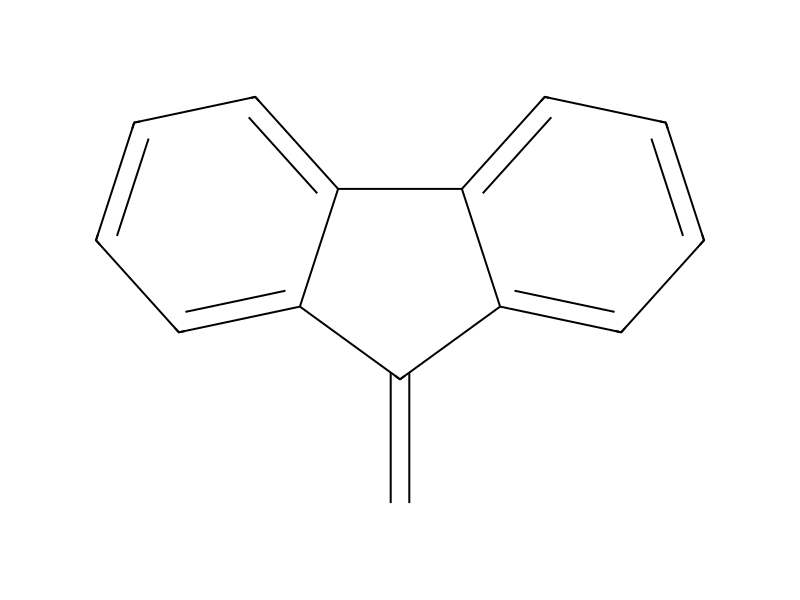
4425-82-5C=C1c2ccccc2-c2ccccc21ZYASLTYCYTYKFC-UHFFFAOYSA-N4425-82-5DTXSID90196082Safety information is for reference only and does not replace the supplier’s Safety Data Sheet (SDS), applicable regulations, or professional assessment.
Warning
H315 (100%): Causes skin irritation [Warning Skin corrosion/irritation]
P261, P264, P264+P265, P271, P280, P302+P352, P304+P340, P305+P351+P338, P319, P321, P332+P317, P337+P317, P362+P364, P403+P233, P405, and P501 (click each P-code to see the statement)
Aggregated GHS information provided per 3 reports by companies from 3 notifications to the ECHA C&L Inventory. Each notification may be associated with multiple companies.
Description9-Methylene-9H-fluorene is a fluorescent probe that can be used to detect the presence of hydroxyl groups in vitro. It reacts with the hydroxyl group on the substrate film and emits light, which is then detected using a fluorometer. The reaction mechanism is shown below. Fluorophores are often used for sample preparation because they are relatively stable and can be easily removed from the final product. 9-Methylene-9H-fluorene has been shown to enhance cationic polymerization, which can lead to improved efficacy in some applications.
Uses9-Methylidenefluorene is an analog of 9-Methylfluorene (M305335); a compound that has been shown to be mutagenic in Salmonella typhimurium TA98 and TA100 in the presence of 9000 X g supernantant from Aroclor-induced rats.
PreparationA suspension of methyl triphenylphosphonium bromide (31.22 g; 87.3 mmol) in 500 mL of ether was added at -30°C. 10M n-butyllithium in hexane (8.73 mL; 87.3 mmol) was added to the mixture, and the mixture was stirred at room temperature for 1-2 hours. To the above mixture, 15 g (83.2 mmol) of 9-fluorenone in 50 mL of tetrahydrofuran was added, and the mixture was refluxed for 1 hour. After cooling the above mixture to 0°C, 9-Methylene-9H-fluorene was obtained after purification.


