Reaction equation

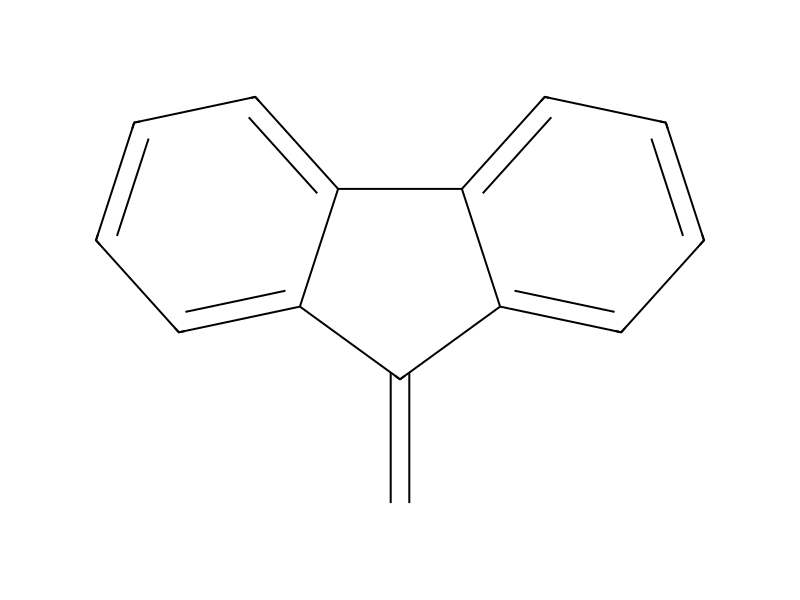
C(O[CH2:5][CH:6]1[C:18]2[CH:17]=[CH:16][CH:15]=[CH:14][C:13]=2[C:12]2[C:7]1=[CH:8][CH:9]=[CH:10][CH:11]=2)(=O)C.CC(C)([O-])C.[K+].Cl>CCOCC>[CH2:5]=[C:6]1[C:7]2[C:12](=[CH:11][CH:10]=[CH:9][CH:8]=2)[C:13]2[C:18]1=[CH:17][CH:16]=[CH:15][CH:14]=2Participants
Reactant 3



Product 1
Reagents, catalysts & solvents 1

Conditions
- Temperature
- 5 °C
Procedure
A 1000 mL flask was charged with 9-acetoxymethylfluorene (30.0 g, 126 mmol) and anhydrous petroleum ether (bp 35-60° C., 400 mL, Aldrich) and it was cooled to 5° C. Solid potassium tert-butoxide (16.0 g, 142 mmol, Aldrich) was added in one portion. After stirring for 6 hours, the mixture was poured into dilute HCl (200 mL, 0.1 N). Et2O was added (100 mL); the layers were separated and the product extracted into Et2O (2×100 mL). Combined organic portions were dried over anhydrous MgSO4 and the solvent was removed via rotary evaporation. The crude product dibenzofulvene was isolated as a yellow solid (21.3 g, 94% yield, >99% pure by GC). Further purification was accomplished by recrystallization from petroleum ether, to yield dibenzofulvene in the form of white needles (Tm 51.5-53° C.).
Workup
- customthe layers were separated
- extractionthe product extracted into Et2O (2×100 mL)
- dry with materialCombined organic portions were dried over anhydrous MgSO4
- customthe solvent was removed via rotary evaporation
Sources & evidence
- ORD record
- ord-54f4cf02a21b4680a27a9e5b6e869325
- Source dataset
- uspto-grants-2000_12
- Patent number
- US06162937
Linked notes
Loading…