HomeMCPWorkbenchSkills
HomeWorkbenchNotificationsMe
llms.txt · MCP GuidePrivacy Policy · Terms of Service · Supportv1.8.3
  1. Home
  2. /Compound

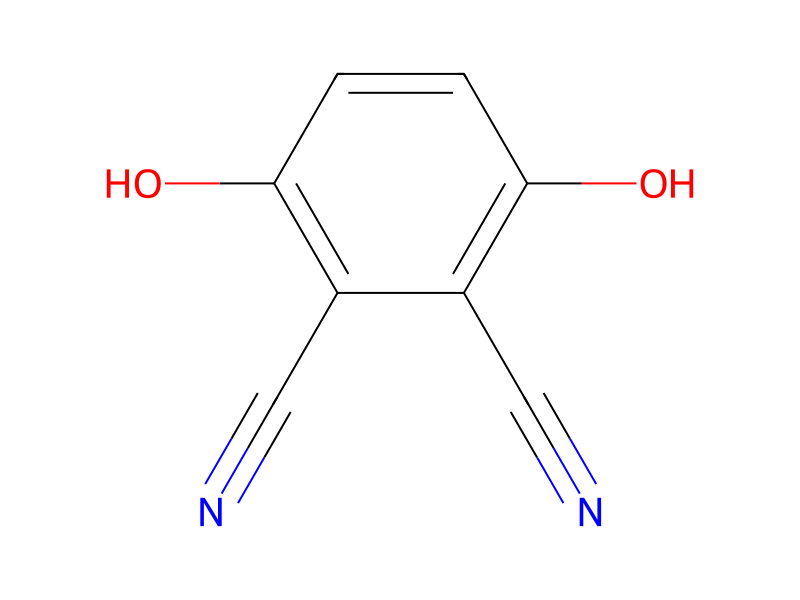
2,3-Dicyanohydroquinone

HCID 78467
New reaction
Print
Basic informationNames & identifiersPropertiesSafety & regulationChemistry & industryRelated reactionsCompound notes
Substructure searchFind similar structures

Basic information

CAS
4733-50-0
Standard SMILES
N#Cc1c(O)ccc(O)c1C#N
InChIKey
MPAIWVOBMLSHQA-UHFFFAOYSA-N
Molecular formula
C8H4N2O2
Average molar mass
160.13 g/mol
Monoisotopic mass
160.02727738

Names & identifiers

Preferred name
2,3-Dicyanohydroquinone
IUPAC
3,6-dihydroxybenzene-1,2-dicarbonitrile
English name
3,6-Dihydroxyphthalonitrile
Molecular formula
C8H4N2O2
Molecular weight
160.13

Names & synonyms

2,3-Dicyanohydroquinone3,6-Dihydroxyphthalonitrile4733-50-01,2-Benzenedicarbonitrile, 3,6-dihydroxy-Phthalonitrile, 3,6-dihydroxy-TTR9Y6YSS82,3-dicyano-hydroquinoneNSC-435541,4-dihydroxyphthalonitrile3,6-Dihydroxy-1,2-benzenedicarbonitrileDTXSID80197109RefChem:442078
Show more names
DCHDCHQRARECHEM AQ BD 00153,6-DihydroxyphthaloN#Cc1c(O)ccc(O)c1C#N2,3-dicyanohydroquinme2,3-Dicynohydroquinone3,6-DIHYDROXYPHTHONITRILE2,3-Dicyanohydroquinone>
1,4-DHPN2,3-DCHQDTXCID40119600225-241-03,6-dihydroxybenzene-1,2-dicarbonitrile2,3-Dicyano-p-hydroquinone3,6-DihydroxyphthalodinitrileMFCD00001790

Database identifiers

CAS
4733-50-0
PubChem CID
78467
DTXSID
DTXSID80197109
UNII
TTR9Y6YSS8
EC Number
225-241-0
Nikkaji
J30.864A

Properties

Computed structural properties

XLogP
1.8
Topological polar surface area
88 Ų
Hydrogen bond donors
2
Hydrogen bond acceptors
4
Rotatable bonds
0
Heavy atoms
12
Formal charge
0
Complexity
231

Physicochemical properties

Melting point
230 °C · >230 °C (dec.) (lit.)
Boiling point
286.01 °C · 286.01°C (rough estimate)
Density
1.3848 · 1.3848 (rough estimate)
refractive index
1.49 · 1.4900 (estimate)
storage temp.
30 °C · Store below +30°C.
pka
6.21 · 6.21±0.23(Predicted)
form
Crystalline Powder or Needles
color
Khaki to brown
Water Solubility
Soluble in hot water
BRN
2101249 · 2101249
InChI
InChI=1S/C8H4N2O2/c9-3-5-6(4-10)8(12)2-1-7(5)11/h1-2,11-12H
InChIKey
MPAIWVOBMLSHQA-UHFFFAOYSA-N
SMILES
C1(C#N)=C(O)C=CC(O)=C1C#N
CAS DataBase Reference
4733 · 4733-50-0(CAS DataBase Reference)
FDA UNII
9 Y6YSS8 · TTR9Y6YSS8

Safety & regulation

Safety information is for reference only and does not replace the supplier’s Safety Data Sheet (SDS), applicable regulations, or professional assessment.

GHS classification

GHS Classification · 4 items

Warning

H315 (100%): Causes skin irritation [Warning Skin corrosion/irritation]

P261, P264, P264+P265, P271, P280, P302+P352, P304+P340, P305+P351+P338, P319, P321, P332+P317, P337+P317, P362+P364, P403+P233, P405, and P501 (click each P-code to see the statement)

Aggregated GHS information provided per 46 reports by companies from 5 notifications to the ECHA C&L Inventory. Each notification may be associated with multiple companies.

Hazard information

Regulatory Information2,3-Dicyanohydroquinone: Does not have an individual approval but may be used under an appropriate group standard
Hazard Classes and CategoriesSkin Irrit. 2 (100%)

Safety data

PPE
dust mask type N95 (US), Eyeshields, Gloves
wgk
3
ridadr
UN 2811 6.1/PG III
hs_code
2926909090
risk_code
36/37/38-20/21/22
Signal word
Danger
Symbol(GHS)
GHS06
hazard_code
Xi,Xn
safety_code
26-37/39-36/37/39
hazard_class
6.1
Storage Class
11 - Combustible Solids
packing_group
III

Chemistry & industry

Applications

Uses2,3-Dicyanohydroquinone was used in the synthesis of phthalonitrile-3,6-ditriflate. It is a fluorescent dye and was used in determination of intracellular pH and calcium in avian neural crest cells.

Upstream & downstream products

Upstream raw materials

2,5-Dihydroxybenzonitrile1,4-BenzoquinoneHydrogen cyanide

Downstream products

2,3-Dichloro-5,6-dicyano-1,4-benzoquinone1,4,8,11,15,18,22,25-Octabutoxy- phthalocyanine3,6-Bis(decyl)phthalonitrile3,6-Diacetoxyphthalic acid anhydride

Related reactions

21 records
New reaction record
HRID 257293 reaction equation
HRID 257293As reactant
HRID 342320 reaction equation
HRID 342320As reactant
HRID 342323 reaction equation
HRID 342323As reactant
HRID 374733 reaction equation
HRID 374733As reactant
HRID 400247 reaction equation
HRID 400247As reactant
HRID 437982 reaction equation
HRID 437982As reactant
HRID 892382 reaction equation
HRID 892382As reactant
HRID 1128418 reaction equation
HRID 1128418As reactant
PreviousPage 1 of 3

Compound notes

On this pageBasic informationNames & identifiersPropertiesSafety & regulationChemistry & industryRelated reactionsCompound notes
Comptox DTXSID
80197109 · DTXSID80197109
UNSPSC Code
12352100 · 12352100
NACRES
22 · NA.22
Symbol(GHS)
6 · GHS06
Signal word
Danger
Hazard statements
301 · H301+H311+H331-H315-H319-H335
Precautionary statements
501 · P501-P261-P270-P271-P264-P280-P337+P313-P305+P351+P338-P361+P364-P332+P313-P301+P310+P330-P302+P352+P312-P304+P340+P311-P403+P233-P405
PPE
95 · dust mask type N95 (US), Eyeshields, Gloves
Hazard Codes
Xi,Xn
Risk Statements
36 · 36/37/38-20/21/22
Safety Statements
26 · 26-37/39-36/37/39
RIDADR
2811 · UN 2811 6.1/PG III
WGK Germany
3 · 3
HazardClass
6.1 · 6.1
PackingGroup
III
HS Code
2926909090 · 2926909090
Storage Class
11 · 11 - Combustible Solids
Hazard Classifications
2 Skin · Eye Irrit. 2Skin Irrit. 2
Hazard statements
H301+H311+H331-H315-H319-H335
Hazard Classifications
Eye Irrit. 2Skin Irrit. 2
Precautionary statements
P501-P261-P270-P271-P264-P280-P337+P313-P305+P351+P338-P361+P364-P332+P313-P301+P310+P330-P302+P352+P312-P304+P340+P311-P403+P233-P405