Reaction equation

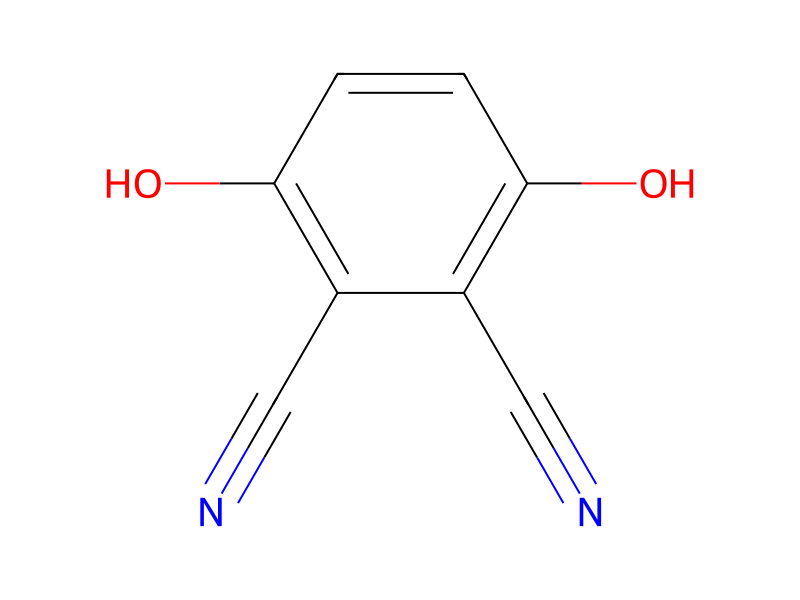
[H-].[Na+].[C:3]([C:5]1[C:10]([C:11]#[N:12])=[C:9]([OH:13])[CH:8]=[CH:7][C:6]=1[OH:14])#[N:4].[CH:15]([N:18]([CH:23]([CH3:25])[CH3:24])[C:19](=[O:22])[CH2:20]Br)([CH3:17])[CH3:16]>CN(C)C=O>[CH:15]([N:18]([CH:23]([CH3:25])[CH3:24])[C:19](=[O:22])[CH2:20][O:14][C:6]1[CH:7]=[CH:8][C:9]([OH:13])=[C:10]([C:11]#[N:12])[C:5]=1[C:3]#[N:4])([CH3:17])[CH3:16]Participants




Procedure
960 mg of sodium hydride (50% in oil) were added to a solution of 1.6 g of 2,3-dicyano-4-hydroxy-phenol in 100 ml of dimethylformamide, and after stirring for 30 minutes at ambient temperature, then 2.3 g of N,N-bis(isopropyl)-2-bromoacetamide (preparation 8) were added. After stirring for 48 hours, the solvent was evaporated under reduced pressure and 200 ml of 2N hydrochloric acid were added. Extraction was carried out with ethyl acetate and the organic phase was dried over magnesium sulfate, filtered and evaporated under reduced pressure. The residue was chromatographed, eluting with a cyclohexane-ethyl acetate mixture (50/50), then with pure ethyl acetate, and finally an ethyl acetate-methanol mixture (98/2) to obtain 1.8 g of the expected product is obtained which was used as is for the following stage.
Workup
- stirringAfter stirring for 48 hours
- customthe solvent was evaporated under reduced pressure and 200 ml of 2N hydrochloric acid
- additionwere added
- extractionExtraction
- dry with materialthe organic phase was dried over magnesium sulfate
- filtrationfiltered
- customevaporated under reduced pressure
- customThe residue was chromatographed
- washeluting with a cyclohexane-ethyl acetate mixture (50/50)
Sources & evidence
- ORD record
- ord-ac0fd5a614cc4137b36a2bbc8cda2fe9
- Source dataset
- uspto-grants-1998_10
- Patent number
- US05827887
Linked notes
Loading…