
HRID 620130As catalyst
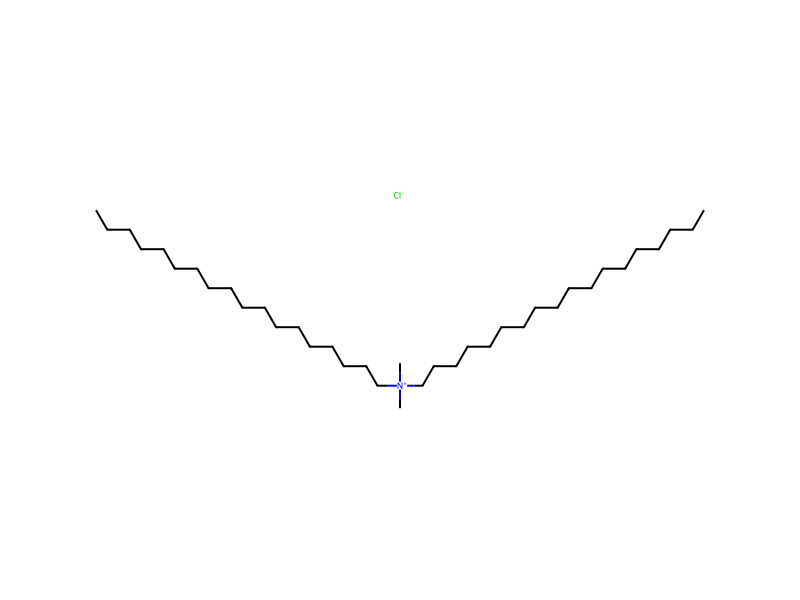
107-64-2CCCCCCCCCCCCCCCCCC[N+](C)(C)CCCCCCCCCCCCCCCCCC.[Cl-]REZZEXDLIUJMMS-UHFFFAOYSA-M107-64-2DTXSID8026771Antistatic; Hair conditioning
Personal care product
Virtually insoluble in water.
Solubility in water: none
When heated to decomposition it emits very toxic fumes of /nitrogen oxides and hydrogen chloride/.
135 °C
Solid; [ICSC] Faintly beige flakes; [MSDSonline]
Safety information is for reference only and does not replace the supplier’s Safety Data Sheet (SDS), applicable regulations, or professional assessment.
Danger
H318: Causes serious eye damage [Danger Serious eye damage/eye irritation]
P264+P265, P273, P280, P305+P354+P338, P317, P391, and P501 (click each P-code to see the statement)
Danger
H318 (100%): Causes serious eye damage [Danger Serious eye damage/eye irritation]
P264+P265, P273, P280, P305+P354+P338, P317, P391, and P501 (click each P-code to see the statement)
Chemical: 1-Octadecanaminium, N,N-dimethyl-N-octadecyl-, chloride
Dimethyldioctadecylammonium chloride: Does not have an individual approval but may be used under an appropriate group standard
A skin irritant; Corrosive to eyes; [ICSC] Usually not commercially available as isolated compound, but as the main constituent of dihydrogenated tallow dimethyl ammonium chloride (DHTDMAC), that is a mixture of dialkyl dimethyl ammonium compounds with varying length carbon chains of C12 to C20; [eChemPortal: SIDSUNEP] An irritant; May cause serious eye injury; [eChemPortal: ESIS] DHTDMAC is commercially available as a paste-like substance, powder, or aqueous emulsion and contains 32%, 40%, and 7% dimethyldioctadecylammonium chloride respectively; Technical grade DODMAC (77% dimethyldioctadecylammonium chloride, 11.3% isopropanol, and 11.7% water) was corrosive to rabbit skin; The pure compound caused moderate skin irritation and corrosive effects to eyes, based on rabbit studies; [eChemPortal: RAR]
Substances that augment, stimulate, activate, potentiate, or modulate the immune response at either the cellular or humoral level. The classical agents (Freund's adjuvant, BCG, Corynebacterium parvum, et al.) contain bacterial antigens. Some are endogenous (e.g., histamine, interferon, transfer factor, tuftsin, interleukin-1). Their mode of action is either non-specific, resulting in increased immune responsiveness to a wide variety of antigens, or antigen-specific, i.e., affecting a restricted type of immune response to a narrow group of antigens. The therapeutic efficacy of many biological response modifiers is related to their antigen-specific immunoadjuvanticity.
Substances that prevent infectious agents or organisms from spreading or kill infectious agents in order to prevent the spread of infection.
Agents that modify interfacial tension of water; usually substances that have one lipophilic and one hydrophilic group in the molecule; includes soaps, detergents, emulsifiers, dispersing and wetting agents, and several groups of antiseptics.
Used as fabric softener (retail, commercial, and textile mills), surfactant (i.e. hair rinses and cosmetics), and flocculating agent; [HSDB] Used in Germany to activate organic clays (bentonites); [eChemPortal: SIDSUNEP]
Textiles (Printing, Dyeing, or Finishing) [Category: Industry]
SURFACTANT; LAUNDRY SOFTENER
IN HAIR RINSE FORMULATIONS
FABRIC SOFTENER FOR RETAIL, COMMERCIAL & TEXTILE MILLS
CATIONIC SURFACTANT IN COSMETIC PRODUCTS-EG, CREME RINSES
(1979) PROBABLY GREATER THAN 2.27X10+6 GRAMS
(1981) PROBABLY GREATER THAN 2.27X10+6 GRAMS
(1993) Separate statistics for this item are not published to avoid disclosure of individual company operations.
POWDER.
Eye Dam. 1 (100%)
Eye damage - category 1
Skin corrosion/irritation - Category 2 Note: the substance of technical grade is in Category 1
Skin corrosion/irritation - Category 2
Eye Dam. 1
Fresh air, rest.
Remove contaminated clothes. Rinse skin with plenty of water or shower.
First rinse with plenty of water for several minutes (remove contact lenses if easily possible), then refer for medical attention.
Rinse mouth. Do NOT induce vomiting. Give one or two glasses of water to drink. Refer for medical attention .
SRP: At the time of review, criteria for land treatment or burial (sanitary landfill) disposal practices are subject to significant revision. Prior to implementing land disposal of waste residue (including waste sludge), consult with environmental regulatory agencies for guidance on acceptable disposal practices.
Vacuum spilled material with specialist equipment. If appropriate, moisten first to prevent dusting. Do NOT let this chemical enter the environment. Personal protection: particulate filter respirator adapted to the airborne concentration of the substance.
THE TOXICITY OF DISTEARYLDIMETHYLAMMONIUM CHLORIDE TO DAPHNIA MAGNA WAS REDUCED BY 32 TIMES IN THE PRESENCE OF LIGNIN. ENVIRONMENTAL COMPONENTS SUCH AS LINEAR ALKYLBENZENESULFONATE, FULVIC ACIDS, CHLORELLA VULGARIS CELLS, ACTIVATED SLUDGE, BENTONITE & SILICA GEL HAD SIMILAR EFFECT.
TERRESTRIAL FATE: Based on a classification scheme(1), an estimated Koc value of 1X10+10(SRC), determined from a log Kow of 3.80(2) and a regression-derived equation(3), indicates that dimethyldioctadecylammonium chloride is expected to be immobile in soil(SRC). Volatilization of dimethyldioctadecylammonium chloride from moist soil surfaces is not expected to be an important fate process(SRC) given an estimated Henry's Law constant of 6.4X10⁻⁸ atm-cu m/mole(SRC), using a fragment constant estimation method(4). Dimethyldioctadecylammonium chloride is not expected to volatilize from dry soil surfaces(SRC) based upon an estimated vapor pressure of 2.6X10⁻¹⁷ mm Hg(SRC), determined from a fragment constant method(5). In an OECD screening test, at a 2.5 mg/l concentration, dimethyldioctadecylammonium chloride degradation reaches over 90% in 2-4 days and at 10 mg/l concentration, a Zahn-Wellen test found degradation is nearly complete in 10 days(2).
AQUATIC FATE: Based on a classification scheme(1), an estimated Koc value of 1X10+10(SRC), determined from a log Kow of 3.80(2) and a regression-derived equation(3), indicates that dimethyldioctadecylammonium chloride is expected to adsorb to suspended solids and sediment in water(SRC). Volatilization from water surfaces is not expected(3) based upon an estimated Henry's Law constant of 6.4X10⁻⁸ atm-cu m/mole(SRC), developed using a fragment constant estimation method(4). According to a classification scheme(5), an estimated BCF of 71(SRC), from a log Kow(2) and a regression-derived equation(6), suggests the potential for bioconcentration in aquatic organisms is moderate. Dimethyldioctadecylammonium chloride biodegradation in river water is found to take place in 4.9-13.8 days(7,8), and an OECD and Zahn-Wellens screening test found degradation takes place in 2-10 days(2).
ATMOSPHERIC FATE: According to a model of gas/particle partitioning of semivolatile organic compounds in the atmosphere(1), dimethyldioctadecylammonium chloride, which has an estimated vapor pressure of 2.6X10⁻¹⁷ mm Hg at 25 °C(SRC), using a fragment constant estimation method(2), is expected to exist solely in the particulate phase. Particulate-phase dimethyldioctadecylammonium chloride may be removed from the air by wet and dry deposition(SRC).
Cough.
Redness. Pain.
Redness. Pain. Blurred vision. Severe deep burns.
Burning sensation in the throat and chest.
The Koc of dimethyldioctadecylammonium chloride is estimated as 1X10+10(SRC), using a log Kow of 3.80(1) and a regression-derived equation(2). According to a classification scheme(3), this estimated Koc value suggests that dimethyldioctadecylammonium chloride is expected to be immobile in soil.
Dimethyldioctadecylammonium chloride's production and use as a retail powdered detergent-softener, in industrial laundry and pap-softening formulas, and in cosmetic formulations(1), as a flocculating agent(2), and in the monitoring of cationic surfactants in sewage treatment plants(3) may result in its release to the environment through various waste streams(SRC).
AEROBIC: Dimethyldioctadecylammonium chloride biodegradation in river water was found to take place in approximately 5 days with degradation occurring faster in river water containing higher levels of sediments and suspended solids(1). Dimethyldioctadecylammonium degradation in rapid creek river water, in Rapid City, SD, was measured with a half life of 4.9-13.8 days(3). In an OECD screening test, at a 2.5 mg/l concentration, dimethyldioctadecylammonium chloride degradation reaches over 90% in 2-4 days and at 10 mg/l concentration, a Zahn-Wellen test found degradation is nearly complete in 10 days(2). A 91-95% dimethyldioctadecylammonium chloride removal rate was observed in a continuous flow activated sludge system(4).
An estimated BCF of 71 was calculated for dimethyldioctadecylammonium chloride(SRC), using a log Kow of 3.80(1) and a regression-derived equation(2). According to a classification scheme(3), this BCF suggests the potential for bioconcentration in aquatic organisms is low.
The Henry's Law constant for dimethyldioctadecylammonium chloride is estimated as 6.4X10⁻⁸ atm-cu m/mole(SRC) using a fragment constant estimation method(1). This Henry's Law constant indicates that dimethyldioctadecylammonium chloride is expected to be essentially nonvolatile from water surfaces(2). Dimethyldioctadecylammonium chloride's Henry's Law constant(1) indicates that volatilization from moist soil surfaces will not occur(SRC). Dimethyldioctadecylammonium chloride is not expected to volatilize from dry soil surfaces(SRC) based upon a an estimated vapor pressure of 2.6X10⁻¹⁷ mm Hg(3), determined from a fragment constant method(3).
48-HR LC50 OF DISTEARYLDIMETHYLAMMONIUM CHLORIDE TO CRASSOSTREA VIRGINICA LARVAE WAS 2.0 MG/L IN ESTUARINE WATER. 96-HR LC50 FOR PENAEUS DUORARUM, MYSIDOPSIS BAHIA, CALLINECTES SAPIDUS, AND CYPRINIDON VARIEGATUS WERE 36.0, 0.22-0.42, GREATER THAN 50, & 24.0 MG/L, RESPECTIVELY.
THE 5-DAY ALGISTATIC CONCN OF DISTEARYLDIMETHYLAMMONIUM CHLORIDE TO SELENASTRUM CAPRICORNUTUM WAS 0.23 MG/L IN FILTERED LAB WATER & 0.71 MG/L IN RIVER WATER; CONCN FOR MICROCYSTIS AERUGINOSA, NAVICULA SEMINULUM, & DUNALIELLA TERTIOLECTA WAS GREATER THAN 0.1-1 G/L LAB WATER.
THE NO OBSERVED EFFECT CONCN OF DISTEARYLDIMETHYLAMMONIUM CHLORIDE FOR EGGS AND FRY OF PIMEPHALES PROMELAS WAS 0.05 MG/L LAB WATER & 0.5 MG/L RIVER WATER; FOR DAPHNIA MAGNA THE NO OBSERVED EFFECT CONCN WAS 0.38 MG/L RIVER WATER, WHEREAS THE 21-DAY LC50 WAS 1.75 MG/L.
DISTEARYLDIMETHYLAMMONIUM CHLORIDE WAS NOT MUTAGENIC IN SALMONELLA TYPHIMURIUM TA98 AND TA100 AFTER ACTIVATION WITH LIVER HOMOGENATES OF RATS, HAMSTERS, & GUINEA PIGS & INDUCERS PCB, PHENOBARBITAL AND 3-METHYLCHOLANTHRENE, OR IN PRESENCE OF NORHARMAN.
The rate constant for the vapor-phase reaction of dimethyldioctadecylammonium chloride with photochemically-produced hydroxyl radicals has been estimated as 6.9X10⁻¹³ cu m/molecule-sec at 25 °C(SRC) using a structure estimation method(1). This corresponds to an atmospheric half-life of about 5 hours at an atmospheric concentration of 5X10+5 hydroxyl radicals per cu cm(1).
1-Octadecanaminium, N,N-dimethyl-N-octadecyl-, chloride (1:1): ACTIVE
ARQUAD /IS/ TRADEMARK FOR A SERIES OF QUATERNARY AMMONIUM SALTS CONTAINING ONE OR TWO ALKYL GROUPS RANGING FROM C8-C18. APPLICATIONS: CORROSION INHIBITORS; EMULSIFIERS; GERMICIDES AND SANITIZING AGENTS; TEXTILE FABRIC SOFTENERS. /ARQUAD/
PPTN & MICROFLOTATION OF EGG ALBUMIN & OF HEMOGLOBIN WAS STUDIED AS A FUNCTION OF PH IN THE PRESENCE OF DIOCTADECYLDIMETHYLAMMONIUM CHLORIDE.
UsesDioctadecyl dimethyl ammonium chloride is a useful quaternary ammonium salt for proteomics research.
DefinitionA powder cationic-quaternary fabric softener.


