HomeMCPWorkbenchSkills
HomeWorkbenchNotificationsMe
llms.txt · MCP GuidePrivacy Policy · Terms of Service · Supportv1.8.3
  1. Home
  2. /Compound

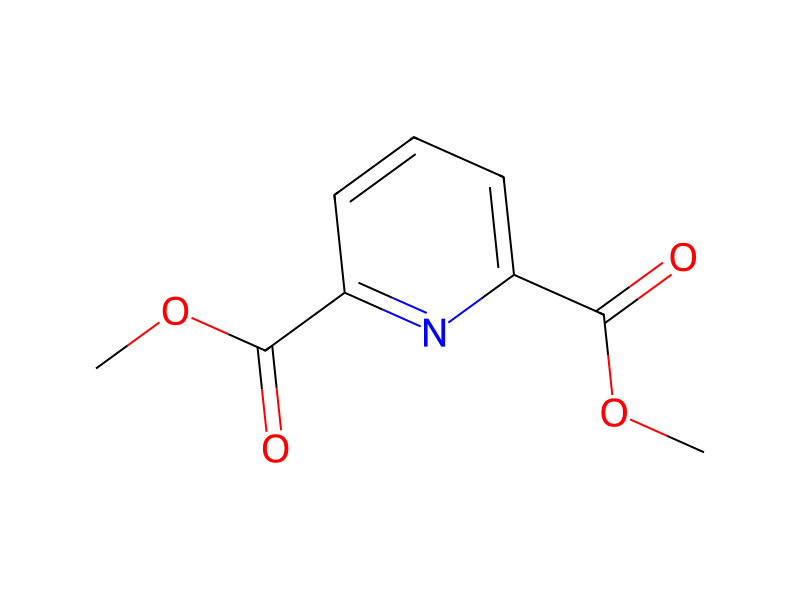
Dimethyl pyridine-2,6-carboxylate

HCID 79549
New reaction
Print
Basic informationNames & identifiersPropertiesSafety & regulationChemistry & industryRelated reactionsCompound notes
Substructure searchFind similar structures

Basic information

CAS
5453-67-8
Standard SMILES
COC(=O)c1cccc(C(=O)OC)n1
InChIKey
SNQQJEJPJMXYTR-UHFFFAOYSA-N
Molecular formula
C9H9NO4
Average molar mass
195.17 g/mol
Monoisotopic mass
195.05315777

Names & identifiers

Preferred name
Dimethyl pyridine-2,6-carboxylate
IUPAC
dimethyl pyridine-2,6-dicarboxylate
English name
Dimethyl 2,6-Pyridinedicarboxylate
Molecular formula
C9H9NO4
Molecular weight
195.17

Names & synonyms

2,6-Pyridinedicarboxylic acid, dimethyl esterDimethyl pyridine-2,6-carboxylateYA2DJW5CFYDTXSID40202940EINECS 226-697-3NSC-18855AI3-175922,6-Pyridinedicarboxylic acid, 2,6-dimethyl esterNSC 18855RefChem:588310DTXCID70125431226-697-3
Show more names
20g2,6-Pyridine Dicarboxylic Acid Methyl EsterAKOS 9066120G/100G/1KGRARECHEM AL BF 0203Dimethyl2,6-pyridin
5453-67-8dimethyl pyridine-2,6-dicarboxylateDimethyl 2,6-pyridinedicarboxylate2,6-dimethyl pyridine-2,6-dicarboxylateMFCD001344932,6-Pyridinedicarboxylic Acid Dimethyl EsterPyridine-2,6-dicarboxylic acid dimethyl esterDipicolinic Acid Dimethyl Ester

Database identifiers

CAS
5453-67-8
PubChem CID
79549
DTXSID
DTXSID40202940
ChEMBL
CHEMBL72405
UNII
YA2DJW5CFY
EC Number
226-697-3
Nikkaji
J117.526B

Properties

Computed structural properties

XLogP
1.2
Topological polar surface area
65.5 Ų
Hydrogen bond donors
0
Hydrogen bond acceptors
5
Rotatable bonds
4
Heavy atoms
14
Formal charge
0
Complexity
207

Physicochemical properties

Melting point
121 · 121-125 °C(lit.)
Boiling point
100 °C · 100 °C(Press: 0.005 Torr)
Density
1.231 · 1.231±0.06 g/cm3(Predicted)
storage temp.
Inert atmosphere,Room Temperature
solubility
Chloroform
pka
-0.46 · -0.46±0.10(Predicted)
form
Solid
color
Off-White
Water Solubility
Soluble in water(14 g/L) (25°C). Soluble in chloroform.
InChI
InChI=1S/C9H9NO4/c1-13-8(11)6-4-3-5-7(10-6)9(12)14-2/h3-5H,1-2H3
InChIKey
SNQQJEJPJMXYTR-UHFFFAOYSA-N
SMILES
C1(C(OC)=O)=NC(C(OC)=O)=CC=C1
CAS DataBase Reference
5453 · 5453-67-8(CAS DataBase Reference)
FDA UNII
2 DJW5CFY · YA2DJW5CFY
Comptox DTXSID
40202940 · DTXSID40202940

Safety & regulation

Safety information is for reference only and does not replace the supplier’s Safety Data Sheet (SDS), applicable regulations, or professional assessment.

GHS classification

GHS Classification · 4 items

Danger

H315 (90.9%): Causes skin irritation [Warning Skin corrosion/irritation]

P261, P264, P264+P265, P271, P280, P302+P352, P304+P340, P305+P354+P338, P317, P319, P321, P332+P317, P362+P364, P403+P233, P405, and P501 (click each P-code to see the statement)

Aggregated GHS information provided per 44 reports by companies from 4 notifications to the ECHA C&L Inventory. Each notification may be associated with multiple companies.

Hazard information

Hazard Classes and CategoriesSkin Irrit. 2 (90.9%)

Safety data

PPE
dust mask type N95 (US), Eyeshields, Gloves
wgk
3
hs_code
2933399090
risk_code
37/38-41
Signal word
Danger
Symbol(GHS)
GHS05,GHS07
hazard_code
Xi
safety_code
26-39
Storage Class
11 - Combustible Solids
Hazard statements
H315-H318-H335
Hazard Classifications
Eye Dam. 1Skin Irrit. 2STOT SE 3
Precautionary statements
P261-P280-P305+P351+P338

Chemistry & industry

Applications · 2 items

UsesDimethyl 2,6-pyridinedicarboxylate may be used in the synthesis of:ditopic macrocycle having two xylyl rings linked by diethylene glycol and 2,6-pyridinediamide spacers, which acts as host molecule capable of forming complexes with diphenylurea derivativesN,N′-bis(2-aminoethyl)dipicoloinic acid diamide Schiff base1,1′-(2,6-bispyridyl)bis-3-(9-ethylcarbazole-3-yl)-1,3-propanedione

General DescriptionThe standard molar enthalpy of formation for dimethyl 2,6-pyridinedicarboxylate (dimethylpyridine-2,6-dicarboxylate) has been calculated from the standard molar enthalpy of combustion, which was measured by a static bomb calorimeter.

Upstream & downstream products

Upstream raw materials

Pyridine-2,6-dicarboxylic acidChloroformMethanolSulfuric acid

Downstream products

2,6-Bis[(4R)-4-phenyl-2-oxazolinyl]pyridinecis-Piperidine-2,6-dicarboxylic acid dimethyl ester HCl4-[[[(4-Methylphenyl)sulfonyl]oxy]Methyl]-2,6-pyridinedicarboxylic Acid 2,6-DiMethyl Ester

Related reactions

9 records
New reaction record
HRID 178550 reaction equation
HRID 178550As reactant
HRID 662086 reaction equation
HRID 662086As reactant
HRID 662096 reaction equation
HRID 662096As reactant
HRID 1174155 reaction equation
HRID 1174155As reactant
HRID 1174196 reaction equation
HRID 1174196As reactant
HRID 2254457 reaction equation
HRID 2254457As reactant
HRID 2279933 reaction equation
HRID 2279933As reactant
HRID 2313964 reaction equation
HRID 2313964As reactant
PreviousPage 1 of 2

Compound notes

On this pageBasic informationNames & identifiersPropertiesSafety & regulationChemistry & industryRelated reactionsCompound notes
UNSPSC Code
12352100 · 12352100
NACRES
22 · NA.22
Symbol(GHS)
5 · GHS05,GHS07
Signal word
Danger
Hazard statements
315 · H315-H318-H335
Precautionary statements
261 · P261-P280-P305+P351+P338
PPE
95 · dust mask type N95 (US), Eyeshields, Gloves
Hazard Codes
Xi
Risk Statements
37 · 37/38-41
Safety Statements
26 · 26-39
WGK Germany
3 · 3
HS Code
2933399090 · 2933399090
Storage Class
11 · 11 - Combustible Solids
Hazard Classifications
1 Skin · Eye Dam. 1Skin Irrit. 2STOT SE 3