Safety information is for reference only and does not replace the supplier’s Safety Data Sheet (SDS), applicable regulations, or professional assessment.
GHS classification
GHS Classification · 4 items
Danger
H302 (58.3%): Harmful if swallowed [Warning Acute toxicity, oral]
P260, P264, P264+P265, P270, P273, P280, P301+P317, P301+P330+P331, P302+P361+P354, P304+P340, P305+P354+P338, P316, P317, P321, P330, P363, P405, and P501 (click each P-code to see the statement)
Aggregated GHS information provided per 206 reports by companies from 10 notifications to the ECHA C&L Inventory. Each notification may be associated with multiple companies.
Hazard information
Regulatory Information · 5 items
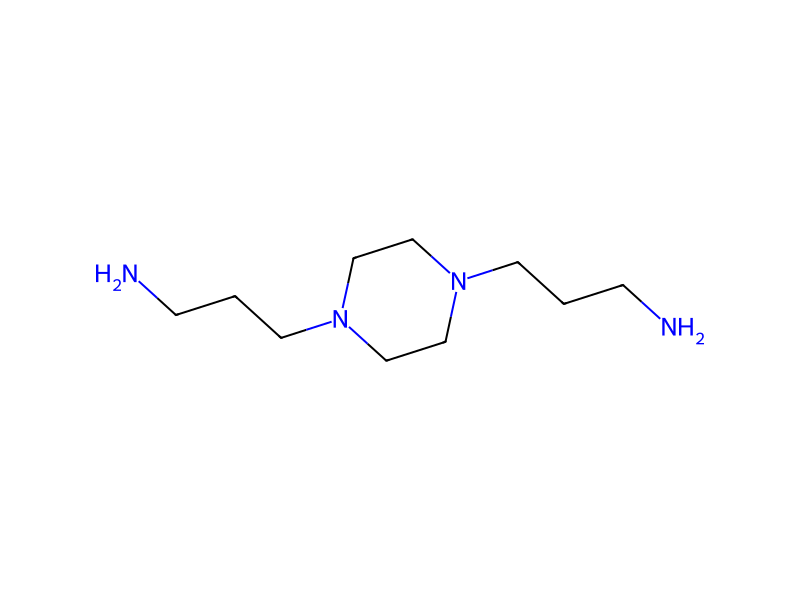
Chemical: 1,4-Piperazinedipropanamine
1,4-Piperazinedipropanamine is listed on the EPA's Chemical Data Reporting (CDR) system. Manufacturers and importers of 1,4-Piperazinedipropanamine are required to report information about their production and use of this chemical to the EPA under the Toxic Substances Control Act (TSCA). (40 eCFR Part 711)
1,4-Bis(3-aminopropyl)piperazine: Does not have an individual approval but may be used as a component in a product covered by a group standard. It is not approved for use as a chemical in its own right.
The New Jersey Worker and Community Right to Know Act requires public and private employers to provide information about hazardous substances at their workplaces. (N.J.S.A. 34:5A-1 et. seq.)
Hazard Classes and Categories · 2 items
Acute Tox. 4 (58.3%)
Corrosives
Safety data
PPE
Faceshields, Gloves, Goggles, type ABEK (EN14387) respirator filter
wgk
3
tsca
TSCA listed
Chemistry & industry
Uses & manufacturing
U.S. Production2023: 46,914 lb
Industry UsesAdhesion/cohesion promoter
General Manufacturing Information · 2 items
Adhesive Manufacturing
1,4-Piperazinedipropanamine: ACTIVE
Applications
Uses1,4-Bis(3-aminopropyl)piperazine was used to functionalize natural montmorillonite (M) and synthetic kanemite (K)1.
General DescriptionThe thermodynamic parameters for protonation of 1,4-bis(3-aminopropyl)-piperazine (BAPP) were studied in aqueous solution using a potentiometric technique.