
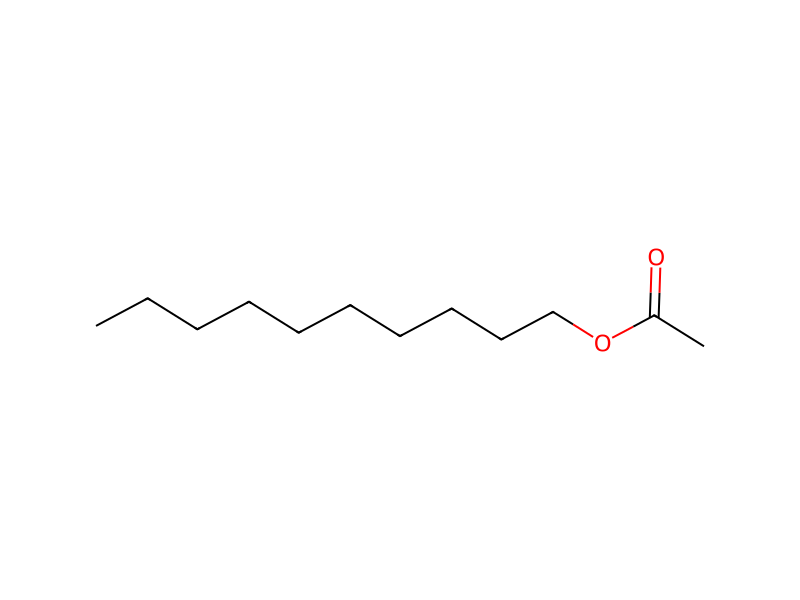
Basic information
- CAS
112-17-4- Standard SMILES
CCCCCCCCCCOC(C)=O- InChIKey
NUPSHWCALHZGOV-UHFFFAOYSA-N- Molecular formula
- C12H24O2
- Average molar mass
- 200.32 g/mol
- Monoisotopic mass
- 200.17763
Overview
Decyl acetate is a carboxylic ester.
Names & identifiers
- Preferred name
- Decyl acetate
- IUPAC
- decyl acetate
- English name
- N-DECYL ACETATE
- Molecular formula
- C12H24O2
- Molecular weight
- 200.32
Names & synonyms
DECYL ACETATEn-Decyl acetateAcetic acid, decyl ester1-Decanol acetateAcetate C 10n-Decyl ethanoateDecyl ethanoate1-Decyl acetateDecanyl acetateAcetate C-10Decanol acetateDecyl alcohol, acetate
Show more names
decylFEMA 2367Decylacetat1-decylacetateCAPRYL ACETATE
FEMA No. 2367DTXSID8047189UNII-VNW56K9DYTVNW56K9DYTDecyl ester of acetic acidEINECS 203-942-2NSC 46131DECYLACETATE
Database identifiers
- CAS
112-17-4- PubChem CID
- 8167
- DTXSID
DTXSID8047189- ChEMBL
CHEMBL2228458- ChEBI
CHEBI:179750- UNII
- VNW56K9DYT
- EC Number
- 203-942-2
- Nikkaji
- J95.543D
Properties
Computed structural properties
- XLogP
- 4.5
- Topological polar surface area
- 26.3 Ų
- Hydrogen bond donors
- 0
- Hydrogen bond acceptors
- 2
- Rotatable bonds
- 10
- Heavy atoms
- 14
- Formal charge
- 0
- Complexity
- 132
Experimental & physicochemical properties
Chemical ClassesOther Classes -> Esters, Other
LipidsFatty Acyls [FA] -> Fatty esters [FA07] -> Short fatty esters [FA0710]
SpringerMaterials PropertiesBoiling point
FragrancesFragrance Ingredient (Decyl acetate) -> IFRA transparency List
Food AdditivesFLAVORING AGENT OR ADJUVANT -> FDA Substance added to food
Density0.861-0.866
Flavoring AgentsEU Flavoring substances
Solubility
insoluble in water
1 ml in 2 ml 80% alcohol (in ethanol)
Boiling Point
126.00 to 127.00 °C. @ 20.00 mm Hg
272 °C
Melting Point-15 °C
Safety & regulation
Safety information is for reference only and does not replace the supplier’s Safety Data Sheet (SDS), applicable regulations, or professional assessment.
GHS classification
GHS Classification
This chemical does not meet GHS hazard criteria for 98.2% (1547 of 1576) of all reports.
Not Classified
Aggregated GHS information provided per 1576 reports by companies from 4 notifications to the ECHA C&L Inventory.
Hazard information
Regulatory Information
Chemical: Acetic acid, decyl ester
REACH registered substance: Decyl acetate (EC: 203-942-2)
Decyl acetate: Does not have an individual approval but may be used under an appropriate group standard
Other Safety InformationEvaluation - Chemicals that are unlikely to require further regulation to manage risks to human health
Hazards SummarySafe when used as a flavoring agent in food; [JECFA] May cause irritation; [Alfa Aesar MSDS]
Hazard Classes and CategoriesNot Classified
Safety data
- PPE
- Eyeshields, Gloves
- wgk
- 2
- tsca
- TSCA listed
- rtecs
- AG5235000
- hs_code
- 2915.39.9000
- Toxicity
- Both the acute oral LD50 value in rats and the acute dermal LD50 value in rabbits were reported as >5 g/kg(Levenstein, 1974).
- Signal word
- Warning
- Symbol(GHS)
- GHS09
Chemistry & industry
Pharmacology
Cellular LocationsExtracellular
Uses & manufacturing
UsesUsed as flavoring agent or adjuvant; [FDA]
Use Classification
Fragrance Ingredients
Flavouring Agent -> FLAVOURING_AGENT -> JECFA Functional Classes
Flavoring Agents -> JECFA Flavorings Index
Flavouring Agent -> FLAVOURING_AGENT -> JECFA Functional Classes
General Manufacturing InformationAcetic acid, decyl ester: ACTIVE
Applications
OccurrenceReported found in orange, lemon, melon, apple, plums, citrus peel oils, grapefruit, orange, grapefruit juice, strawberry fruit, blue cheese, cognac and cardamom.
UsesDecyl acetate finds little use in perfume compositions as a modifier for Linalyl acetate and generally as a ‘“fresh’” note in delicate florals (Muguet, etc. ) or in aldehydic top note compositions. It blends excellently with Dodecanal (Aldehyde C-1 2, Laurie). Finds some use in flavour compositions, mainly for imitation Apple, Berry, Honey, Orange, Peach, Plum, etc. and also in Rum flavours. The concentration of Decyl acetate in the functional product amounts usually to traces only.
Preparation methods
PreparationBy direct acetylation on n-decanol with acetic acid via azeotropic conditions or using acetic anhydride.
Upstream & downstream products
Upstream raw materials
Related reactions
2 records

Compound notes
Loading…