HomeMCPWorkbenchSkills
HomeWorkbenchNotificationsMe
llms.txt · MCP GuidePrivacy Policy · Terms of Service · Supportv1.8.0
  1. Home
  2. /Compound

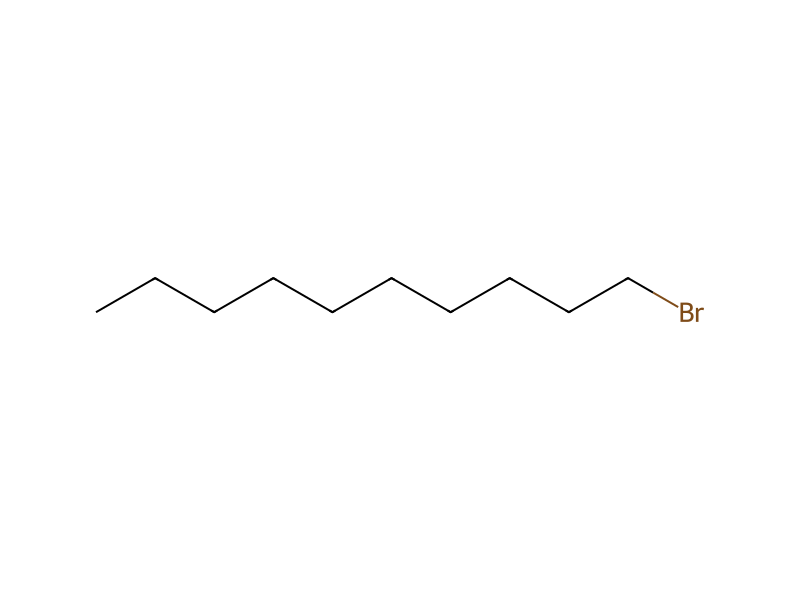
1-Bromodecane

HCID 8173
New noteNew reactionRequest quotes
Print preview

Completing data — refresh the page later to see the latest
Basic informationNames & identifiersPropertiesSafety & regulationChemistry & industryRelated reactionsCompound notes
Substructure searchFind similar structures

Basic information

CAS
112-29-8
Standard SMILES
CCCCCCCCCCBr
InChIKey
MYMSJFSOOQERIO-UHFFFAOYSA-N
Molecular formula
C10H21Br
Average molar mass
221.18 g/mol
Monoisotopic mass
220.08266277

Names & identifiers

Preferred name
1-Bromodecane
IUPAC
1-bromodecane
English name
1-Bromodecane
Molecular formula
C10H21Br
Molecular weight
221.18

Names & synonyms

1-BROMODECANE112-29-8Decyl bromiden-Decyl bromideDecane, 1-bromo-1-Decyl bromideDTXSID9051581Y2JDF9ZCB6NSC-8780DTXCID3030133RefChem:75157203-955-3
Show more names
1-BromdecanBROMO DECANEI–Bromodecane1-bromo-decan1-DecylbromidBroMine decane10-Bromodecane
DecylbromidebromodecaneC10H21BrMFCD00000221Decane, bromo-1-bromo-decaneNSC 8780EINECS 203-955-3

Database identifiers

CAS
112-29-8
PubChem CID
8173
DTXSID
DTXSID9051581
ChEMBL
CHEMBL3559832
UNII
Y2JDF9ZCB6
EC Number
203-955-3
Nikkaji
J5.209D

Properties

Computed structural propertiesFilling in

XLogP
6
Topological polar surface area
0 Ų
Hydrogen bond donors
0
Hydrogen bond acceptors
0
Rotatable bonds
8
Heavy atoms
11
Formal charge
0
Complexity
61.9

Experimental & physicochemical properties

Chemical ClassesOther Classes -> Halogenated Aliphatics, Saturated
SpringerMaterials PropertiesBoiling point
LogP6.0
Density1.0702 @ 20°C
Boiling Point240.6 °C @760 [mm Hg]
Melting Point-29.2 °C
Vapor Pressure0.04 [mmHg]
Physical Description · 2 items

Liquid

Clear, light yellow liquid; [Aldrich MSDS]

Physicochemical properties

Melting point
-29.6 °C · -29.6 °C
Boiling point
238 °C · 238 °C(lit.)

Safety & regulation

Safety information is for reference only and does not replace the supplier’s Safety Data Sheet (SDS), applicable regulations, or professional assessment.

GHS classification

GHS Classification · 4 items

Warning

H315 (15.1%): Causes skin irritation [Warning Skin corrosion/irritation]

P264, P264+P265, P273, P280, P302+P352, P305+P351+P338, P321, P332+P317, P337+P317, P362+P364, P391, and P501 (click each P-code to see the statement)

Aggregated GHS information provided per 53 reports by companies from 10 notifications to the ECHA C&L Inventory. Each notification may be associated with multiple companies.

Hazard information

Regulatory Information · 4 items

Chemical: Decane, 1-bromo-

Decane, 1-bromo- is listed on the EPA's Chemical Data Reporting (CDR) system. Manufacturers and importers of Decane, 1-bromo- are required to report information about their production and use of this chemical to the EPA under the Toxic Substances Control Act (TSCA). (40 eCFR Part 711)

Status: Active Update: 17-05-2018 https://echa.europa.eu/registration-dossier/-/registered-dossier/5308

Decane, 1-bromo-: Does not have an individual approval but may be used under an appropriate group standard

Hazards SummaryMay cause irritation; [Aldrich MSDS] See 1-Bromopropane and 2-Bromopentane.
Hazard Classes and CategoriesSkin Irrit. 2 (15.1%)

Safety & protection

Protective Action Criteria (PAC) · 3 items

13 [mg/m3]

150 [mg/m3]

880 [mg/m3]

Toxicology

Chemistry & industry

Uses & manufacturing

U.S. Production2022: 70,547 lb
Industry UsesIntermediate
General Manufacturing Information · 2 items

Miscellaneous Manufacturing

Decane, 1-bromo-: ACTIVE

Applications · 3 items

Uses1-Bromodecane is used to produce decanal. It is also used in organic synthesis.

Uses1-Bromodecane was used in the synthesis of ferrocene containing hexacatenar metallomesogen.

General Description1-Bromodecane participates in alkylation of pentaerythritol and introduces two lipophilic groups in pentaerythritol. It reacts with 1,2-dimethylimidazole to yield 1-decyl-2,3-dimethylimidazolium bromide.

Upstream & downstream products

Upstream raw materials

4-Decene, 1-bromo-, (4Z)-Acetic acid, 2,2,2-trifluoro-, decyl esterDecyl methane sulfate2,3,4,6-Tetra-O-acetyl-alpha-D-glucopyranosyl bromideβ-D-Glucose pentaacetatedecyl formateN-DECYL ACETATE10-Bromo-1-decene

Related reactions

214 records
New reaction record
HRID 1417 reaction equation
HRID 1417As reactantuspto-grants-1998_03
HRID 2583 reaction equation
HRID 2583As reactantuspto-grants-1998_03
HRID 44138 reaction equation
HRID 44138As reactantuspto-grants-2013_09
HRID 53467 reaction equation
HRID 53467As reactantuspto-grants-1997_04
HRID 53468 reaction equation
HRID 53468As reactantuspto-grants-1997_04
HRID 55269 reaction equation
HRID 55269As reactantuspto-grants-1997_04
HRID 65068 reaction equation
HRID 65068As reactantuspto-grants-1986_09
HRID 93590 reaction equation
HRID 93590As reactantTraining data from https://doi.org/10.1039/C8SC04228D (2/10)
Page 1 of 27

Compound notes

Loading…

On this pageBasic informationNames & identifiersPropertiesSafety & regulationChemistry & industryRelated reactionsCompound notes
More actions
New noteNew reactionRequest quotes
Density
1.066 g/mL · 1.066 g/mL at 25 °C(lit.)
refractive index
20 · n20/D 1.456(lit.)
Flash point
202 °F · 202 °F
storage temp.
30 °C · Store below +30°C.
solubility
Chloroform, Ethyl Acetate (Slightly)
form
Liquid
color
Clear colorless to slightly yellow
Water Solubility
SLIGHTLY SOLUBLE
BRN
1735227 · 1735227
Henry's Law Constant
1.7 · 1.7×10-4 mol/(m3Pa) at 25℃, Ebert et al. (2023)
Dielectric constant
4.4 · 4.4(24℃)
Stability
Stable. Combustible. Incompatible with strong oxidizing agents, strong bases.
InChI
1S/C10H21Br/c1-2-3-4-5-6-7-8-9-10-11/h2-10H2,1H3
InChIKey
MYMSJFSOOQERIO-UHFFFAOYSA-N
SMILES
CCCCCCCCCCBr
CAS DataBase Reference
112 · 112-29-8(CAS DataBase Reference)
FDA UNII
2 JDF9ZCB6 · Y2JDF9ZCB6
NIST Chemistry Reference
1 · Decane, 1-bromo-(112-29-8)
EPA Substance Registry System
1 · Decane, 1-bromo- (112-29-8)
UNSPSC Code
12352101 · 12352101
NACRES
22 · NA.22
Symbol(GHS)
7 · GHS07
Signal word
Warning
Hazard statements
315 · H315-H319
Precautionary statements
264 · P264-P280-P302+P352-P305+P351+P338-P332+P313-P337+P313
PPE
Eyeshields, Gloves, multi-purpose combination respirator cartridge (US)
Risk Statements
36 · 36/37/38
Safety Statements
23 · 23-24/25
RIDADR
2810 · 2810
WGK Germany
3 · 3
RTECS
6850000 · HD6850000
F
8 · 8
TSCA
TSCA listed
HazardClass
6.1 · 6.1
HS Code
29033036 · 29033036
Storage Class
10 · 10 - Combustible liquids
Hazard Classifications
2 Skin · Eye Irrit. 2Skin Irrit. 2
Toxicity
50 orally · LD50 orally in Rabbit: > 2000 mg/kg
REACH Registrations
Active
Limited Quantities
5 L · 5.0 L (1.3 gallons) (liquid) or 5.0 kg (11 lbs) (solid)
Excepted Quantities
Max Inner Pack (30g or 30ml) and Max Outer Pack (1Kg or 1L)
Adverse EffectsNeurotoxin - Acute solvent syndrome
Toxicity DataLC50 (mouse) = 4,200 mg/m3/2hr

Safety data

F
8
PPE
Eyeshields, Gloves, multi-purpose combination respirator cartridge (US)
wgk
3
tsca
TSCA listed
rtecs
HD6850000
ridadr
2810
hs_code
29033036
Toxicity
LD50 orally in Rabbit: > 2000 mg/kg
risk_code
36/37/38
Signal word
Warning
Symbol(GHS)
GHS07
safety_code
23-24/25
hazard_class
6.1
Storage Class
10 - Combustible liquids
Hazard statements
H315-H319
Limited Quantities
5.0 L (1.3 gallons) (liquid) or 5.0 kg (11 lbs) (solid)
Excepted Quantities
Max Inner Pack (30g or 30ml) and Max Outer Pack (1Kg or 1L)
REACH Registrations
Active
Hazard Classifications
Eye Irrit. 2Skin Irrit. 2
Precautionary statements
P264-P280-P302+P352-P305+P351+P338-P332+P313-P337+P313
Triphenylphosphine dibromide
Carbon tetrabromide
Decane

Downstream products

Sodium decane-1-sulfonate4-n-DecyloxybenzaldehydeTetrakis(decyl)ammonium bromide3',4'-(Didecyloxy)benzaldehydeDecoquinatetrans-2-Tridecen-1-ol2-Propenoic acid, 3-[4-(decyloxy)phenyl]-