
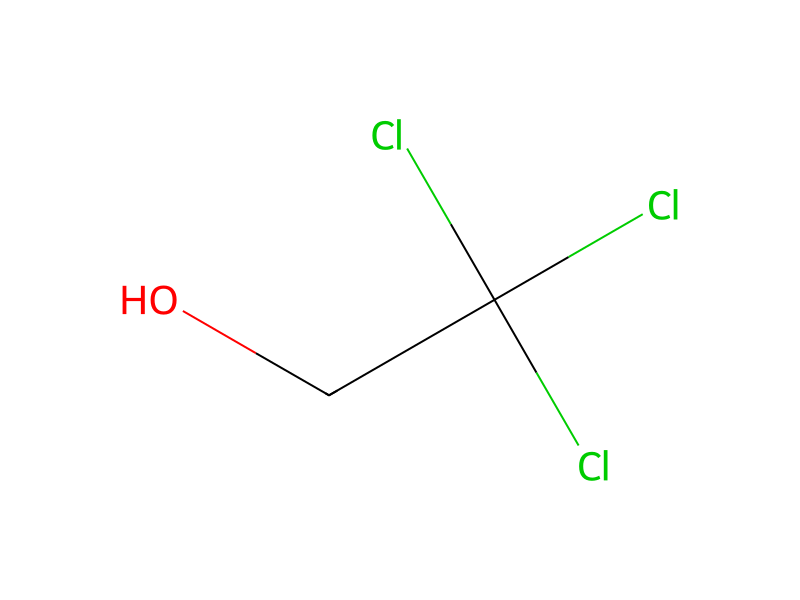
Basic information
- Standard SMILES
OCC(Cl)(Cl)Cl- InChIKey
KPWDGTGXUYRARH-UHFFFAOYSA-N- Molecular formula
- C2H3Cl3O
- Average molar mass
- 149.4 g/mol
- Monoisotopic mass
- 147.92494776
Overview
2,2,2-trichloroethanol is a chloroethanol. It has a role as a mouse metabolite.
Names & identifiers
- Preferred name
- Trichloroethanol
- IUPAC
- 2,2,2-trichloroethanol
- English name
- Trichloroethanol
- Molecular formula
- C2H3Cl3O
- Molecular weight
- 149.4
Names & synonyms
2,2,2-TRICHLOROETHANOL115-20-8TrichloroethanolTrichloroethyl alcoholEthanol, 2,2,2-trichloro-2,2,2-Trichloroethan-1-ol2,2,2-Trichloro-1-ethanol(Hydroxymethyl)trichloromethaneAW835AJ62NDTXSID1021950NSC-66407CHEBI:28094
Show more names
CCl3CH2OH2,2,2-trichloroethylalcoholEthaponoroethanoL38310883062,2,2-TrichL
NSC66407RefChem:80791DTXCID401950204-071-0Trichlorethanol2,2,2-Trichloroethyl alcoholC2H3Cl3O2,2,2-trichloro-ethanol
Database identifiers
- CAS
115-20-8- PubChem CID
- 8259
- DTXSID
DTXSID1021950- ChEMBL
CHEMBL1171、CHEMBL449666- ChEBI
CHEBI:28094- UNII
- AW835AJ62N
- EC Number
- 204-071-0
- Nikkaji
- J2.895I
Properties
Computed structural properties
- XLogP
- 1.4
- Topological polar surface area
- 20.2 Ų
- Hydrogen bond donors
- 1
- Hydrogen bond acceptors
- 1
- Rotatable bonds
- 0
- Heavy atoms
- 6
- Formal charge
- 0
- Complexity
- 38.5
Experimental & physicochemical properties
Chemical ClassesOther Classes -> Halogenated Alcohols
DrugsPharmaceuticals -> Metabolite of Chloral hydrate
SpringerMaterials PropertiesOptical coefficient
LogP1.42
Density1.54 @25 °C
Solubility83.3 mg/mL at 25 °C
Endocrine DisruptorsPotential endocrine disrupting compound
Boiling Point150 °C @760 [mm Hg]
Melting Point
19 °C
17.8 °C
Vapor Pressure
1.08 [mmHg]
1 [mm Hg] @20 °C
Physical Description
Hygroscopic liquid with an ethereal odor; mp = 18 deg C; [Merck Index]
Liquid
Physicochemical properties
- Melting point
- 17.8 °C · 17.8 °C (lit.)
- Boiling point
- 152 · 152-154 °C (lit.)
- Density
- 1.56 g/mL · 1.56 g/mL at 20 °C (lit.)
- vapor density
- 5.16 · 5.16 (vs air)
- vapor pressure
- 1 mm · 1 mm Hg ( 20 °C)
- refractive index
- 20 · n20/D 1.49(lit.)
- Flash point
- 230 °F · >230 °F
- storage temp.
- 30 °C · Store below +30°C.
- solubility
- 83 g/l · 83g/l
- form
- Liquid
- pka
- 12.24 · 12.24(at 25℃)
- color
- Clear colorless to light yellow
- Specific Gravity
- 1.56 · 1.560 (20/4℃)
- Odor
- ethereal odor
- PH
- 5 · 5-6 (H2O, 20℃)(saturated solution)
- Water Solubility
- Slightly soluble in water.
- Sensitive
- Hygroscopic
- Merck
- 14 · 14,9638
- BRN
- 1697495 · 1697495
- Henry's Law Constant
- 1.7 · 1.7×100 mol/(m3Pa) at 25℃, Wang et al. (2017)
- InChI
- 1S/C2H3Cl3O/c3-2(4,5)1-6/h6H,1H2
- InChIKey
- KPWDGTGXUYRARH-UHFFFAOYSA-N
- SMILES
- OCC(Cl)(Cl)Cl
- CAS DataBase Reference
- 115 · 115-20-8(CAS DataBase Reference)
- EWG's Food Scores
- 1 · 1
- FDA UNII
- 835 AJ62N · AW835AJ62N
- NIST Chemistry Reference
- 2 · Ethanol, 2,2,2-trichloro-(115-20-8)
- EPA Substance Registry System
- 2 · 2,2,2-Trichloroethanol (115-20-8)
- UNSPSC Code
- 12352104 · 12352104
- NACRES
- 22 · NA.22
- Symbol(GHS)
- 5 · GHS05,GHS07
- Signal word
- Danger
- Hazard statements
- 302 · H302-H318-H336
- Precautionary statements
- 261 · P261-P280-P305+P351+P338
- Hazard Codes
- Xn
- Risk Statements
- 22 · 22-41-67
- Safety Statements
- 26 · 26-39
- RIDADR
- 1760 · 1760
- WGK Germany
- 1 · 1
- RTECS
- 3850000 · KM3850000
- F
- 3 · 3-21
- Autoignition Temperature
- 151 °C · 151°C
- TSCA
- TSCA listed
- HazardClass
- 8 · 8
- PackingGroup
- III
- HS Code
- 29055910 · 29055910
- Storage Class
- 10 · 10 - Combustible liquids
- Hazard Classifications
- 4 OralEye · Acute Tox. 4 OralEye Dam. 1STOT SE 3
- Toxicity
- 500 mg/kg · LDLo orl-rat: 500 mg/kg CRAAA7 17,258,38
Safety & regulation
GHS classification
GHS Classification
Danger
H302 (100%): Harmful if swallowed [Warning Acute toxicity, oral]
P261, P264, P264+P265, P270, P271, P280, P301+P317, P302+P352, P304+P340, P305+P354+P338, P317, P319, P321, P330, P332+P317, P362+P364, P403+P233, P405, and P501 (click each P-code to see the statement)
Aggregated GHS information provided per 49 reports by companies from 9 notifications to the ECHA C&L Inventory. Each notification may be associated with multiple companies.
Hazard information
Regulatory Information
Chemical: Ethanol, 2,2,2-trichloro-
2,2,2-Trichloroethanol: Does not have an individual approval but may be used under an appropriate group standard
Hazards Summary
Causes changes in lungs in oral lethal-dose studies of mice and rats; Causes changes in urine, red blood cells, and renal function tests in repeated dose oral studies of rats; [RTECS] A metabolite of chloral hydrate and trichloroethylene; [REPROTOX] An irritant; [Aldrich MSDS] See Chloral hydrate.
Hazard Classes and CategoriesAcute Tox. 4 (100%)
Safety & protection
Protective Action Criteria (PAC)
2.0 [mg/m3]
22 [mg/m3]
130 [mg/m3]
Toxicology
Adverse EffectsNeurotoxin - Acute solvent syndrome
Safety data
- F
- 3-21
- wgk
- 1
- tsca
- TSCA listed
- rtecs
- KM3850000
- ridadr
- 1760
- hs_code
- 29055910
- Toxicity
- LDLo orl-rat: 500 mg/kg CRAAA7 17,258,38
- risk_code
- 22-41-67
- Signal word
- Danger
- Symbol(GHS)
- GHS05,GHS07
- hazard_code
- Xn
- safety_code
- 26-39
- hazard_class
- 8
- Storage Class
- 10 - Combustible liquids
- packing_group
- III
- Hazard statements
- H302-H318-H336
- Hazard Classifications
- Acute Tox. 4 OralEye Dam. 1STOT SE 3
- Autoignition Temperature
- 151°C
- Precautionary statements
- P261-P280-P305+P351+P338
Chemistry & industry
Pharmacology
Metabolism/MetabolitesTrichloroethanol is a known human metabolite of Trichloroethane.
Uses & manufacturing
UsesUsed as a therapeutic sedative and hypnotic; [Merck Index]
General Manufacturing InformationEthanol, 2,2,2-trichloro-: ACTIVE
Applications
UsesIntermediate, anesthetic.
Uses2,2,2-Trichloroethanol (TCE) is an active metabolite of Trichloroacetaldehyde monohydrate [chloral hydrate (CH)] (T774055), a sedative/hypnotic that increases cerebral blood flow (CBF).
UsesThe 2,2,2-Trichloroethyl (TCE) moiety of 2,2,2-trichloroethanol is mainly used as a protecting group for acids, acetals and also phosphoryl groups of nucleotides. It can be easily cleaved by zinc reduction.Some of its other application include:Conversion of per-O-acetylated sugars to per-O-acetylated trichloroethyl derivatives.Preparation of TCE ester of chlorosulfuric acid.Preparation of 2,2,2-trichloroethyl acetimidate hydrochloride.
Upstream & downstream products
Upstream raw materials
Downstream products
Suppliers50 total
国药集团化学试剂有限公司86-21-63210123 · [email protected]
梯希爱(上海)化成工业发展有限公司021-67121386 · [email protected]
湖北永阔科技有限公司027-59223108 15972152991 · [email protected]
上海阿拉丁生化科技股份有限公司400-6206333 13167063860 · [email protected]
T&W GROUP021-61551611 13296011611 · [email protected]
爱斯特(成都)生物制药股份有限公司+86-28-85122536 85324413 · [email protected]
Baoji Guokang Healthchem co.,ltd+8615604608665 15604608665 · [email protected]
Dayang Chem (Hangzhou) Co.,Ltd.+86-0571-88938639 17705817739 · [email protected]
上海将来实业股份有限公司400-0066400 13621662912 · [email protected]
Syntechem Co.,Ltd[email protected]
上海迈瑞尔生化科技有限公司4006356688 18621169109 · [email protected]
阿法埃莎(中国)化学有限公司400-6106006 · [email protected]
上海德默医药科技有限公司400-021-7337 2355568890 · [email protected]
安耐吉化学&3A(安徽泽升科技股份有限公司)400-0056266 · [email protected]
北京绿百草科技发展有限公司010-61136123 · [email protected]
山东八千合化工有限公司15865655795 · [email protected]
上海瀚鸿科技股份有限公司021-54306202 13764082696 · [email protected]
武汉威顺达科技发展有限公司86-027-88774375 · [email protected]
武汉丰泰威远科技有限公司+86-27-8746-5837 +86-18627785180 · [email protected]
武汉丰泰威远科技有限公司027-87465837 19945049750 · [email protected]
孝感深远化工有限公司15527621225; 15527621225 · [email protected]
玛雅试剂+86 (573) 82222445 (0)18006601000 452520369 · [email protected]
四川库利南科技有限公司400-1166-196 18981987031 · [email protected]
天津希恩思生化科技有限公司400 638 7771 · [email protected]
南京维奥化工有限公司Please Send Email 18652950785 · [email protected]
斯百全化学(上海)有限公司021-021-021-67601398-809-809-809 15221380277 · [email protected]
艾科试剂4008-755-333 18080918076 · [email protected]
上海思域化工科技有限公司86-21-34053660 · [email protected]
赛默飞世尔科技(中国)有限公司800-810-5118 · [email protected]
北京伊诺凯科技有限公司400-810-7969 010-59572699 · [email protected]
TOKYO CHEMICAL INDUSTRY CO., LTD.03-36680489 · [email protected]
深圳振强药物研发有限公司0755-66853366 13670046396 · [email protected]
北京环宇世纪化学科技有限公司hysj_bj.com
上海将来实业股份有限公司400-0066400 13621662912 · [email protected]
上海将来实业股份有限公司021-61552785 · [email protected]
安徽科迪达化工有限公司0554-2106669 · [email protected]
日照力德士化工有限公司010-51268198 · [email protected]
美岚实业(上海)有限公司021-58958189 · [email protected]
上海爱蝶实业有限公司021-58957966 18930537195 · [email protected]
成都零六生物科技有限公司400-1166-196 13458535857 · [email protected]
广拓化学(上海)有限公司021-60899189-8001 18918189673 · [email protected]
上海御略医药科技有限公司021-60345187 13671753212 · [email protected]
上海麦克林生化科技股份有限公司15221275939 15221275939 · [email protected]
杭州杰恒化工有限公司0571-87396432 · [email protected]
北京欣赛维化学科技有限公司010-56218822 13717722232 · [email protected]
上海凯赛化工有限公司021-33516722 13701817765 · [email protected]
凯试(上海)科技有限公司021-50135380 · [email protected]
北京华扬致成科技有限公司13716033033 · [email protected]
上海容立化学科技有限公司021-69992220 13701886816 · [email protected]
上海康拓化工有限公司021-69185552 13701777608 · [email protected]
Additional notes
DefinitionChEBI: 2,2,2-trichloroethanol is a chloroethanol. It has a role as a mouse metabolite.
Related reactions
86 records


Linked notes
Loading…