Completing data — refresh the page later to see the latest
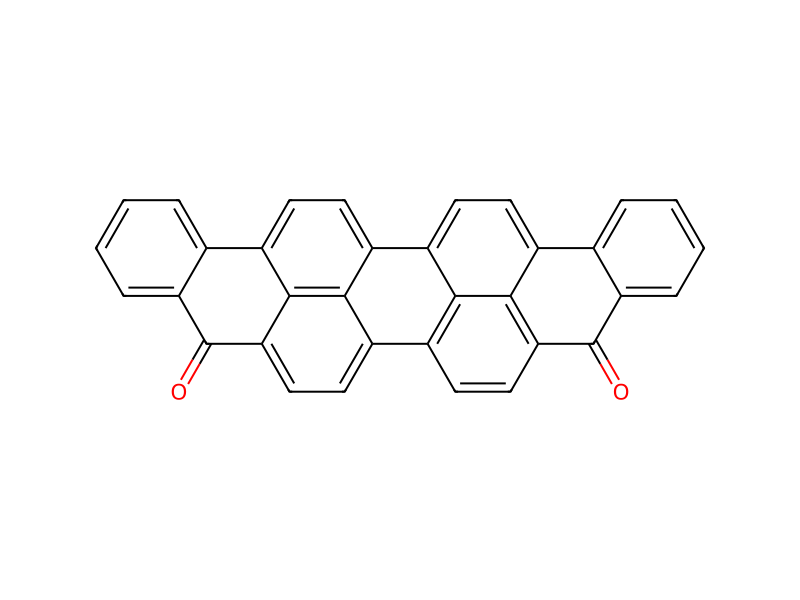
Basic information
- CAS
116-71-2- Standard SMILES
O=C1c2ccccc2-c2ccc3c4ccc5c6c(ccc(c7ccc1c2c73)c64)C(=O)c1ccccc1-5- InChIKey
YKSGNOMLAIJTLT-UHFFFAOYSA-N- Molecular formula
- C34H16O2
- Average molar mass
- 456.5 g/mol
- Monoisotopic mass
- 456.11502975
Names & identifiers
- Preferred name
- Vat Blue 20
- IUPAC
- Anthra[9,1,2-cde]benzo[rst]pentaphene-5,10-dione
- English name
- DIBENZANTHRONE
- Molecular formula
- C34H16O2
- Molecular weight
- 456.49
Names & synonyms
Blue BOc.i.59800C.I. 59815C.I. 59800VAT BLUE 20Vat Blue 18bianthroneavat blue BOVIOLANTHRONEvatdarkblueo
Database identifiers
- CAS
116-71-2、475-50-3、57455-86-4- PubChem CID
- 8317
- DTXSID
DTXSID7026281- ChEMBL
CHEMBL344254- UNII
- VH1DQP6QPQ
- EC Number
- 204-152-0、814-885-3、841-219-9
- Nikkaji
- J5.524G
Properties
Physicochemical properties
- Melting point
- 338 · 338-339 °C
- Boiling point
- 522.64 °C · 522.64°C (rough estimate)
- Density
- 1.1055 · 1.1055 (rough estimate)
- refractive index
- 1.4875 · 1.4875 (estimate)
- storage temp.
- Sealed in dry,Room Temperature
- Appearance
- Brown to black Solid
- CAS DataBase Reference
- 116 · 116-71-2(CAS DataBase Reference)
- EWG's Food Scores
- 1 · 1
- FDA UNII
- 1 DQP6QPQ · VH1DQP6QPQ
- NIST Chemistry Reference
- Dibenzanthrone(116-71-2)
- EPA Substance Registry System
- Violanthrone (116-71-2)
- Symbol(GHS)
- 7 · GHS07
- Signal word
- Warning
- Hazard statements
- 302 · H302-H315-H319-H335
- Precautionary statements
- 261 · P261-P305+P351+P338
- TSCA
- TSCA listed
- REACH Registrations
- Active
Safety & regulation
Safety information is for reference only and does not replace the supplier’s Safety Data Sheet (SDS), applicable regulations, or professional assessment.
Safety data
- tsca
- TSCA listed
- Signal word
- Warning
- Symbol(GHS)
- GHS07
- Hazard statements
- H302-H315-H319-H335
- REACH Registrations
- Active
- Precautionary statements
- P261-P305+P351+P338
Chemistry & industry
Applications
DescriptionViolanthrone, Indanthren Dark Blue BOA,is generated by potash fusion of benzanthrone , . Direct potash fusion leads to side products, such as isoviolanthrone and 4-hydroxybenzanthrone. The crude product may be used directly or in mixtures with other dyes in vat dyeing. It is also used to generate violanthrone derivatives. Several processes have been developed to decrease the amounts of undesirable side products of the direct potash fusion of benzanthrone or to purify the bibenzanthronyl or the crude violanthrone . Especially effective is the addition of high-boiling solvents such as naphthalene, the so-called low carbazole anthracene residues, or sodium acetate to the melt. The quality of the products prepared by these methods is satisfactory for the production of almost all violanthrone dyes.
UsesDIBENZANTHRONE is mainly used for dyeing and printing cotton fibers and fabrics. It has good affinity, fast color uptake, and moderate leveling properties. It is rarely used alone for printing, but more often for color matching. It can also be used for dyeing silk, viscose fiber, viscose cotton, and vinylon, as well as for hot-melt dyeing of polyester-cotton blended fabrics with disperse dyes in the same bath. It is also used to prepare organic pigments.
General DescriptionBluish-black to black powder.
Upstream & downstream products
Upstream raw materials
Related reactions
0 records
No reaction records under the current filter.
Compound notes
Loading…