Anthra(9,1,2-cde)benzo(rst)pentaphene-5,10-dione
Blue BO · c.i.59800 · C.I. 59815 · C.I. 59800 · VAT BLUE 20 · Vat Blue 18 · bianthronea · vat blue BO
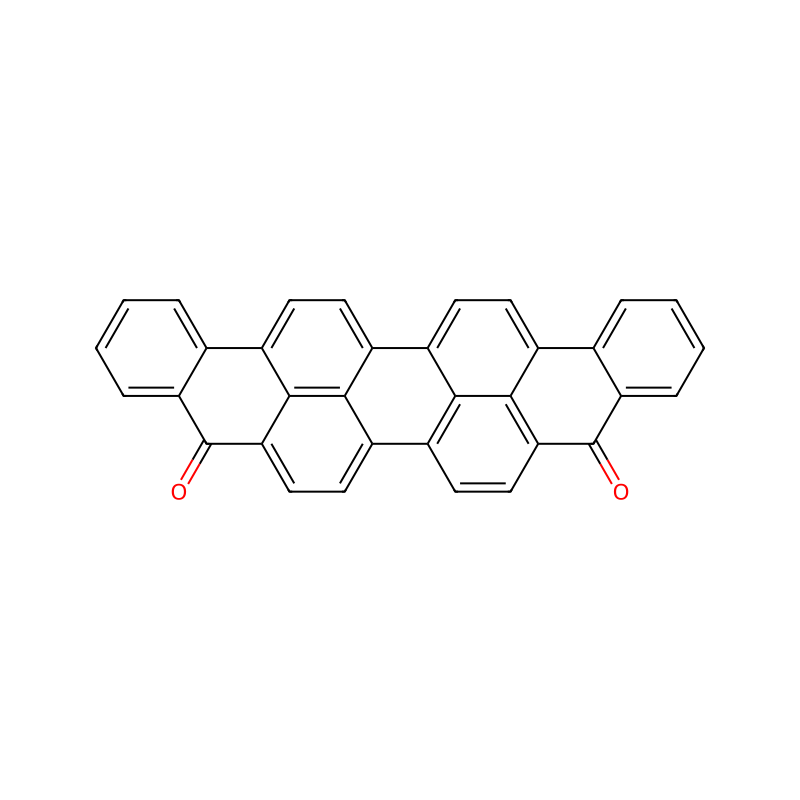
Identifiers & Physical Properties
| CAS No. | 116-71-2 |
|---|---|
| Molecular formula | C34H16O2 |
| Average molar mass | 456.5 g/mol |
| Monoisotopic mass | 456.11502975 g/mol |
| SMILES | O=C1c2ccccc2-c2ccc3c4ccc5c6c(ccc(c7ccc1c2c73)c64)C(=O)c1ccccc1-5 |
| InChIKey | YKSGNOMLAIJTLT-UHFFFAOYSA-N |
| PubChem CID | 8317 |
| ChEMBL | CHEMBL344254 |
| EC No. | 204-152-0 |
| DTXSID | DTXSID7026281 |
Chemical & Physical Properties
| XLogP | 8 |
|---|---|
| Topological polar surface area | 34.1 |
| Hydrogen bond donors | 0 |
| Hydrogen bond acceptors | 2 |
| Rotatable bonds | 0 |
| Heavy atoms | 36 |
| Formal charge | 0 |
| Complexity | 877 |
| SpringerMaterials Properties | Boiling point |
| Solubility | less than 1 mg/mL at 66 °F (NTP, 1992) |
| Melting point | 914 to 923 °F (decomposes) (NTP, 1992)338-339 °C |
| Physical Description | Vat blue 20 is a bluish-black to black powder. (NTP, 1992)Dry Powder |
| Boiling point | 522.64°C (rough estimate) |
| Density | 1.1055 (rough estimate) |
| Refractive index | 1.4875 (estimate) |
| Storage conditions | Sealed in dry,Room Temperature |
| Appearance | Brown to black Solid |
| CAS DataBase Reference | 116-71-2(CAS DataBase Reference) |
| EWG's Food Scores | 1 |
| FDA UNII | VH1DQP6QPQ |
| NIST Chemistry Reference | Dibenzanthrone(116-71-2) |
| EPA Substance Registry System | Violanthrone (116-71-2) |
| GHS pictogram | GHS07 |
| Signal word | Warning |
| GHS hazard statements | H302-H315-H319-H335 |
| GHS precautionary statements | P261-P305+P351+P338 |
| TSCA inventory status | TSCA listed |
| REACH registrations | Active |
Safety & Regulations
| GHS classification | This chemical does not meet GHS hazard criteria for 96% (24 of 25) of all reports.Not ClassifiedAggregated GHS information provided per 25 reports by companies from 2 notifications to the ECHA C&L Inventory. |
|---|---|
| Regulatory information | Chemical: Dinaphtho[1,2,3-cd:3',2',1'-lm]perylene-5,10-dioneAnthra[9,1,2-cde]benzo[rst]pentaphene-5,10-dione is listed on the EPA's Chemical Data Reporting (CDR) system. Manufacturers and importers of Anthra[9,1,2-cde]benzo[rst]pentaphene-5,10-dione are required to report information about their production and use of this chemical to the EPA under the Toxic Substances Control Act (TSCA). (40 eCFR Part 711)REACH registered substance: Violanthrene-5,10-dione (EC: 204-152-0)Anthra9,1,2-cdebenzorstpentaphene-5,10-dione: Does not have an individual approval but may be used as a component in a product covered by a group standard. It is not approved for use as a chemical in its own right. |
| Fire hazards | Flash point data for this chemical are not available. It is probably combustible. (NTP, 1992) |
| Reactive group | Hydrocarbons, Aromatic |
| Air and Water Reactions | Insoluble in water. |
| Hazard Classes and Categories | Not Classified |
| Fire fighting | Fires involving this material can be controlled with a dry chemical, carbon dioxide or Halon extinguisher. (NTP, 1992) |
| First aid | EYES: First check the victim for contact lenses and remove if present. Flush victim's eyes with water or normal saline solution for 20 to 30 minutes while simultaneously calling a hospital or poison control center. Do not put any ointments, oils, or medication in the victim's eyes without specific instructions from a physician. IMMEDIATELY transport the victim after flushing eyes to a hospital even if no symptoms (such as redness or irritation) develop. |
| Nonfire spill response | SMALL SPILLS AND LEAKAGE: If you spill this chemical, you should dampen the solid spill material with water, then transfer the dampened material to a suitable container. Use absorbent paper dampened with water to pick up any remaining material. Seal your contaminated clothing and the absorbent paper in a vapor-tight plastic bag for eventual disposal. Wash all contaminated surfaces with a soap and water solution. Do not reenter the contaminated area until the Safety Officer (or other responsible person) has verified that the area has been properly cleaned. |
Applications & Uses
Description
Violanthrone, Indanthren Dark Blue BOA,is generated by potash fusion of benzanthrone , . Direct potash fusion leads to side products, such as isoviolanthrone and 4-hydroxybenzanthrone. The crude product may be used directly or in mixtures with other dyes in vat dyeing. It is also used to generate violanthrone derivatives. Several processes have been developed to decrease the amounts of undesirable side products of the direct potash fusion of benzanthrone or to purify the bibenzanthronyl or the crude violanthrone . Especially effective is the addition of high-boiling solvents such as naphthalene, the so-called low carbazole anthracene residues, or sodium acetate to the melt. The quality of the products prepared by these methods is satisfactory for the production of almost all violanthrone dyes.
Uses
DIBENZANTHRONE is mainly used for dyeing and printing cotton fibers and fabrics. It has good affinity, fast color uptake, and moderate leveling properties. It is rarely used alone for printing, but more often for color matching. It can also be used for dyeing silk, viscose fiber, viscose cotton, and vinylon, as well as for hot-melt dyeing of polyester-cotton blended fabrics with disperse dyes in the same bath. It is also used to prepare organic pigments.
General Description
Bluish-black to black powder.