HomeMCPWorkbenchSkills
HomeWorkbenchNotificationsMe
llms.txt · MCP GuidePrivacy Policy · Terms of Service · Supportv1.8.3
  1. Home
  2. /Compound

Dibutylcarbamoyl chloride

HCID 83371
New reaction
Print
Basic informationNames & identifiersPropertiesSafety & regulationChemistry & industryRelated reactionsCompound notes
Substructure searchFind similar structures

Basic information

CAS
13358-73-1
Standard SMILES
CCCCN(CCCC)C(=O)Cl
InChIKey
OSWBZCCZJXCOGL-UHFFFAOYSA-N
Molecular formula
C9H18ClNO
Average molar mass
191.7 g/mol
Monoisotopic mass
191.1076919

Names & identifiers

Preferred name
Dibutylcarbamoyl chloride
IUPAC
N,N-dibutylcarbamoyl chloride
English name
Dibutylcarbamyl chloride
Molecular formula
C9H18ClNO
Molecular weight
191.7

Names & synonyms

Dibutylcarbamoyl chlorideRefChem:586559236-410-3dibutylcarbamic chloride13358-73-1N,N-dibutylcarbamoyl chlorideDibutylcarbamyl chlorideCarbamic chloride, 1,6-dibutyl-MFCD00015740Carbamoyl chloride, dibutyl-EINECS 236-410-3TL 459
Show more names
tl459dibutylcarbamoylchloridedibutyl-carbamoylchlorid1,6-dibutyl-carbamicchloridDibutylcarbamic acid chloride
BRN 2040828dibutylcarbamicchloridedibutyl carbamyl chlorideN,N-dibutylcarbamyl chlorideSCHEMBL417141DTXSID10158187AKOS015907783LS-05256

Database identifiers

CAS
13358-73-1
PubChem CID
83371
DTXSID
DTXSID10158187
EC Number
236-410-3
Nikkaji
J213.868I

Properties

Computed structural properties

XLogP
3.3
Topological polar surface area
20.3 Ų
Hydrogen bond donors
0
Hydrogen bond acceptors
1
Rotatable bonds
6
Heavy atoms
12
Formal charge
0
Complexity
120

Physicochemical properties

Boiling point
257 · 257-260 °C(lit.)
Density
0.985 g/mL · 0.985 g/mL at 25 °C(lit.)
refractive index
20 · n20/D 1.456(lit.)
Flash point
110 °C · 110 °C
storage temp.
0 · Store at 0-8 °C
pka
-1.85 · -1.85±0.70(Predicted)
EWG's Food Scores
1 · 1
Comptox DTXSID
10158187 · DTXSID10158187
Symbol(GHS)
5 · GHS05
Signal word
Danger
Hazard statements
314 · H314
Precautionary statements
260 · P260-P264-P280-P301+P330+P331-P303+P361+P353-P363-P304+P340-P310-P321-P305+P351+P338-P405-P501
Hazard Codes
C
Risk Statements
34 · 34
Safety Statements
26 · 26-36/37/39-45

Safety & regulation

Safety information is for reference only and does not replace the supplier’s Safety Data Sheet (SDS), applicable regulations, or professional assessment.

GHS classification

GHS Classification · 4 items

Danger

H314 (100%): Causes severe skin burns and eye damage [Danger Skin corrosion/irritation]

P260, P264, P264+P265, P280, P301+P330+P331, P302+P361+P354, P304+P340, P305+P354+P338, P316, P317, P321, P363, P405, and P501 (click each P-code to see the statement)

Aggregated GHS information provided per 39 reports by companies from 1 notifications to the ECHA C&L Inventory. Each notification may be associated with multiple companies.

Hazard information

Hazard Classes and CategoriesSkin Corr. 1B (100%)

Safety data

wgk
3
rtecs
FD2230000
ridadr
UN 3265 8/PG 3
hs_code
2924199090
risk_code
34
Signal word
Danger
Symbol(GHS)
GHS05
hazard_code
C
safety_code
26-36/37/39-45
hazard_class
IRRITANT
Hazard statements
H314
Precautionary statements
P260-P264-P280-P301+P330+P331-P303+P361+P353-P363-P304+P340-P310-P321-P305+P351+P338-P405-P501

Chemistry & industry

Applications · 1 item

UsesIt is reported that Dibutylcarbamoyl Chloride is used as a reagent for the preparation of 7-azaindole-1,3-dicarboxamide hydroxyethylamine which exhibited potent BACE-1 enzyme inhibition. Also it is used for the preparation of copper salicylaldehyde semicarbazone complex which showed cytotoxicity in human cancer cells.

Preparation methods · 1 item

PreparationIn a 100 mL roundbottomed flask were placed dibutylamine (6.45 g, 0.05 mol), pyridine (4.0 g, 0.05 mol), N-cyclohexyl-N0,N0,N00,N00-tetraethylguanidine (12.7 g, 0.05 mol), and toluene (40 mL). The resulting solution was cooled to 10 °C using an ice/salt bath and carbon dioxide was bubbled into the cooled solution for 30 min. After this period of time, the pre-formed carbamate solution was added in a single portion via a cannula to a cooled ( 10 °C) solution of thionyl chloride (6 g, 0.05 mol) in toluene (40 mL). The reaction mixture was stirred at 10 °C for 45 min. It was then poured into 0.1 m aq. HCl (100 mL), giving rise to two layers. The organic layer was separated, dried over anhydrous Mg2SO4, filtered, and the solvent was removed in vacuo. The residue was distilled in vacuo (1 mmHg) at 95–98 °C to give 7.62 g (79%) of N,N-dibutyl carbamoyl chloride.

Related reactions

11 records
New reaction record
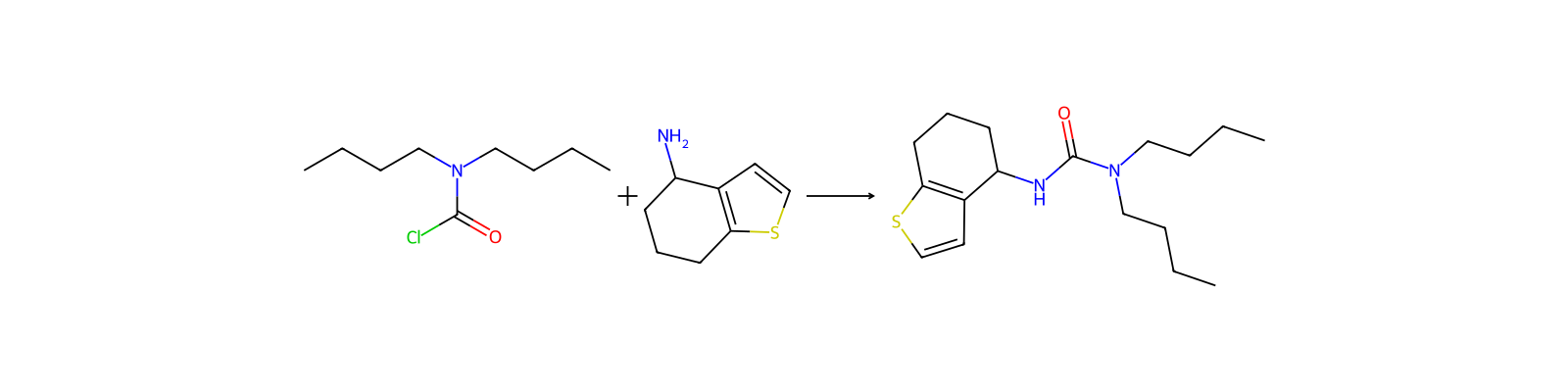
HRID 193250 reaction equation
HRID 193250As reactant
HRID 250633 reaction equation
HRID 250633As reactant
HRID 259334 reaction equation
HRID 259334As reactant
HRID 263201 reaction equation
HRID 263201As reactant
HRID 622330 reaction equation
HRID 622330As reactant
HRID 860921 reaction equation
HRID 860921As reactant
HRID 1098449 reaction equation
HRID 1098449As reactant
HRID 1142876 reaction equation
HRID 1142876As reactant
PreviousPage 1 of 2

Compound notes

On this pageBasic informationNames & identifiersPropertiesSafety & regulationChemistry & industryRelated reactionsCompound notes
RIDADR
3265 · UN 3265 8/PG 3
WGK Germany
3 · 3
RTECS
2230000 · FD2230000
HazardClass
IRRITANT
HS Code
2924199090 · 2924199090