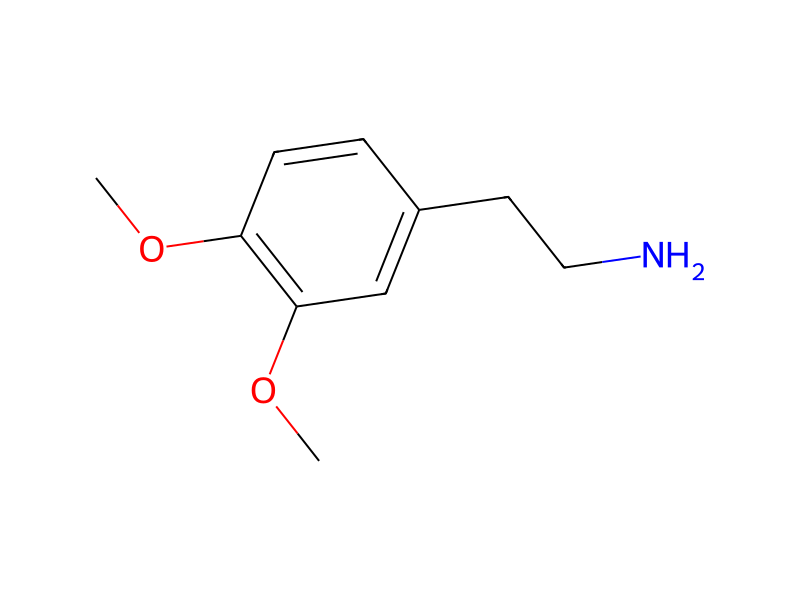
3,4-dimethoxyphenylethylamine is an aromatic ether that is the derivative of 2-phenylethylamine with methoxy substituents at the 3- and 4-positions. It is an alkaloid isolated from the Cactaceae family. It has a role as an allergen and a plant metabolite. It is an alkaloid, an aromatic ether and a phenylethylamine. It derives from a hydride of a 2-phenylethylamine.
Chemical ClassesNitrogen Compounds -> Other Aromatics (Nitrogen)
Drugs · 2 items
DEA NFLIS-Drug Category -> Phenethylamines (Amphetamines) (H)
Pharmaceuticals -> Synthetic Cannabinoids or Psychoactive Compounds
LogP0.77
Solubility24.8 [ug/mL] (The mean of the results at pH 7.4)
Boiling Point163 - 165 °C
Vapor Pressure0.00261 [mmHg]
Physical Description · 2 items
Colorless liquid with an amine-like odor; [Alfa Aesar MSDS]
Solid
Physicochemical properties
Melting point
11 °C · 11 °C
Boiling point
156 °C · 156 °C
Safety & regulation
Safety information is for reference only and does not replace the supplier’s Safety Data Sheet (SDS), applicable regulations, or professional assessment.
GHS classification
GHS Classification · 4 items
Danger
H302 (99.5%): Harmful if swallowed [Warning Acute toxicity, oral]
P261, P264, P264+P265, P270, P271, P272, P280, P301+P317, P302+P352, P304+P340, P305+P351+P338, P305+P354+P338, P317, P319, P321, P330, P332+P317, P333+P317, P337+P317, P362+P364, P403+P233, P405, and P501 (click each P-code to see the statement)
Aggregated GHS information provided per 203 reports by companies from 14 notifications to the ECHA C&L Inventory. Each notification may be associated with multiple companies.
2-(3,4-Dimethoxyphenyl) ethylamine: Does not have an individual approval but may be used under an appropriate group standard
Hazards SummaryCauses burns; Inhalation may cause corrosive injuries to upper respiratory tract and lungs; Harmful by ingestion; Toxic by inhalation; [Alfa Aesar MSDS]
Hazard Classes and CategoriesAcute Tox. 4 (99.5%)
Toxicology
Adverse EffectsDermatotoxin - Skin burns.
Toxicity DataLC50 (rat) > 5,500 mg/m3/4hr
Safety data
F
10
Chemistry & industry
Uses & manufacturing
General Manufacturing InformationBenzeneethanamine, 3,4-dimethoxy-: ACTIVE
Applications · 4 items
Description3,4-Dimethoxyphenylethylamine, also known as 3,4-DMPEA or DMPEA is an endogenous metabolite found in urine that belongs to both the phenethylamine and catecholamine families. DMPEA is an analogue of dopamine (3,4-dihydroxyphenethylamine), with a substitution of the hydroxy groups with methoxy groups. It is also structurally similar to mescaline (3,4,5-trimethoxyphenylethylamine) and occurs naturally alongside it in various species of cacti such as the San Pedro and Peruvian Torch. DMPEA received wide attention after it was proposed as a biomarker in schizophrenic patients urine, however later studies revealed that DMPEA is also excreted by non-schizophrenics. DMPEA has little known bioactivity, but it has some action as a monoamine oxidase inhibitor. It has also been shown to have neurotoxic effects, especially in the nigrostriatal system and among dopaminergic neurons. DMPEA appears to be an inhibitor of mitochondrial complex I.
Occurrence3,4-Dimethoxyphenethylamine is a natural product found in Pilosocereus leucocephalus, Vachellia rigidula, and Ototropis elegans with data available.
Uses3,4-Dimethoxyphenethylamine is a methylated metabolite of Dopamine (D533780); a potent inhibitor of brain mitochondrial respiration used in Parkinson’s disease studies.
DefinitionChEBI: An aromatic ether that is the derivative of 2-phenylethylamine with methoxy substituents at the 3- and 4-positions. It is an alkaloid isolated from the Cactaceae family.