
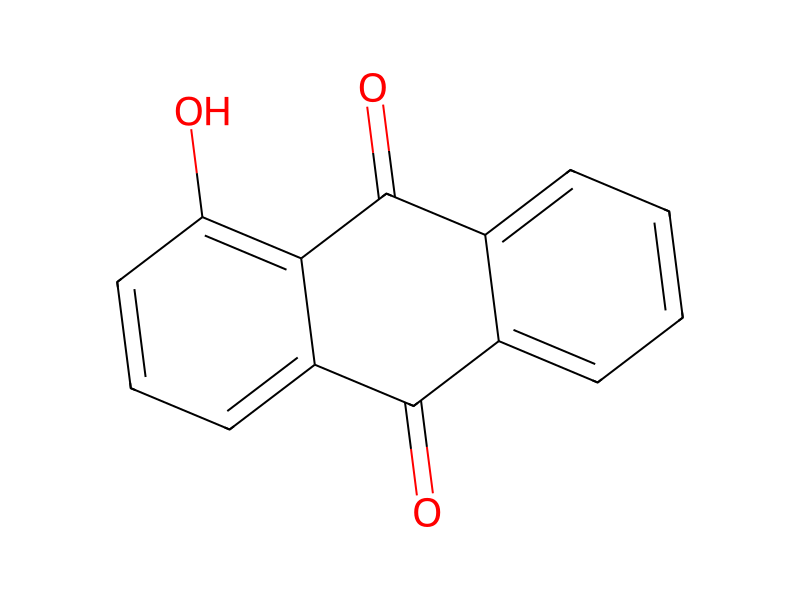
Basic information
- Standard SMILES
O=C1c2ccccc2C(=O)c2c(O)cccc21- InChIKey
BTLXPCBPYBNQNR-UHFFFAOYSA-N- Molecular formula
- C14H8O3
- Average molar mass
- 224.21 g/mol
- Monoisotopic mass
- 224.04734411
Names & identifiers
- Preferred name
- 1-Hydroxyanthraquinone
- IUPAC
- 1-hydroxyanthracene-9,10-dione
- English name
- 1-Hydroxy anthraquinone
- Molecular formula
- C14H8O3
- Molecular weight
- 224.21
Names & synonyms
1-HYDROXYANTHRAQUINONE129-43-11-hydroxyanthracene-9,10-dione9,10-Anthracenedione, 1-hydroxy-1-Hydroxy-9,10-anthraquinoneHydroxyanthraquinone1-HydroxyanthrachinonAnthraquinone, 1-hydroxy-alpha-HydroxyanthraquinoneLFU129OE9H1-hydroxy-9,10-anthracenedioneCHEBI:28877
Show more names
1-HAQNISTC129431I-0syanthrachinon1-hydroxy-anthraquinonerythroxyanthraquinone
NSC-8640DTXSID1020722RefChem:76013DTXCID70722204-946-71-Hydroxy anthraquinone1-Hydroxyanthra-9,10-quinoneMFCD00058946
Database identifiers
- CAS
129-43-1- PubChem CID
- 8512
- DTXSID
DTXSID1020722- ChEMBL
CHEMBL501834- ChEBI
CHEBI:28877- UNII
- LFU129OE9H
- EC Number
- 204-946-7
- Nikkaji
- J53.422F
Properties
Computed structural properties
- XLogP
- 3.5
- Topological polar surface area
- 54.4 Ų
- Hydrogen bond donors
- 1
- Hydrogen bond acceptors
- 3
- Rotatable bonds
- 0
- Heavy atoms
- 17
- Formal charge
- 0
- Complexity
- 349
Experimental & physicochemical properties
LogPlog Kow = 3.52
Color/Form
Orange red needles
Red-orange needles from ethyl alcohol
Orange-red to fine yellow crystals in ethanol
Solubility
Soluble in ethanol, ethyl ether, and benzene.
Soluble in oxygenated solvents
Slightly soluble in liquid NH3
In water, 8.5 mg/L @ 25 °C
Boiling PointSublimes
DecompositionWhen heated to decomposition it emits acrid smoke and fumes.
Melting Point193.8 °C
Vapor Pressure
0.00000021 [mmHg]
2.09X10⁻⁷ mm Hg @ 25 °C
Henry's Law ConstantHenry's Law constant = 7.2X10⁻⁹ atm-cu m/mole @ 25 °C /Estimated/
Physical DescriptionOrange-red to yellow solid; [HSDB] Orange powder; [MSDSonline]
Other Experimental PropertiesHydroxyl radical reaction rate constant = 1.4X10⁻¹¹ cu cm/molecul-sec @ 25 °C /Estimated/
Physicochemical properties
- Melting point
- 194 °C · 194°C
- Boiling point
- 325.61 °C · 325.61°C (rough estimate)
- Density
- 1.2337 · 1.2337 (rough estimate)
- refractive index
- 1.54 · 1.5400 (estimate)
- storage temp.
- Inert atmosphere,Room Temperature
- solubility
- 30 mg/ml · Chloroform: 30 mg/ml
- form
- powder to crystal
- pka
- 7.15 · 7.15±0.20(Predicted)
- color
- Light yellow to Brown
- Henry's Law Constant
- 1.4 · 1.4×103 mol/(m3Pa) at 25℃, Duchowicz et al. (2020)
- InChI
- 1S/C14H8O3/c15-11-7-3-6-10-12(11)14(17)9-5-2-1-4-8(9)13(10)16/h1-7,15H
- InChIKey
- BTLXPCBPYBNQNR-UHFFFAOYSA-N
- SMILES
- Oc1cccc2C(=O)c3ccccc3C(=O)c12
- CAS DataBase Reference
- 129 · 129-43-1(CAS DataBase Reference)
- EWG's Food Scores
- 1 · 1
- FDA UNII
- 129 OE9H · LFU129OE9H
- Proposition 65 List
- 1 · 1-Hydroxyanthraquinone
- IARC
- 2 B · 2B (Vol. 82) 2002
- NIST Chemistry Reference
- 9 · 9,10-Anthracenedione, 1-hydroxy-(129-43-1)
- EPA Substance Registry System
- 9 · 9,10-Anthracenedione, 1-hydroxy- (129-43-1)
- UNSPSC Code
- 12352200 · 12352200
- Symbol(GHS)
- 8 · GHS08
- Signal word
- Warning
- Hazard statements
- 320 · H320-H351
- Precautionary statements
- 501 · P501-P202-P201-P264-P280-P308+P313-P337+P313-P305+P351+P338-P405
- Hazard Codes
- Xn
- Risk Statements
- 36 · 36/37/38-40-36
- Safety Statements
- 26 · 26-36/37/39-45
- WGK Germany
- 3 · WGK 3
- RTECS
- 7178000 · CB7178000
- TSCA
- TSCA listed
- HS Code
- 2914.69 · 2914.69.9000
- Storage Class
- 11 · 11 - Combustible Solids
- Hazard Classifications
- 2 Eye · Carc. 2Eye Irrit. 2
- Hazardous Substances Data
- 129 · 129-43-1(Hazardous Substances Data)
Safety & regulation
GHS classification
GHS Classification
Warning
H319 (100%): Causes serious eye irritation [Warning Serious eye damage/eye irritation];H351 (100%): Suspected of causing cancer [Warning Carcinogenicity]
P203, P264+P265, P280, P305+P351+P338, P318, P337+P317, P405, and P501 (click each P-code to see the statement)
Aggregated GHS information provided per 40 reports by companies from 3 notifications to the ECHA C&L Inventory. Each notification may be associated with multiple companies.;Information may vary between notifications depending on impurities, additives, and other factors. The percentage value in parenthesis indicates the notified classification ratio from companies that provide hazard codes. Only hazard codes with percentage values above 10% are shown. For more detailed information, please visit ECHA C&L website.
Hazard information
Regulatory InformationHazard Traits - Carcinogenicity;Authoritative List - IARC Carcinogens - 2B; Prop 65;Report - regardless of intended function of ingredient in the product
Hazards SummaryAnthraquinones are toxic by ingestion: vomiting, diarrhea, kidney and liver damage, and coma; Deaths have been reported after children ingested Rhamnus berries; [HSDB] An eye irritant; [HSDB] An irritant; [MSDSonline]
Hazard Classes and Categories
Eye Irrit. 2 (100%);Carc. 2 (100%)
Serious eye damage/eye irritation - Category 2B;Carcinogenicity - Category 2
Shipment Methods and Regulations
PRECAUTIONS FOR "CARCINOGENS": Procurement ... of unduly large amt ... should be avoided. To avoid spilling, carcinogens should be transported in securely sealed glass bottles or ampoules, which should themselves be placed inside strong screw-cap or snap-top container that will not open when dropped & will resist attack from the carcinogen. Both bottle & the outside container should be appropriately labelled. ... National post offices, railway companies, road haulage companies & airlines have regulations governing transport of hazardous materials. These authorities should be consulted before ... material is shipped. /Chemical Carcinogens/
PRECAUTIONS FOR "CARCINOGENS": When no regulations exist, the following procedure must be adopted. The carcinogen should be enclosed in a securely sealed, watertight container (primary container), which should be enclosed in a second, unbreakable, leakproof container that will withstand chem attack from the carcinogen (secondary container). The space between primary & secondary container should be filled with absorbent material, which would withstand chem attack from the carcinogen & is sufficient to absorb the entire contents of the primary container in the event of breakage or leakage. Each secondary container should then be enclosed in a strong outer box. The space between the secondary container & the outer box should be filled with an appropriate quantity of shock-absorbent material. Sender should use fastest & most secure form of transport & notify recipient of its departure. If parcel is not received when expected, carrier should be informed so that immediate effort can be made to find it. Traffic schedules should be consulted to avoid ... arrival on weekend or holiday ... /Chemical Carcinogens/
Skin, Eye, and Respiratory IrritationsAn eye irritant.
Safety & protection
Storage Conditions
PRECAUTIONS FOR "CARCINOGENS": Storage site should be as close as practical to lab in which carcinogens are to be used, so that only small quantities required for ... expt need to be carried. Carcinogens should be kept in only one section of cupboard, an explosion-proof refrigerator or freezer (depending on chemicophysical properties ...) that bears appropriate label. An inventory ... should be kept, showing quantity of carcinogen & date it was acquired ... Facilities for dispensing ... should be contiguous to storage area. /Chemical Carcinogens/
Cleanup Methods
PRECAUTIONS FOR "CARCINOGENS": A high-efficiency particulate arrestor (HEPA) or charcoal filters can be used to minimize amt of carcinogen in exhausted air ventilated safety cabinets, lab hoods, glove boxes or animal rooms ... Filter housing that is designed so that used filters can be transferred into plastic bag without contaminating maintenance staff is avail commercially. Filters should be placed in plastic bags immediately after removal ... The plastic bag should be sealed immediately ... The sealed bag should be labelled properly ... Waste liquids ... should be placed or collected in proper containers for disposal. The lid should be secured & the bottles properly labelled. Once filled, bottles should be placed in plastic bag, so that outer surface ... is not contaminated ... The plastic bag should also be sealed & labelled. ... Broken glassware ... should be decontaminated by solvent extraction, by chemical destruction, or in specially designed incinerators. /Chemical Carcinogens/
Disposal Methods
SRP: The most favorable course of action is to use an alternative chemical product with less inherent propensity for occupational exposure or environmental contamination. Recycle any unused portion of the material for its approved use or return it to the manufacturer or supplier. Ultimate disposal of the chemical must consider: the material's impact on air quality; potential migration in soil or water; effects on animal, aquatic, and plant life; and conformance with environmental and public health regulations.
PRECAUTIONS FOR "CARCINOGENS": There is no universal method of disposal that has been proved satisfactory for all carcinogenic compounds & specific methods of chem destruction ... published have not been tested on all kinds of carcinogen-containing waste. ... summary of avail methods & recommendations ... /given/ must be treated as guide only. /Chemical Carcinogens/
PRECAUTIONS FOR "CARCINOGENS": ... Incineration may be only feasible method for disposal of contaminated laboratory waste from biological expt. However, not all incinerators are suitable for this purpose. The most efficient type ... is probably the gas-fired type, in which a first-stage combustion with a less than stoichiometric air:fuel ratio is followed by a second stage with excess air. Some ... are designed to accept ... aqueous & organic-solvent solutions, otherwise it is necessary ... to absorb soln onto suitable combustible material, such as sawdust. Alternatively, chem destruction may be used, esp when small quantities ... are to be destroyed in laboratory. /Chemical Carcinogens/
PRECAUTIONS FOR "CARCINOGENS": HEPA (high-efficiency particulate arrestor) filters ... can be disposed of by incineration. For spent charcoal filters, the adsorbed material can be stripped off at high temp & carcinogenic wastes generated by this treatment conducted to & burned in an incinerator. ... LIQUID WASTE: ... Disposal should be carried out by incineration at temp that ... ensure complete combustion. SOLID WASTE: Carcasses of lab animals, cage litter & misc solid wastes ... should be disposed of by incineration at temp high enough to ensure destruction of chem carcinogens or their metabolites. /Chemical Carcinogens/
For more Disposal Methods (Complete) data for 1-HYDROXYANTHRAQUINONE (6 total), please visit the HSDB record page.
Preventive Measures
SRP: The scientific literature for the use of contact lenses in industry is conflicting. The benefit or detrimental effects of wearing contact lenses depend not only upon the substance, but also on factors including the form of the substance, characteristics and duration of the exposure, the uses of other eye protection equipment, and the hygiene of the lenses. However, there may be individual substances whose irritating or corrosive properties are such that the wearing of contact lenses would be harmful to the eye. In those specific cases, contact lenses should not be worn. In any event, the usual eye protection equipment should be worn even when contact lenses are in place.
PRECAUTIONS FOR "CARCINOGENS": Smoking, drinking, eating, storage of food or of food & beverage containers or utensils, & the application of cosmetics should be prohibited in any laboratory. All personnel should remove gloves, if worn, after completion of procedures in which carcinogens have been used. They should ... wash ... hands, preferably using dispensers of liq detergent, & rinse ... thoroughly. Consideration should be given to appropriate methods for cleaning the skin, depending on nature of the contaminant. No standard procedure can be recommended, but the use of organic solvents should be avoided. Safety pipettes should be used for all pipetting. /Chemical Carcinogens/
PRECAUTIONS FOR "CARCINOGENS": In animal laboratory, personnel should remove their outdoor clothes & wear protective suits (preferably disposable, one-piece & close-fitting at ankles & wrists), gloves, hair covering & overshoes. ... Clothing should be changed daily but ... discarded immediately if obvious contamination occurs ... /also,/ workers should shower immediately. In chemical laboratory, gloves & gowns should always be worn ... however, gloves should not be assumed to provide full protection. Carefully fitted masks or respirators may be necessary when working with particulates or gases, & disposable plastic aprons might provide addnl protection. If gowns are of distinctive color, this is a reminder that they should not be worn outside of lab. /Chemical Carcinogens/
PRECAUTIONS FOR "CARCINOGENS": ... Operations connected with synth & purification ... should be carried out under well-ventilated hood. Analytical procedures ... should be carried out with care & vapors evolved during ... procedures should be removed. ... Expert advice should be obtained before existing fume cupboards are used ... & when new fume cupboards are installed. It is desirable that there be means for decreasing the rate of air extraction, so that carcinogenic powders can be handled without ... powder being blown around the hood. Glove boxes should be kept under negative air pressure. Air changes should be adequate, so that concn of vapors of volatile carcinogens will not occur. /Chemical Carcinogens/
For more Preventive Measures (Complete) data for 1-HYDROXYANTHRAQUINONE (10 total), please visit the HSDB record page.
Personal Protective Equipment (PPE)
PRECAUTIONS FOR "CARCINOGENS": ... Dispensers of liq detergent /should be available./ ... Safety pipettes should be used for all pipetting. ... In animal laboratory, personnel should ... wear protective suits (preferably disposable, one-piece & close-fitting at ankles & wrists), gloves, hair covering & overshoes. ... In chemical laboratory, gloves & gowns should always be worn ... however, gloves should not be assumed to provide full protection. Carefully fitted masks or respirators may be necessary when working with particulates or gases, & disposable plastic aprons might provide addnl protection. ... Gowns ... /should be/ of distinctive color, this is a reminder that they are not to be worn outside the laboratory. /Chemical Carcinogens/
Toxicology
Interactions... In addition, 1-HAQ has a synergistic effect with methylazoxymethaol (MAM) acetate on colon carcinogenesis.
Environmental Fate
TERRESTRIAL FATE: Based on a classification scheme(1), an estimated Koc value of 2,000(SRC), determined from a log Kow of 3.52(2) and a regression-derived equation(3), indicates that 1-hydroxyanthraquinone is expected to have slight mobility in soil(SRC). Volatilization of 1-hydroxyanthraquinone from moist soil surfaces is not expected to be an important fate process(SRC) given an estimated Henry's Law constant of 7.2X10⁻⁹ atm-cu m/mole(SRC), derived from its vapor pressure, 2.09X10⁻⁷ mm Hg(4), and water solubility, 8.5 mg/l(5). 1-Hydroxyanthraquinone is not expected to volatilize from dry soil surfaces(SRC) based upon it's vapor pressure(4). Biodegradation in soil is not expected to be an important environmental fate process based on a 1-5% theoretical BOD using activated sludge and the Japanese MITI test(6).
AQUATIC FATE: Based on a classification scheme(1), an estimated Koc value of 2,000(SRC), determined from a log Kow of 3.52(2) and a regression-derived equation(3), indicates that 1-hydroxyanthraquinone is expected to adsorb to suspended solids and sediment(SRC). Volatilization from water surfaces is not expected(3) based upon an estimated Henry's Law constant of 7.2X10⁻⁹ atm-cu m/mole(SRC), derived from its vapor pressure, 2.09X10⁻⁷ mm Hg(4), and water solubility, 8.5 mg/l(5). According to a classification scheme(6), BCFs ranging from 55-318(7), suggest the potential for bioconcentration in aquatic organisms is moderate to high(SRC). Biodegradation in water is not expected to be an important environmental fate process based on a 1-5% theoretical BOD using activated sludge and the Japanese MITI test(8). However, in most anoxic sediments, uncharged simple anthraquinone dyes exhibit half-lives of less than 10 days(8).
ATMOSPHERIC FATE: According to a model of gas/particle partitioning of semivolatile organic compounds in the atmosphere(1), 1-hydroxyanthraquinone, which has a vapor pressure of 2.09X10⁻⁷ mm Hg at 25 °C(2), will exist in both the vapor and particulate phases in the ambient atmosphere. Vapor-phase 1-hydroxyanthraquinone is degraded in the atmosphere by reaction with photochemically-produced hydroxyl radicals(SRC); the half-life for this reaction in air is estimated to be 28 hrs(SRC), calculated from its rate constant of 1.4X10⁻¹¹ cu cm/molecule-sec at 25 °C(SRC) that was derived using a structure estimation method(3). Particulate-phase 1-hydroxyanthraquinone may be removed from the air by wet and dry deposition(SRC). 1-Hydroxyanthraquinone isomers photodecomposed under irradiation with visible light in aerated alkaline solution, with phthalic acid as the main product(4).
Adverse Effects
Occupational hepatotoxin - Secondary hepatotoxins: the potential for toxic effect in the occupational setting is based on cases of poisoning by human ingestion or animal experimentation.;IARC Carcinogen - Class 3: Chemicals are not classifiable by the International Agency for Research on Cancer.
Medical Surveillance
PRECAUTIONS FOR "CARCINOGENS": Whenever medical surveillance is indicated, in particular when exposure to a carcinogen has occurred, ad hoc decisions should be taken concerning ... /cytogenetic and/or other/ tests that might become useful or mandatory. /Chemical Carcinogens/
Soil Adsorption/Mobility
The Koc of 1-hydroxyanthraquinone is estimated as 2,000(SRC), using a log Kow of 3.52(1) and a regression-derived equation(2). According to a classification scheme(3), this estimated Koc value suggests that 1-hydroxyanthraquinone is expected to have slight mobility in soil.
Artificial Pollution Sources1-Hydroxyanthraquinone's former production and use as a dye(1) may have resulted in its release to the environment through various waste streams(SRC).
Environmental Biodegradation
AEROBIC: 1-Hydroxyanthraquinone, present at 100 mg/l, reached 1-5% of its theoretical BOD in four weeks using an activated sludge inoculum at 20 mg/l and the Japanese MITI test(1).
ANAEROBIC: In most anoxic sediments, uncharged simple anthraquinone dyes exhibit half-lives of less than 10 days(1).
Carcinogen Classification
1-Hydroxyanthraquinone
Group 2B: Possibly carcinogenic to humans
Volume 82: (2002) Some Traditional Herbal Medicines, Some Mycotoxins, Naphthalene and Styrene
2002
2002
Environmental Bioconcentration
BCF ranges of 55-318 and 62-297 at test chemical concns of 50 and 5 mg/l, respectively, were measured for 1-hydroxyanthraquinone using orange-red killifish (Oryzias latipes) which were exposed over an 8-week period(1). According to a classification scheme(2), BCF values of 30 to 100 are moderate and from 100 to 1,000 are high.
Volatilization from Water/Soil
The Henry's Law constant for 1-hydroxyanthraquinone is estimated as 7.25X10⁻⁹ atm-cu m/mole(SRC) derived from its vapor pressure, 2.09X10⁻⁷ mm Hg(1), and water solubility, 8.5 mg/l(2). This Henry's Law constant indicates that 1-hydroxyanthraquinone is expected to be essentially nonvolatile from water surfaces(3). 1-Hydroxyanthraquinone is not expected to volatilize from dry soil surfaces(SRC) based upon its vapor pressure(1).
Non-Human Toxicity Excerpts
/LABORATORY ANIMALS: Subchronic or Prechronic Exposure/ 1-Hydroxyanthraquinone was fed in the diet (0.5%, 1%, 2% 4%) to male Fischer 344 rats for seven days. Induction of cell proliferation in the intestines was analysed by BrdU labelling. At the high dose, 1-hydroxyanthraquinone induced cell proliferation in the cecum and the proximal colorectum, but there was little evidence of intestinal cytotoxicity.
/LABORATORY ANIMALS: Chronic Exposure or Carcinogenicity/ A group of 30 male ACI/N rats, 1.5 months of age, was fed 1% 1-hydroxyanthraquinone in CE-2 diet throughout the experimental period of 480 days. Thirty control rats were fed basal diet. Rats that survived more than 280 days developed various tumors of the intestine (25/29). These comprised cecal adenomas (10/29) or adenocarcinomas (5/29) and colonic adenomas (12/29) or adenocarcinomas (11/29). No such tumors were diagnosed in control rats. In addition, neoplastic nodules and hepatocellular adenomas (12/29) and forestomach papillomas and glandular stomach adenomas (5/29) were observed. No such tumors were observed in control animals.
/LABORATORY ANIMALS: Chronic Exposure or Carcinogenicity/ A group of 27 male ACI/N rats, six weeks of age, was fed 1.5% 1-hydroxyanthraquinone in the diet for 48 weeks. A second group (14 rats) was also given 16 mg/l indomethacin in the drinking water for the experimental period. Fifteen control rats were fed basal diet. Rats fed with 1-hydroxyanthraquinone had incidences of 12/27 large intestinal neoplasms (adenomas and adenocarcinomas) and 14/27 forestomach tumors (papillomas). In rats fed 1-hydroxyanthraquinone and treated with indomethacin, these incidences were 0/14 and 2/14 respectively. Untreated animals and rats given indomethacin alone had no neoplasms in the large intestine and forestomach.
/LABORATORY ANIMALS: Chronic Exposure or Carcinogenicity/ A group of ACI/N rats fed 1/5% 1-hydroxyanthraquinone in the diet for 48 weeks showed inflammatory changes of various degrees (colitis, ulcerative colitis or melanosis coli) in the large bowel, but no clinical sign of toxicity.
For more Non-Human Toxicity Excerpts (Complete) data for 1-HYDROXYANTHRAQUINONE (10 total), please visit the HSDB record page.
Evidence for Carcinogenicity
Evaluation: There is inadequate evidence in humans for the carcinogenicity of laxatives containing anthraquinone derivatives. There is sufficient evidence in experimental animals for the carcinogenicity of 1-hydroxyanthraquinone. Overall evaluation: 1-Hydroxyanthraquinone is possibly carcinogenic to humans (Group 2B).
Regulatory information
Regulatory InformationHazard Traits - Carcinogenicity;Authoritative List - IARC Carcinogens - 2B; Prop 65;Report - regardless of intended function of ingredient in the product
Safety data
- wgk
- WGK 3
- tsca
- TSCA listed
- rtecs
- CB7178000
- hs_code
- 2914.69.9000
- risk_code
- 36/37/38-40-36
- Signal word
- Warning
- Symbol(GHS)
- GHS08
- hazard_code
- Xn
- safety_code
- 26-36/37/39-45
- Storage Class
- 11 - Combustible Solids
- Hazard statements
- H320-H351
- Hazard Classifications
- Carc. 2Eye Irrit. 2
- Precautionary statements
- P501-P202-P201-P264-P280-P308+P313-P337+P313-P305+P351+P338-P405
- Hazardous Substances Data
- 129-43-1(Hazardous Substances Data)
Chemistry & industry
Pharmacology
Metabolism/Metabolites
... 1-Hydroxyanthraquinone was found to be absorbed when continuously administered to rats (strain not specified) by stomach tube (50 mg suspended in aqueous gum arabic), and its metabolites were identified by paper chromatography. Urine and feces were collected during 48 hours after treatment and extracted with diethyl ether. Of the 1-hydroxyanthraquinone originally present, 2.49% and 0.74% were converted into alizarin (1,2-dihydroxyanthraquinone), in urine and feces, respectively. The alizarin was then excreted after sulfation and glucuronidation.
MeSH Pharmacological ClassificationSubstances that increase the risk of NEOPLASMS in humans or animals. Both genotoxic chemicals, which affect DNA directly, and nongenotoxic chemicals, which induce neoplasms by other mechanism, are included.
Absorption, Distribution and Excretion
1-Hydroxyanthraquinone was found to be absorbed when continuously administered to rats (strain not specified) by stomach tube (50 mg suspended in aqueous gum arabic), and its metabolites were identified by paper chromatography. Urine and feces were collected during 48 hours after treatment and extracted with diethyl ether. Of the 1-hydroxyanthraquinone originally present, 2.49% and 0.74% were converted into alizarin (1,2-dihydroxyanthraquinone), in urine and feces, respectively. The alizarin was then excreted after sulfation and glucuronidation.
Uses & manufacturing
Uses
Used to make dyes and pharmaceuticals; [HSDB]
1-Hydroxyanthraquinone can be used as an intermediate in the production of dyes and drugs.
Methods of Manufacturing
A general method for synthesis of anthraquinones, including 1-hydroxy-anthraquinone, has been developed. The anthraquinones were obtained under mild conditions from ortho-dicarboxylic acid chlorides and suitable aromatic substrates via a FriedelCrafts process.
1-Hydroxyanthraquinone has been synthesized by diazotization of 1-aminoanthraquinone and heating the diazonium salt with concentrated sulfuric acid. After dilution with water, the precipitated crude product was diluted with acetone and purified by preparative thin-layer chromatography (TLC) in toluene:ethyl formate:formic acid (75:24:1).
1-Hydroxyanthraquinone has also been prepared in 96.4% yield by reacting 1-nitroanthraquinone with sodium formate in dimethylformamide at 130 C for 17 hours.
General Manufacturing Information
9,10-Anthracenedione, 1-hydroxy-: INACTIVE
1-Hydroxyanthraquinone has been isolated from the roots of Rubia cordifolia, Morinda officinalis and Damnacanthus indicus, from the heartwood of Tabebuia avellanedae and the herb Cassia occidentalis.
Applications
Uses1-Hydroxyanthraquinone, a naturally occurring compound with oral activity from some plants like Tabebuia avellanedae, exhibits carcinogenic effect[1].
Upstream & downstream products
Upstream raw materials
Downstream products
Suppliers50 total
梯希爱(上海)化成工业发展有限公司021-67121386 · [email protected]
苏州道澜生物医药科技有限公司15952404857 · [email protected]
上海阿拉丁生化科技股份有限公司400-6206333 13167063860 · [email protected]
合肥曼奇诺生物医药技术有限公司19719236623 · [email protected]
成都超九八生物科技有限公司13348960310 13348960310 · [email protected]
上海麦克林生化科技股份有限公司021-50706066 15221275939 · [email protected]
Dayang Chem (Hangzhou) Co.,Ltd.+86-0571-88938639 17705817739 · [email protected]
上海赛可锐生物科技有限公司021-58000709 13120558703 · [email protected]
韶远科技(上海)有限公司021-50795510 4000665055 · [email protected]
Ark Pharm, Inc.847-367-3680 · [email protected]
上海迈瑞尔生化科技有限公司4006356688 18621169109 · [email protected]
北京华威锐科化工有限公司0757-86329057 18934348241 · [email protected]
上海晶抗生物工程有限公司021-54721350 13524668266 · [email protected]
大连美仑生物技术有限公司0411-62910999 13889544652 · [email protected]
安耐吉化学&3A(安徽泽升科技股份有限公司)400-0056266 · [email protected]
梯希爱(上海)化工贸易有限公司021-61109150 · [email protected]
成都普思生物科技股份有限公司028-85370565-229 18080489829 · [email protected]
上海相辉医药科技有限公司13761987713 · [email protected]
銳迪國際科技有限公司18024082417 · [email protected]
上海维亦特生物科技有限公司15317051735 · [email protected]
武汉市皇臻生物化工有限公司13795480948 · [email protected]
佛山宝诺生物科技有限公司0757-85921206 18520245316 · [email protected]
孝感深远化工有限公司15527621225; 15527621225 · [email protected]
玛雅试剂+86 (573) 82222445 (0)18006601000 452520369 · [email protected]
天津希恩思生化科技有限公司400 638 7771 · [email protected]
ZHEJIANG JIUZHOU CHEM CO., LTD+86-0576225566889 +86-13454675544 · [email protected];[email protected];[email protected]
上海源叶生物科技有限公司13636370518 · [email protected]
TCI AMERICA800-4238616 · [email protected]
TOKYO CHEMICAL INDUSTRY CO., LTD.03-36680489 · [email protected]
TCI Europe320-37350700 · [email protected]
河南赢创生物科技有限公司15672878902 · [email protected]
上海倍卓生物科技有限公司021-61119791,13386096464 · [email protected]
上海丽康新材料有限公司+86-16631818819 +86-17736933208 · [email protected]
PT CHEM GROUP LIMITED+86-85511178; +86-85511178 · [email protected]
上海将来实业股份有限公司400-0066400 13621662912 · [email protected]
成都零六生物科技有限公司400-1166-196 13458535857 · [email protected]
湖南华腾制药有限公司400-8592883 · [email protected]
天津普西唐生物医药科技有限公司010-60605840 · [email protected]
陕西缔都医药化工有限公司029-81024372 17792795018 · [email protected]
上海陶术生物科技股份有限公司+1-781-999-5354; +1-00000000000 · [email protected]
九鼎化学(上海)科技有限公司4009209199 · [email protected]
上海谱振生物科技有限公司4001650900 13817534909 · [email protected]
HANGZHOU LEAP CHEM CO., LTD.+86-571-87711850 +86-15355479329 · [email protected]
武汉沃轩科技有限公司13322067656 · [email protected]
Alfa Chemistry+1-5166625404 · [email protected]
成都大道三灵生物科技有限公司18108108965 18108108965 · [email protected]
湖北扬信医药科技有限公司07143299675 13092790750 · [email protected]
上海西陇生化科技有限公司021-52907766-8042
山东西亚化学有限公司4009903999 13395398332 · [email protected]
广东翁江化学试剂有限公司0751-2886750 13927877953 · [email protected]
Additional notes
DefinitionChEBI: 1-hydroxyanthraquinone is a monohydroxyanthraquinone.
Related reactions
7 records


Linked notes
Loading…