
HRID 224568As product
Completing data — refresh the page later to see the latest
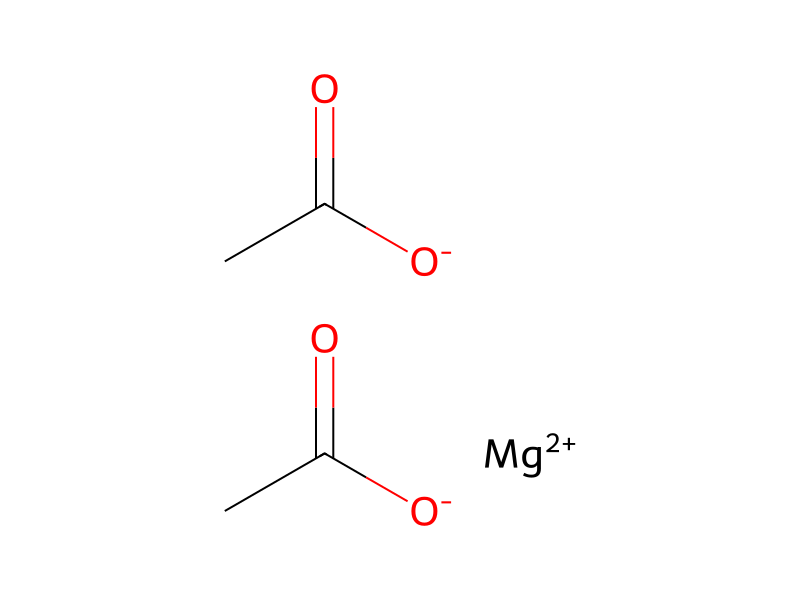
142-72-3CC(=O)[O-].CC(=O)[O-].[Mg+2]UEGPKNKPLBYCNK-UHFFFAOYSA-LMagnesium acetate is the magnesium salt of acetic acid. It is functionally related to an acetic acid.
142-72-3DTXSID7027097CHEMBL1200691CHEBI:62964Cosmetic ingredients (Magnesium Acetate) -> CIR (Cosmetic Ingredient Review)
Buffering
FDA approved drugs -> Active ingredient
FDA approved drugs -> Active ingredient
Liquid; Large Crystals
Tetrahydrate: Colorless or white deliquescent solid; [Merck Index] White hygroscopic crystals with a mild odor of acetic acid; [Mallinckrodt Baker MSDS]
Safety information is for reference only and does not replace the supplier’s Safety Data Sheet (SDS), applicable regulations, or professional assessment.
This chemical does not meet GHS hazard criteria for 99.5% (2416 of 2427) of all reports.
Not Classified
Aggregated GHS information provided per 2427 reports by companies from 3 notifications to the ECHA C&L Inventory.
Chemical: Acetic acid, magnesium salt
Acetic acid, magnesium salt (2:1) is listed on the EPA's Chemical Data Reporting (CDR) system. Manufacturers and importers of Acetic acid, magnesium salt (2:1) are required to report information about their production and use of this chemical to the EPA under the Toxic Substances Control Act (TSCA). (40 eCFR Part 711)
REACH registered substance: Magnesium di(acetate) (EC: 205-554-9)
Acetic acid, magnesium salt: Does not have an individual approval but may be used under an appropriate group standard
Members of the acetic acid and salts subcategory demonstrate low acute oral, dermal, and inhalation toxicity; Hyperplasia of the esophagus and forestomach in repeated-dose oral studies of rats; Increased spleen and kidney weights and signs of kidney injury in continuous inhalation studies at 23-31 ppm/day (60-80 mg/m3/day); No maternal or developmental toxicity in mice, rats, or rabbits in oral studies (doses up to 1,600 mg/kg/day); No evidence of mutagenicity; [EPA ChAMP: Hazard Characterization] May cause irritation; [Mallinckrodt Baker MSDS] See Sodium acetate.
CIR ingredient: Magnesium Acetate
Used as a buffer and to detect sodium; [Merck Index] Used as a catalyst for sulfuric acid; [EPA OHM/TADS] Permitted for use as an inert ingredient in non-food pesticide products; [EPA]
EPA Safer Chemical Functional Use Classes -> Processing Aids and Additives
Safer Chemical Classes -> Green circle - The chemical has been verified to be of low concern
Food Additives -> FOOD_ADDITIVE -> JECFA Functional Classes
Cosmetics -> Buffering
All Other Basic Inorganic Chemical Manufacturing
Acetic acid, magnesium salt (2:1): ACTIVE
UsesMagnesium acetate is used in the manufacture of rayon fiber for cigarette filters; and as a fixative for dyes in textile printing. It also is used as an antiseptic and disinfectant.
DescriptionAnhydrous Magnesium Acetate has the chemical formula Mg(CH3COO)2 and in its hydrous form, Magnesium Acetate Tetrahydrate, it has the chemical formula Mg(CH3COO)2.4H2O. In this compound the magnesium metal has an oxidation state of 2+. Magnesium acetate is the magnesium salt of acetic acid.It is deliquescent and upon heating, it decomposes to form magnesium oxide.Magnesium acetate is commonly used as a source of magnesium or as a chemical reagent.
UsesDye fixative in textile printing, deodorant, disinfectant, and antiseptic. Magnesium acetate is used in chemistry and molecular biology as a reagent and a source of magnesium. Magnesium has a variety of biological roles in enzymology, cell membrane and wall structural integrity, muscle cell physiology, and nucleic acid structure.Magnesium is an essential co-factor in many enzymes, including deoxyribonuclease (DNase), the restriction enzymes EcoR I and EcoR V, and Ribonuclease H. Magnesium also stabilizes polymeric nucleic acids such as transfer RNA and ribozymes. Magnesium acetate has been widely used in the crystallization of proteins. A protocol for the separation of MB and BB isoenzymes of creatine kinase and the LD1 isoenzyme of lactate dehydrogenase that involves elution with magnesium acetate has been published.


26 [mg/m3]
280 [mg/m3]
1700 [mg/m3]
UsesThe largest use for magnesium acetate is in the production of rayon fiber, which is used for cigarette filter tow. Magnesium acetate also has uses as a dye fixative in textile printing, as a deodorant, disinfectant, an antiseptic in medicine, and as a reagent chemical.
UsesMagnesium acetate is used in molecular biology applications such as batch in vitro transcription of RNA and the crystallization of transcription factor:DNA complexes and proteins via the sitting-drop vapor-diffusion method. Also used as a buffer and to detect sodium and as a catalyst for sulfuric acid.
PreparationMagnesium acetate is prepared by treating magnesium oxide with acetic acid. Magnesium oxide reacts with concentrated acetic acid in boiling ethyl acetate to produce the alpha form of anhydrous magnesium acetate. The beta form is obtained by treating the oxide with 5–6% acetic acid. In slightly hydrated isobutyl alcohol medium the product is a monohydrate, Mg(OOCCH3)2•H2O. In aqueous solution magnesium acetate crystallizes as a tetrahydrate, the commercial product. The tetrahydrate dehydrates to anhydrous salt at 134°C.
DefinitionChEBI: The magnesium salt of acetic acid.