
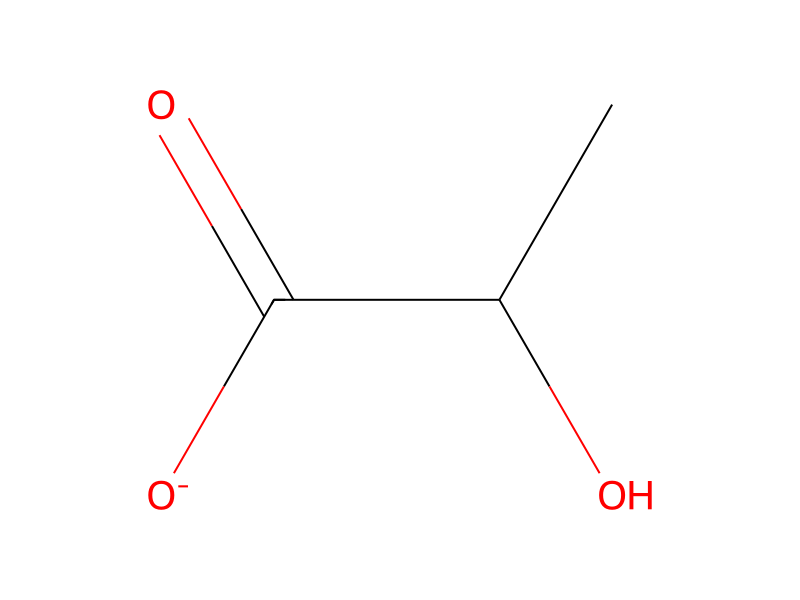
Basic information
- CAS
113-21-3- Standard SMILES
CC(O)C(=O)[O-]- InChIKey
JVTAAEKCZFNVCJ-UHFFFAOYSA-M- Molecular formula
- C3H5O3-
- Average molar mass
- 89.07 g/mol
- Monoisotopic mass
- 89.0244176
Overview
Lactate is a hydroxy monocarboxylic acid anion that is the conjugate base of lactic acid, arising from deprotonation of the carboxy group. It has a role as an Escherichia coli metabolite and a human metabolite. It is functionally related to a propionate. It is a conjugate base of a rac-lactic acid and a 2-hydroxypropanoic acid.
Names & identifiers
- Preferred name
- Lactate
- IUPAC
- 2-hydroxypropanoate
- English name
- LACTATE
- Molecular formula
- C3H5O3
- Molecular weight
- 0
Names & synonyms
lactate2-hydroxypropanoateb-lactatebeta-LactateCHEBI:24996RefChem:924460113-21-32-HydroxypropionateLactate ion, DL-MeCH(OH)CO2 anionPropanoic acid, 2-hydroxy-, ion(1-)13GMT0VU0O
Show more names
L-LACTIC ACID, 40% SOLNMethylglycolateCHEMBL1357UNII-13GMT0VU0OLithium L(+)-lactate; Lithiumdl-lactateDL lactateDL lactic acid
Database identifiers
- CAS
113-21-3- PubChem CID
- 91435
- DTXSID
DTXSID10873500- ChEBI
CHEBI:24996- UNII
- 13GMT0VU0O
- Nikkaji
- J291.337B
Properties
Computed structural properties
- XLogP
- 0.2
- Topological polar surface area
- 60.4 Ų
- Hydrogen bond donors
- 1
- Hydrogen bond acceptors
- 3
- Rotatable bonds
- 0
- Heavy atoms
- 6
- Formal charge
- -1
- Complexity
- 53.5
Physicochemical properties
- FDA UNII
- 13 GMT0VU0O · 13GMT0VU0O
Safety & regulation
Toxicology
Health Effects
Chronically high levels of Lactic acid are associated with at least a dozen inborn errors of metabolism including: 2-Methyl-3-hydroxybutyryl CoA dehydrogenase deficiency, Biotinidase deficiency, Fructose-1,6-diphosphatase deficiency, Glycogen Storage Disease Type 1A (GSD1A) or Von Gierke Disease, Glycogenosis, Type IB, Glycogenosis, Type IC, Glycogenosis, Type VI. Hers disease, Lactic Acidemia, Leigh Syndrome, Methylmalonate Semialdehyde Dehydrogenase Deficiency, Pyruvate Decarboxylase E1 Component Deficiency, Pyruvate dehydrogenase complex deficiency, Pyruvate dehydrogenase deficiency, Short Chain Acyl CoA Dehydrogenase Deficiency (SCAD Deficiency).
Toxicity Summary
Accumulation of L-lactic acid in the body has been shown to be toxic. At times of lactic acidosis, when excess intracellular lactate is released into the blood, maintenance of electroneutrality of the blood requires that a cation be released into the blood, as well. This can reduce blood pH. Lactate may exert a strong action over GABAergic networks in the developing brain, making them more inhibitory than it was previously assumed, acting either through better support of metabolites, or alterations in base intracellular pH levels, or both. (Wikipedia)
Carcinogen ClassificationNot listed by IARC.
Chemistry & industry
Upstream & downstream products
Downstream products
Suppliers1 total
Syntechem Co.,Ltd[email protected]
Additional notes
DefinitionChEBI: A hydroxy monocarboxylic acid anion that is the conjugate base of lactic acid, arising from deprotonation of the carboxy group.
Related reactions
72 records


Compound notes
Loading…