
Manganese acetate tetrahydrate
Basic information
- CAS
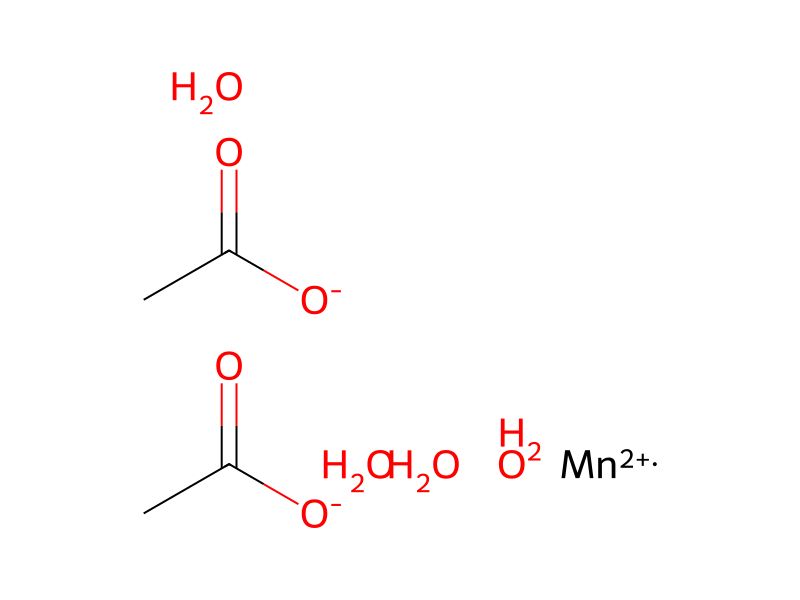
6156-78-1- Standard SMILES
CC(=O)[O-].CC(=O)[O-].O.O.O.O.[Mn+2]- InChIKey
CESXSDZNZGSWSP-UHFFFAOYSA-L- Molecular formula
- C4H6MnO4 . 4H2O
- Average molar mass
- 245.09 g/mol
- Monoisotopic mass
- 245.00691
Overview
Manganese triacetate is a chemical compound of manganese. Manganese is a naturally occurring metal with the symbol Mn and the atomic number 25. It does not occur naturally in its pure form, but is found in many types of rocks in combination with other substances such as oxygen, sulfur, or chlorine. Manganese occurs naturally in most foods and small amounts are needed to stay healthy, as manganese ions act as cofactors for a number of enzymes. (L228, L229)
Names & identifiers
- Preferred name
- Manganese acetate tetrahydrate
- IUPAC
- manganese(2+);diacetate;tetrahydrate
- English name
- Manganese(II) acetate tetrahydrate
- Molecular formula
- C4H14MnO8
- Molecular weight
- 245.09
Names & synonyms
6156-78-1Manganese acetate tetrahydrateManganese(II) acetate tetrahydrateManganous acetate tetrahydrateManganese diacetate, tetrahydratemanganese diacetate tetrahydrateMANGANUM ACETICUMUNII-9TO51D176NDTXSID002105669TO51D176NDTXCID30133057RefChem:59029
Show more names
MANGANESE ACETATEMANGANESE(II) ACETATECo-MnManganeseAcetateAracetate tetrahydrateManganese acetate, GR 99%+MANGANESE(II) ACETATE 4 H2OTetrahydrate of acetic acid
C4H14MnO8manganese (II) acetate tetrahydrate4-BENZOYLBENZENEBORONICACIDACETIC ACID, MANGANESE(2+) SALT, TETRAHYDRATEManganese(II); acetate tetrahydrateManganeseacetatetetrahydratemanganous;diacetate;tetrahydrateMANGANUM ACETICUM [HPUS]
Database identifiers
- CAS
Properties
Computed structural properties
- Topological polar surface area
- 84.3 Ų
- Hydrogen bond donors
- 4
- Hydrogen bond acceptors
- 8
- Rotatable bonds
- 0
- Heavy atoms
- 13
- Formal charge
- 0
- Complexity
- 25.5
Experimental & physicochemical properties
Chemical ClassesMetals -> Organic Acids, Metal Salts
Density1.59 @ 20°C
Melting Point80 °C
Physical DescriptionLight red transparent solid; [Merck Index] Light pink hygroscopic crystals; [Acros Organics MSDS]
Physicochemical properties
- Melting point
- 300 °C · >300 °C(lit.)
- Density
- 1.589 g/mL · 1.589 g/mL at 25 °C(lit.)
- bulk density
- 700 kg/m3 · 700kg/m3
- vapor pressure
- 1 hPa · <1 hPa (25 °C)
- storage temp.
- 30 °C · Store below +30°C.
- solubility
- 233 g/l · 233g/l
- form
- Crystals
- Specific Gravity
- 1.589 · 1.589
- color
- Pink
- PH
- 7 · 7.0 (50g/l, H2O, 20℃)
Safety & regulation
Safety information is for reference only and does not replace the supplier’s Safety Data Sheet (SDS), applicable regulations, or professional assessment.
GHS classification
GHS Classification
This chemical does not meet GHS hazard criteria for 35.1% (26 of 74) of reports.
Warning
H315 (63.5%): Causes skin irritation [Warning Skin corrosion/irritation]
P261, P264, P264+P265, P271, P280, P302+P352, P304+P340, P305+P351+P338, P319, P321, P332+P317, P337+P317, P362+P364, P403+P233, P405, and P501 (click each P-code to see the statement)
Aggregated GHS information provided per 74 reports by companies from 9 notifications to the ECHA C&L Inventory. Each notification may be associated with multiple companies.
Danger
Hazard information
Regulatory Information
Chemical: Acetic acid, manganese(2+) salt, tetrahydrate
Acetic acid, manganese(2+) salt, tetrahydrate: Does not have an individual approval but may be used under an appropriate group standard
Other Safety InformationIMAP assessments - Soluble manganese compounds: Human health tier II assessment
Hazards SummaryAn irritant; Possible reproductive and fetal toxicant; [Acros Organics MSDS] See Manganese(II) acetate. See Manganese and linked occupational diseases.
Hazard Classes and Categories
Skin Irrit. 2 (63.5%)
Acute toxicity (ingestion) - category 4
Safety & protection
Exposure Control and Personal Protection0.2 [mg/m3], as Mn (inhalable fraction), 0.02 mg/m3, as Mn (respirable fraction)[German Research Foundation (DFG)]
Chemistry & industry
Pharmacology
Metabolism/Metabolites
Manganese is absorbed mainly via ingestion, but can also be inhaled. It binds to alpha-2-macroglobulin, albumin, or transferrin in the plasma and is distributed to the brain and all other mammalian tissues, though it tends to accumulate more in the liver, pancreas, and kidney. Manganese is capable of existing in a number of oxidation states and is believed to undergo changes in oxidation state within the body. Manganese oxidation state can influence tissue toxicokinetic behavior, and possibly toxicity. Manganese is excreted primarily in the faeces. (L228)
FDA Pharmacological Classification
MANGANESE ACETATE TETRAHYDRATE
Magnetic Resonance Contrast Activity [MoA]; Paramagnetic Contrast Agent [EPC]
MANGANUM ACETICUM
Osmotic Laxative [EPC]; Magnesium Ion Exchange Activity [MoA]; Inhibition Small Intestine Fluid/Electrolyte Absorption [PE]; Stimulation Large Intestine Fluid/Electrolyte Secretion [PE]; Increased Large Intestinal Motility [PE]; Calculi Dissolution Agent [EPC]; Osmotic Activity [MoA]; Inhibition Large Intestine Fluid/Electrolyte Absorption [PE]
Uses & manufacturing
Uses
Used as a mordant in dyeing, to make a brown pigment, and as a drying agent for paints and varnishes; [Merck Index]
Painting (Pigments, Binders, and Biocides) [Category: Paint]
Applications
UsesManganese(II) acetate tetrahydrate may be used in the sol gel synthesis of doped TiO2 containing different amounts of Mn2+.
General DescriptionManganese(II) acetate tetrahydrate is a hydrated salt of manganese. Kinetic studies suggest that its dehydration takes place in two-step reaction involving the loss of two water molecules. Its crystal structure has been investigated by X-ray studies. Its crystals exhibit monoclinic crystal system and space group P21/c.
Related reactions
46 records







Compound notes
Loading…