
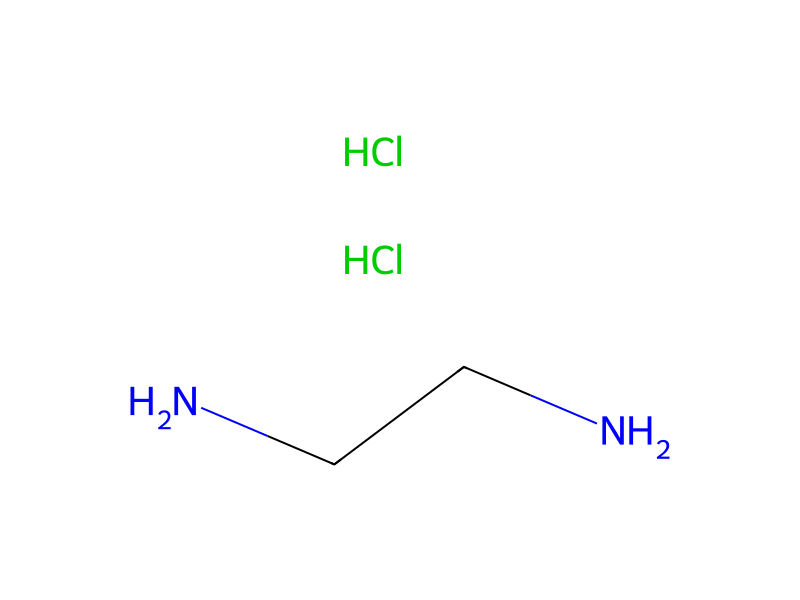
Basic information
- Standard SMILES
Cl.Cl.NCCN- InChIKey
OHHBFEVZJLBKEH-UHFFFAOYSA-N- Molecular formula
- C2H10Cl2N2
- Average molar mass
- 133.02 g/mol
- Monoisotopic mass
- 132.0221037
Names & identifiers
- Preferred name
- Ethylenediamine Dihydrochloride
- IUPAC
- ethane-1,2-diamine;dihydrochloride
- English name
- Ethylenediamine dihydrochloride
- Molecular formula
- C2H10Cl2N2
- Molecular weight
- 133.02
Names & synonyms
Ethylenediamine dihydrochloride333-18-6Ethylenediammonium dichloride1,2-Diaminoethane dihydrochlorideEthylenediammonium chlorideDimethylenediamine dihydrochlorideEthylenediamine, dihydrochlorideCHEBI:5362691WQV43244DTXSID5043920NSC-163962RefChem:139151
Show more names
ETHYLENEDIAMINE 2HCLEthylenediaminehydrochlorideEthylenediamine dihyenediamine dihydrochLETHYLENEDIAMINE DI HCLEthylenediamine dichloride
DTXCID3023920206-369-6ethane-1,2-diamine dihydrochlorideChlor-ethamine1,2-Ethanediamine, dihydrochlorideethane-1,2-diamine;dihydrochlorideMFCD00012524Dimethylenediamine diydrochloride
Database identifiers
- CAS
333-18-6- PubChem CID
- 9521
- DTXSID
DTXSID5043920- ChEBI
CHEBI:53626- UNII
- 91WQV43244
- EC Number
- 206-369-6
Properties
Computed structural properties
- Topological polar surface area
- 52 Ų
- Hydrogen bond donors
- 4
- Hydrogen bond acceptors
- 2
- Rotatable bonds
- 1
- Heavy atoms
- 6
- Formal charge
- 0
- Complexity
- 6
Experimental & physicochemical properties
Physical DescriptionWhite crystalline solid; Hygroscopic; [Sigma-Aldrich MSDS]
Physicochemical properties
- Melting point
- 300 °C · >300 °C(lit.)
- Density
- 1.46 g/cm3 · 1.46 g/cm3
- bulk density
- 650 kg/m3 · 650kg/m3
- storage temp.
- 30 °C · Store below +30°C.
- solubility
- 100 mg/mL, · water: soluble100mg/mL, clear, colorless to very faintly yellow
- form
- Crystalline Powder
- color
- White to off-white
- PH
- 5 · 5 (100g/l, H2O, 20℃)
- Water Solubility
- 300 g/L · 300 g/L (20 ºC)
- Sensitive
- Hygroscopic
- BRN
- 3665235 · 3665235
- Stability
- Stable. Incompatible with strong oxidizing agents.
- InChI
- InChI=1S/C2H8N2.2ClH/c3-1-2-4;;/h1-4H2;2*1H
- InChIKey
- OHHBFEVZJLBKEH-UHFFFAOYSA-N
- SMILES
- C(N)CN.Cl.Cl
- CAS DataBase Reference
- 333 · 333-18-6(CAS DataBase Reference)
- EWG's Food Scores
- 1 · 1
- FDA UNII
- 91 WQV43244 · 91WQV43244
- EPA Substance Registry System
- Ethylenediamine dihydrochloride (333-18-6)
- UNSPSC Code
- 12352107 · 12352107
- NACRES
- 22 · NA.22
- Symbol(GHS)
- 7 · GHS07,GHS08
- Signal word
- Danger
- Hazard statements
- 302 · H302-H315-H317-H319-H334-H335
- Precautionary statements
- 261 · P261-P280-P301+P312-P302+P352-P304+P340+P312-P305+P351+P338
- Hazard Codes
- Xn
- Risk Statements
- 22 · 22-36/37/38-42/43
- Safety Statements
- 22 · 22-26-36/37-45
- WGK Germany
- 2 · 2
- RTECS
- 3850000 · KV3850000
- TSCA
- TSCA listed
- HS Code
- 29212100 · 29212100
- Storage Class
- 11 · 11 - Combustible Solids
- Hazard Classifications
- 4 OralEye · Acute Tox. 4 OralEye Irrit. 2Resp. Sens. 1Skin Irrit. 2Skin Sens. 1STOT SE 3
- Toxicity
- 50 orally · LD50 orally in Rabbit: 3250 mg/kg LD50 dermal Rabbit > 2000 mg/kg
Safety & regulation
GHS classification
GHS Classification
Danger
H302 (94.4%): Harmful if swallowed [Warning Acute toxicity, oral];H315 (93%): Causes skin irritation [Warning Skin corrosion/irritation];H317 (93%): May cause an allergic skin reaction [Warning Sensitization, Skin];H319 (93%): Causes serious eye irritation [Warning Serious eye damage/eye irritation];H334 (88.7%): May cause allergy or asthma symptoms or breathing difficulties if inhaled [Danger Sensitization, respiratory];H335 (88.7%): May cause respiratory irritation [Warning Specific target organ toxicity, single exposure; Respiratory tract irritation]
P233, P260, P261, P264, P264+P265, P270, P271, P272, P280, P284, P301+P317, P302+P352, P304+P340, P305+P351+P338, P319, P321, P330, P332+P317, P333+P317, P337+P317, P342+P316, P362+P364, P403, P403+P233, P405, and P501 (click each P-code to see the statement)
Aggregated GHS information provided per 71 reports by companies from 6 notifications to the ECHA C&L Inventory. Each notification may be associated with multiple companies.;Information may vary between notifications depending on impurities, additives, and other factors. The percentage value in parenthesis indicates the notified classification ratio from companies that provide hazard codes. Only hazard codes with percentage values above 10% are shown. For more detailed information, please visit ECHA C&L website.
Hazard information
Regulatory Information
Chemical: 1,2-Ethanediamine, dihydrochloride
Ethylenediammonium dichloride: Does not have an individual approval but may be used under an appropriate group standard
Hazards Summary
Causes allergic dermatitis in 48-hr constant dermal studies of humans; [RTECS] A skin and strong eye irritant; May cause skin and respiratory sensitization; Harmful by ingestion; Reproductive and developmental toxicity observed in experimental animals; [Sigma-Aldrich MSDS] See Ethylenediamine.
Hazard Classes and CategoriesAcute Tox. 4 (94.4%);Skin Irrit. 2 (93%);Skin Sens. 1 (93%);Eye Irrit. 2A (93%);Resp. Sens. 1 (88.7%);STOT SE 3 (88.7%)
Safety & protection
Protective Action Criteria (PAC)
2.7 [mg/m3]
29 [mg/m3]
180 [mg/m3]
Toxicology
Adverse EffectsSkin Sensitizer - An agent that can induce an allergic reaction in the skin.;Asthma - Reversible bronchoconstriction (narrowing of bronchioles) initiated by the inhalation of irritating or allergenic agents.
Regulatory information
Regulatory Information
Chemical: 1,2-Ethanediamine, dihydrochloride
Ethylenediammonium dichloride: Does not have an individual approval but may be used under an appropriate group standard
Safety data
- wgk
- 2
- tsca
- TSCA listed
- rtecs
- KV3850000
- hs_code
- 29212100
- Toxicity
- LD50 orally in Rabbit: 3250 mg/kg LD50 dermal Rabbit > 2000 mg/kg
- risk_code
- 22-36/37/38-42/43
- Signal word
- Danger
- Symbol(GHS)
- GHS07,GHS08
- hazard_code
- Xn
- safety_code
- 22-26-36/37-45
- Storage Class
- 11 - Combustible Solids
- Hazard statements
- H302-H315-H317-H319-H334-H335
- Hazard Classifications
- Acute Tox. 4 OralEye Irrit. 2Resp. Sens. 1Skin Irrit. 2Skin Sens. 1STOT SE 3
- Precautionary statements
- P261-P280-P301+P312-P302+P352-P304+P340+P312-P305+P351+P338
Chemistry & industry
Uses & manufacturing
General Manufacturing Information1,2-Ethanediamine, hydrochloride (1:2): ACTIVE
Applications
UsesEthylenediamine dihydrochloride is used as stabilizer in steroid creams and rubber latex; inhibitor in antifreeze solutions and cooling fluids; in floor-polish remover; in nystatin cream and aminophylline; epoxy-curing agent; accelerator in color development baths in photography; in veterinary preparations; in electroplating and electrophoretic gels, dyes, fungicides, insecticides, synthetic waxes, textile lubricants, and eye and nose drops; solvent for casein, albumin, shellac.
UsesEthylenediamine dihydrochloride was used in modified ethylenediamine condensation method for fluorimetric determination of catecholamines. It was used to investigate the luminescence properties of complexes of EuIII and TbIII with ethylenediamine. It was used in the synthesis of 1,3,5-tris(4,5-dihydro-1H-imidazol-2-yl)benzene.
Upstream & downstream products
Upstream raw materials
Downstream products
Suppliers50 total
国药集团化学试剂有限公司86-21-63210123 · [email protected]
北京华美互利生物化工010-56205725 · [email protected]
梯希爱(上海)化成工业发展有限公司021-67121386 · [email protected]
河南萨克斯生物科技有限公司13803717460 · [email protected]
上海阿拉丁生化科技股份有限公司400-6206333 13167063860 · [email protected]
南通润丰石油化工有限公司66017690 19952660367 · [email protected]
武汉欣扬瑞和化学科技有限公司13720274133 · [email protected]
武汉欣扬瑞和化学科技有限公司153-07155313 15307155313 · [email protected]
上海如吉生物科技发展有限公司+86-21-65211385-8001 36031160 · [email protected]
Dayang Chem (Hangzhou) Co.,Ltd.+86-0571-88938639 17705817739 · [email protected]
科瑞迪化学400-821-5857 021-64326257 · [email protected]
Syntechem Co.,Ltd[email protected]
上海迈瑞尔生化科技有限公司4006356688 18621169109 · [email protected]
武汉易泰科技有限公司上海分公司18930552037 · [email protected]
阿法埃莎(中国)化学有限公司400-6106006 · [email protected]
安耐吉化学&3A(安徽泽升科技股份有限公司)400-0056266 · [email protected]
武汉卡诺斯科技有限公司027-83238443 15327105076 · [email protected]
北京绿百草科技发展有限公司010-61136123 · [email protected]
山东洛克化工有限公司17653113209 13065062079 · [email protected]
上海泰坦科技股份有限公司400-6009262 15618770481 · [email protected]
山东西亚化学有限公司13355009207 13355009207 · [email protected]
玛雅试剂+86 (573) 82222445 (0)18006601000 452520369 · [email protected]
四川库利南科技有限公司400-1166-196 18981987031 · [email protected]
天津希恩思生化科技有限公司400 638 7771 · [email protected]
湖南汇百侍生物科技有限公司0731-85526065 13308475853 · [email protected]
斯百全化学(上海)有限公司021-021-021-67601398-809-809-809 15221380277 · [email protected]
艾科试剂4008-755-333 18080918076 · [email protected]
上海思域化工科技有限公司86-21-34053660 · [email protected]
赛默飞世尔科技(中国)有限公司800-810-5118 · [email protected]
江苏艾康生物医药研发有限公司025-66113011 13913916777 · [email protected]
上海健超生物科技有限公司150-2103-5486 18017383231 · [email protected]
TCI AMERICA800-4238616 · [email protected]
TOKYO CHEMICAL INDUSTRY CO., LTD.03-36680489 · [email protected]
TCI Europe320-37350700 · [email protected]
南京杜莱生物技术有限公司025-84699383-8003;025-846993838003-8003 18013301590 · [email protected]
安徽科迪达化工有限公司0554-2106669 · [email protected]
HBCChem, Inc.+1-510-219-6317 · [email protected]
成都零六生物科技有限公司400-1166-196 13458535857 · [email protected]
潍坊鲁泽新材料有限公司0536-7971999 13583611556 · [email protected]
上海麦克林生化科技股份有限公司15221275939 15221275939 · [email protected]
杭州杰恒化工有限公司0571-87396432 · [email protected]
武汉弘德悦欣医药科技有限公司027-83855396 15271852016
Shenzhen Vtolo Chemicals Co., Ltd.13534282526 · [email protected]
成都润泽本土化工有限公司13096311329 028-88469284 616445927 · [email protected]
池州凯隆进出口贸易有限公司[email protected]
Sigma-Aldrich西格玛奥德里奇(上海)贸易有限公司021-61415566 800-8193336 · [email protected]
北京诺其雅盛生物科技有限公司4000-819-385 010-62329685 13718666987
九鼎化学(上海)科技有限公司4009209199 · [email protected]
Henan Alfa Chemical Co., Ltd+8618339805032 · [email protected]
厦门志信化学有限公司+86-5922680277 +86-13806087780 · [email protected]
Additional notes
DefinitionChEBI: A hydrochloride that is the dihydrochloride of ethylenediamine.
Related reactions
3 records


Linked notes
Loading…