HomeMCPWorkbenchSkills
HomeWorkbenchNotificationsMe
llms.txt · MCP GuidePrivacy Policy · Terms of Service · Supportv1.8.3
  1. Home
  2. /Compound

Linoleoyl chloride

HCID 9817754
New reaction
Print
Basic informationNames & identifiersPropertiesSafety & regulationChemistry & industryRelated reactionsCompound notes
Substructure searchFind similar structures

Basic information

CAS
7459-33-8
Standard SMILES
CCCCC/C=C\C/C=C\CCCCCCCC(=O)Cl
InChIKey
FBWMYSQUTZRHAT-HZJYTTRNSA-N
Molecular formula
C18H31ClO
Average molar mass
298.9 g/mol
Monoisotopic mass
298.20634329

Names & identifiers

Preferred name
Linoleoyl chloride
IUPAC
(9Z,12Z)-octadeca-9,12-dienoyl chloride
English name
Linoleoyl Chloride
Molecular formula
C18H31ClO
Molecular weight
298.89

Names & synonyms

Linoleoyl chlorideLinoleic acid chloride7459-33-8Lineoleoyl chloride9,12-Octadecadienoyl chloride, (Z,Z)-R0E0WI3SP3EINECS 231-233-8UNII-R0E0WI3SP3NSC 162219DTXSID30880877NSC-162219RefChem:153558
Show more names
Linoleoyl ChorideLinoleoylChloride>Linoleic acid chlorideLinoleoyl chloride, pract.(z,z)-12-octadecadienoylchloride9(Z),12(Z)-Octadecadienoyl chlorideDELTA 9-12 CIS OCTADECADIENOYL CHLORIDE9,12-Octadecadienoyl chloride, (9Z,12Z)-
DTXCID201022225231-233-8FBWMYSQUTZRHAT-HZJYTTRNSA-N(9Z,12Z)-Octadeca-9,12-dienoyl chlorideLINOLEOYLCHLORIDEMFCD00151403C18H31ClOlinolic acid chloride

Database identifiers

CAS
7459-33-8
PubChem CID
9817754
DTXSID
DTXSID30880877
UNII
R0E0WI3SP3
EC Number
231-233-8
Nikkaji
J149.776F

Properties

Computed structural properties

XLogP
7.6
Topological polar surface area
17.1 Ų
Hydrogen bond donors
0
Hydrogen bond acceptors
1
Rotatable bonds
14
Heavy atoms
20
Formal charge
0
Complexity
269

Physicochemical properties

Boiling point
150 · 150-152 °C (0.5 mmHg)
Density
0.93 · 0.93
refractive index
1.47 · 1.47-1.49
storage temp.
Refrigerator
solubility
Chloroform (Slightly), Ethyl Acetate (Slightly)
form
clear liquid
color
Colorless to Light orange to Yellow
Stability
Moisture Sensitive
FDA UNII
0 E0WI3SP3 · R0E0WI3SP3
EPA Substance Registry System
9 · 9,12-Octadecadienoyl chloride, (9Z,12Z)- (7459-33-8)
Symbol(GHS)
5 · GHS05
Signal word
Danger
Hazard statements
290 · H290-H314
Precautionary statements
234 · P234-P260-P264-P280-P301+P330+P331+P310-P303+P361+P353+P310+P363-P304+P340+P310-P305+P351+P338+P310-P390-P405-P406-P501

Safety & regulation

Safety information is for reference only and does not replace the supplier’s Safety Data Sheet (SDS), applicable regulations, or professional assessment.

GHS classification

GHS Classification · 4 items

Danger

H314 (100%): Causes severe skin burns and eye damage [Danger Skin corrosion/irritation]

P260, P264, P264+P265, P280, P301+P330+P331, P302+P361+P354, P304+P340, P305+P354+P338, P316, P317, P321, P363, P405, and P501 (click each P-code to see the statement)

Aggregated GHS information provided per 40 reports by companies from 3 notifications to the ECHA C&L Inventory. Each notification may be associated with multiple companies.

Hazard information

Regulatory Information9,12-Octadecadienoyl chloride, (9Z,12Z)-: Does not have an individual approval but may be used under an appropriate group standard
Hazard Classes and CategoriesSkin Corr. 1B (100%)

Safety data

tsca
TSCA listed
ridadr
UN 3265 8/PG 2
hs_code
29130000
risk_code
34
Signal word
Danger
Symbol(GHS)
GHS05
hazard_code
C
safety_code
28A-26-45-36/37/39-27
hazard_class
8
packing_group
II
Hazard statements
H290-H314
Precautionary statements
P234-P260-P264-P280-P301+P330+P331+P310-P303+P361+P353+P310+P363-P304+P340+P310-P305+P351+P338+P310-P390-P405-P406-P501

Chemistry & industry

Uses & manufacturing

General Manufacturing Information9,12-Octadecadienoyl chloride, (9Z,12Z)-: INACTIVE

Applications

UsesLinoleoyl chloride is a volatile compound found in the leaves of white cedar. It is used in the production of antimicrobial agents.

Preparation methods · 1 item

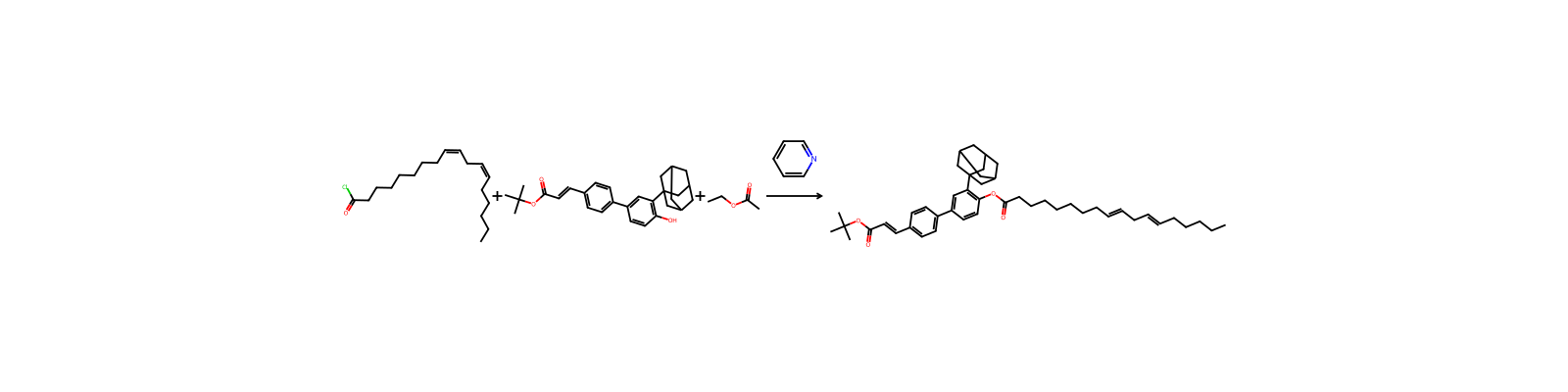
PreparationA solution of linoleoyl chloride prepared from linoleic acid (2 mmol) and oxalyl chloride (3 mmol) in dichloromethane (5 mL), as described above, was added dropwise to a stirred solution of 3 (1 mmol) in pyridine (5 mL) at room temperature. The reaction mixture was stirred for 1 h at room temperature and then processed as already described. The crude product was subjected to SiO₂ column chromatography by elution with n-hexane/ethyl acetate (20:1, vol/vol) to yield OLP (6) as a colorless oil (0.70 g, 82%). ¹H NMR (CDCl₃, δ): 0.86–0.90 (m by three overlapping triplets, 9H, –CH₃), 1.25–1.62 (m, 64H, –CH₂–), 2.01–2.07 (m, 8H, –C=C–CH₂–), 2.31 (t, J = 6.4 Hz, 6H, –OCO–CH₂–), 2.77 (t, J = 5.5 Hz, 2H, –C=C–CH₂–C=C–), 4.14 (dd, J = 12.2 and 6.3 Hz, 2H, 1- and 3-H), 4.28 (dd, J = 12.2 and 4.4 Hz, 2H, 1- and 3-H), 5.27 (m, 1H, 2-H), and 5.34 ppm (m, 6H, –CH=CH–). ¹³C NMR (CDCl₃, δ): 62.07 (glyceryl C1 and C3), 68.86 (glyceryl C2), 87.11 (–CH–OOH–), 127.86, 128.05, 129.69, 129.97, 129.99, 130.21 (–C=C–), 172.82, and 173.25 ppm (–COO–).

Upstream & downstream products

Upstream raw materials

Linoleic acidOxalyl chlorideDichloromethane

Downstream products

1,2-Dilinoleoyl-sn-glycero-3-phosphocholine

Related reactions

15 records
New reaction record
HRID 41724 reaction equation
HRID 41724As reactant
HRID 463751 reaction equation
HRID 463751As reactant
HRID 581627 reaction equation
HRID 581627As product
HRID 1005615 reaction equation
HRID 1005615As product
HRID 1599521 reaction equation
HRID 1599521As reactant
HRID 1788308 reaction equation
HRID 1788308As product
HRID 1788309 reaction equation
HRID 1788309As reactant
HRID 1788319 reaction equation
HRID 1788319As product
PreviousPage 1 of 2

Compound notes

On this pageBasic informationNames & identifiersPropertiesSafety & regulationChemistry & industryRelated reactionsCompound notes
Hazard Codes
C
Risk Statements
34 · 34
Safety Statements
28 A-26-45-36/37/39-27 · 28A-26-45-36/37/39-27
RIDADR
3265 · UN 3265 8/PG 2
TSCA
TSCA listed
HazardClass
8 · 8
PackingGroup
II
HS Code
29130000 · 29130000
Glycidyl Linoleate
3-Linoleoyl-2-oleoyl-sn-glycerol